


How to Accelerate Slow Technology Adoption in Innovation?
For over 15 years in the trenches of innovation management, I've witnessed a recurring, often frustrating scenario: brilliant new technologies, poised to revolutionize an industry, falter not due to their technical merit, but because they simply fail to gain traction within the very organizations meant to benefit from them. It's a silent killer of progress, leaving promising initiatives stranded and investments wasted.
This isn't just a minor hiccup; it's a systemic challenge that can cripple a company's competitive edge, stifling growth and leaving it vulnerable in a rapidly evolving market. The promise of digital transformation, AI, or advanced analytics remains just that—a promise—if your teams aren't embracing and effectively utilizing these tools. The friction of slow technology adoption in innovation is a tangible barrier to future success.
In this definitive guide, I'll draw upon decades of practical experience and cutting-edge research to provide you with a robust framework. We’ll delve into seven actionable strategies, complete with real-world insights, a mini case study, and expert advice, designed to help you not just understand, but truly accelerate slow technology adoption in innovation within your organization and unlock its full potential.
1. Diagnose the Root Causes of Resistance
The Illusion of "Just Build It"
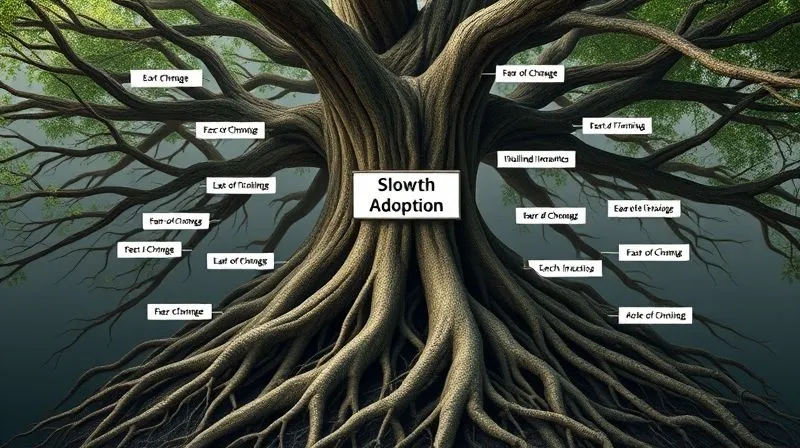
Many leaders fall into the trap of believing that if a technology is superior, adoption will be automatic. This couldn't be further from the truth. In my experience, resistance to new technology isn't arbitrary; it's often a symptom of deeper, unaddressed issues—fear, lack of understanding, or perceived threats to job security.
Understanding why people are hesitant is the crucial first step. Without this diagnosis, any intervention is merely a shot in the dark, and you'll continue to struggle to accelerate slow technology adoption in innovation.
"People don't resist change; they resist being changed." – Peter Senge, echoing a sentiment widely held in organizational psychology. This insight underscores the need for empathy in understanding adoption barriers.
- Conduct Anonymous Surveys & Interviews: Gather honest feedback from all levels. Ask about concerns, perceived benefits, training needs, and current workflow challenges.
- Map Current & Future Workflows: Visually compare how tasks are done now versus how they'll be done with the new tech. Identify friction points and areas requiring significant behavioral shifts.
- Identify Key Stakeholder Groups: Different groups (e.g., frontline staff, middle management, executives) will have unique concerns. Tailor your diagnostic approach to each.
- Analyze Past Adoption Failures: Look at previous attempts at technology integration. What went wrong? What lessons can be learned?
2. Champion a Clear Vision and Communicate Relentlessly
Beyond the 'What': Focusing on the 'Why' and 'How'
Once you understand the resistance, the next step is to articulate a compelling vision for the technology's role in the organization's future. This isn't just about showing off shiny new features; it's about connecting the technology to the company's strategic goals and, crucially, to the individual's daily work and future career path.
A vague vision breeds skepticism. A clear, inspiring vision, on the other hand, can transform skeptics into champions, significantly helping to accelerate slow technology adoption in innovation.
"The role of a leader is to define reality and give hope." – Napoleon Bonaparte. In the context of innovation, this means clearly articulating the current challenges and painting a hopeful, achievable future with the new technology.
- Define the Strategic 'Why': How does this technology align with the company's mission and long-term objectives? Is it about market leadership, efficiency, customer experience, or a new business model?
- Articulate Individual Benefits: How will this technology make employees' jobs easier, more efficient, more impactful, or more rewarding? Focus on problem-solving, not just feature lists.
- Create a Consistent Narrative: Ensure all communication—from executive memos to team meetings—tells the same story about the technology's purpose and benefits.
- Use Multiple Communication Channels: Don't rely on just email. Use town halls, internal social platforms, dedicated workshops, and one-on-one coaching to spread the message.
As Harvard Business Review often emphasizes, effective change management hinges on clear, consistent communication from the top down and bottom up.
3. Design for User-Centricity and Seamless Integration
The Power of Empathy in Technology Design
Even the most brilliant technology will fail if it's difficult or frustrating to use. User-centric design isn't a luxury; it's a necessity for successful technology adoption. This means involving end-users in the design and testing phases, soliciting their feedback, and iterating based on their real-world experiences.
The goal is to make the new technology feel like an extension of existing workflows, rather than a disruptive imposition. When technology is intuitive and fits naturally into daily tasks, you dramatically accelerate slow technology adoption in innovation.
"Good design is obvious. Great design is transparent." – Joe Sparano. The best technology integrates so seamlessly that users barely notice the learning curve; they just experience the benefit.
- Early User Involvement: Engage potential users through focus groups, beta testing, and co-creation workshops from the earliest stages of development.
- Intuitive User Interface (UI) & User Experience (UX): Prioritize simplicity, clarity, and consistency. Reduce cognitive load and minimize the number of steps required for common tasks.
- Integration with Existing Systems: Where possible, ensure the new technology integrates smoothly with tools and platforms already in use, minimizing data silos and duplicate efforts.
- Pilot Programs with Feedback Loops: Roll out the technology to a small, representative group first, gather intense feedback, and use it to refine the solution before a broader launch.
Case Study: InnovateCo's AI Deployment Success
InnovateCo, a mid-sized financial services firm, struggled with internal adoption of a new AI-powered client analytics platform. Their initial rollout was met with resistance, with sales teams finding it overly complex and disconnected from their CRM.
After diagnosing the issue, InnovateCo adopted a user-centric approach. They formed a 'User Council' comprising sales representatives, marketing specialists, and compliance officers. This council actively participated in redesigning the platform's interface, simplifying dashboards, and developing direct API integrations with their existing CRM and communication tools. They also introduced a 'shadowing' program where developers spent days observing sales reps' workflows.
This iterative, user-driven development significantly improved the platform's usability and relevance. The subsequent rollout saw an 85% adoption rate within six months, compared to an initial 20%. The sales team reported a 20% increase in lead conversion efficiency, directly attributable to the AI platform's tailored insights. This resulted in a tangible boost in revenue and a renewed trust in internal innovation initiatives.
| Phase | User Feedback | Adoption Rate | Key Obstacle |
|---|---|---|---|
| Initial Rollout | Complex, Disconnected | 20% | Poor UX, Integration Gaps |
| User-Centric Redesign | Intuitive, Integrated | 85% | Initial Resistance Overcome |
4. Build Internal Capabilities Through Targeted Training and Support
From Fear to Familiarity: The Learning Curve
Fear of the unknown, coupled with a lack of perceived competence, is a powerful inhibitor of technology adoption. Comprehensive, ongoing training and robust support systems are non-negotiable. It's not enough to provide a single training session; learning is a continuous process.
Investing in your people’s skills is investing in your technology’s success. When employees feel equipped and supported, they are far more likely to embrace change and help accelerate slow technology adoption in innovation.
"The only thing worse than training your employees and having them leave is not training them and having them stay." – Henry Ford. This timeless wisdom applies directly to technology adoption; upskilling is paramount.
- Multi-Modal Training: Offer a mix of in-person workshops, online modules, video tutorials, and self-help guides to cater to different learning styles.
- Role-Specific Training: Tailor training content to the specific needs and daily tasks of different user groups, highlighting how the technology directly impacts their work.
- "Train the Trainer" Programs: Empower internal champions to become experts and provide peer-to-peer support, fostering a sense of ownership and community.
- Accessible Support Channels: Establish clear, easily accessible support channels (e.g., dedicated helpdesk, internal forums, live chat) for ongoing questions and troubleshooting.
- Continuous Learning & Refresher Courses: Technology evolves, and so should training. Offer advanced courses and regular refreshers to keep skills sharp and explore new features.

5. Foster a Culture of Experimentation and Psychological Safety
Embracing Failure as a Stepping Stone to Success
Innovation thrives in environments where experimentation is encouraged, and failure is viewed as a learning opportunity, not a reason for punishment. When introducing new technologies, especially those that disrupt existing processes, there will inevitably be missteps and unforeseen challenges.
A culture of psychological safety allows employees to experiment with new tools without fear of reprisal, to ask "dumb questions," and to openly report bugs or difficulties. This openness is essential to truly accelerate slow technology adoption in innovation.
"If you're not prepared to be wrong, you'll never come up with anything original." – Sir Ken Robinson. This principle is vital when pushing the boundaries of technology adoption.
- Leadership by Example: Leaders must visibly embrace and experiment with the new technology themselves, sharing their own challenges and successes.
- "Innovation Sandboxes": Create safe environments or dedicated time slots where employees can explore the technology, test new ideas, and play without pressure.
- Celebrate Learning, Not Just Success: Acknowledge and reward efforts to learn and apply new technologies, even if the initial outcomes aren't perfect.
- Open Feedback Loops: Actively solicit feedback on the technology's performance and usability, and demonstrate that this feedback is being acted upon.
- De-risk Experimentation: Clearly communicate that trying new things, even if they don't immediately yield results, is valued and supported.
As Forbes regularly highlights, companies that foster cultures of psychological safety and continuous learning are far more resilient and innovative.
6. Leverage Pilot Programs and Early Adopter Networks
The Snowball Effect of Early Wins
A full-scale rollout of a new technology can be daunting and risky. Pilot programs offer a controlled environment to test, refine, and build internal credibility. They also create a core group of early adopters who can become powerful advocates for the technology.
These early successes, however small, generate momentum and provide tangible evidence of the technology's value, which is critical to accelerate slow technology adoption in innovation across the wider organization.
"Success breeds success." – A simple adage that holds profound truth in change management. Small, visible wins are far more persuasive than abstract promises.
- Identify Key Pilot Groups: Choose departments or teams that are enthusiastic, open to change, and representative of the broader user base.
- Define Clear Objectives & Metrics: Establish what success looks like for the pilot. How will you measure impact on efficiency, productivity, or user satisfaction?
- Provide Concentrated Support: During the pilot, offer intensive, hands-on support to ensure early adopters have a positive experience and overcome initial hurdles quickly.
- Showcase Early Wins: Publicize the successes and positive outcomes of the pilot program widely across the organization. Use testimonials, data, and compelling stories.
- Cultivate Internal Champions: Empower early adopters to become internal advocates, sharing their experiences and mentoring others during the broader rollout.

7. Measure, Iterate, and Celebrate Small Wins
The Continuous Improvement Loop
Technology adoption isn't a one-time event; it's an ongoing process. To truly accelerate slow technology adoption in innovation, you must establish mechanisms for continuous measurement, feedback, and iteration. What gets measured gets managed, and what gets celebrated gets repeated.
Regularly assess the technology's impact, gather user feedback, make necessary adjustments, and importantly, acknowledge and celebrate every milestone, no matter how small. This reinforces positive behavior and maintains momentum.
"Innovation is not about doing new things; it's about doing old things in new ways." – This perspective emphasizes that the real value comes from effective integration and continuous improvement, not just the initial deployment.
- Define Key Adoption Metrics: Track usage rates, feature engagement, time saved, error reduction, and user satisfaction scores.
- Establish Regular Feedback Channels: Implement surveys, suggestion boxes, and regular check-ins to continuously gather user input.
- Agile Iteration: Be prepared to make adjustments to the technology, its integration, or the support mechanisms based on feedback and performance data.
- Celebrate Milestones: Acknowledge and reward individuals and teams who successfully adopt and leverage the new technology. Public recognition goes a long way.
- Communicate Progress: Regularly share updates on adoption rates, success stories, and how feedback has led to improvements. Transparency builds trust.
For deeper insights into measuring innovation success, refer to leading academic research on technology diffusion models and organizational change, such as the work often cited in journals like MIS Quarterly.
| Metric | Baseline | Pilot Phase | Full Rollout (6 months) |
|---|---|---|---|
| Active Users (Monthly) | 15% | 40% | 75% |
| Feature Engagement Rate | 25% | 60% | 80% |
| Support Ticket Volume (per user) | High | Medium | Low |
| Productivity Gain (Estimated) | 0% | 5% | 15% |

Frequently Asked Questions (FAQ)
Q: What if our employees are resistant due to fear of job displacement? A: This is a very common and valid concern. Address it head-on with transparency. Clearly communicate the technology's purpose—is it to automate repetitive tasks, augmenting human capabilities, or creating new roles? If job roles will change, provide clear pathways for reskilling and upskilling. Frame the technology as an enabler for higher-value, more strategic work, rather than a replacement. Demonstrating a commitment to employee growth and security is paramount.
Q: How do we get executive buy-in for significant investment in technology adoption initiatives? A: Executive buy-in hinges on demonstrating clear ROI and strategic alignment. Frame your proposal in terms of competitive advantage, market share growth, cost savings, enhanced customer experience, or new revenue streams. Present a clear business case with projected benefits, risks, and a phased implementation plan. Highlight potential losses from *not* adopting the technology. Leverage industry benchmarks and case studies to support your arguments, showing how accelerating slow technology adoption in innovation translates directly to business value.
Q: Our company has a history of failed tech rollouts. How do we overcome this ingrained skepticism? A: Acknowledge the past failures openly and honestly. Don't sweep them under the rug. Explain what lessons have been learned and how the current approach differs, emphasizing the user-centric design, robust training, and continuous feedback loops you're now implementing. Start with a smaller, highly visible pilot project that has a high chance of success, and build trust incrementally. Transparency, consistent communication, and delivering on promises are key to rebuilding confidence and showing how to accelerate slow technology adoption in innovation.
Q: How can we measure the ROI of technology adoption, especially for 'soft' benefits like collaboration or innovation? A: Measuring ROI for technology adoption requires a blend of quantitative and qualitative metrics. Quantitatively, track direct cost savings (e.g., reduced manual effort, faster processing), revenue generation from new capabilities, and efficiency gains (e.g., time saved per task, project completion rates). For 'soft' benefits, use proxy metrics: measure employee engagement scores, survey sentiment on collaboration, track the number of new ideas generated, or monitor participation in innovation challenges. Correlate these with adoption rates and demonstrate how improved collaboration, for instance, leads to faster problem-solving and market responsiveness.
Q: What role do middle managers play in accelerating technology adoption, and how can we empower them? A: Middle managers are absolutely critical—they are the bridge between executive vision and frontline execution. Empower them by involving them early in the planning process, providing them with enhanced training and resources, and clearly communicating their role as champions and facilitators. Equip them with the tools and data to articulate the 'why' to their teams and to address specific concerns. Recognize and reward their efforts in driving adoption within their departments. Their leadership and advocacy are indispensable to accelerate slow technology adoption in innovation.
Key Takeaways and Final Thoughts
Accelerating slow technology adoption in innovation is not merely a technical challenge; it's a deeply human one. It requires a holistic approach that prioritizes understanding user needs, clear communication, robust support, and a culture that embraces change and learning. By systematically implementing the seven strategies we've discussed, you can transform resistance into enthusiasm and unlock the true potential of your innovative investments.
- Diagnose Deeply: Understand the true reasons behind resistance.
- Communicate Clearly: Articulate a compelling vision and individual benefits.
- Design with Empathy: Prioritize user-centricity and seamless integration.
- Empower Through Training: Build capabilities with continuous, targeted support.
- Foster Psychological Safety: Encourage experimentation and learning from failures.
- Leverage Pilots: Build momentum with early wins and internal champions.
- Measure & Iterate: Continuously refine your approach based on data and feedback.
Remember, innovation isn't just about creating something new; it's about successfully integrating that newness into the fabric of your organization. As an industry specialist, I've seen firsthand that the companies that master technology adoption are the ones that don't just survive but thrive, leading their sectors into the future. Embrace these principles, and you won't just accelerate slow technology adoption in innovation; you'll cultivate a perpetually innovative and adaptive enterprise.
Recommended Reading
- How to Evaluate FDD for Red Flags: Your 8-Point Checklist
- 7 Reasons Your Mobile Marketing ROI is Zero & How to Fix It
- Unlock Your Genius: How to Overcome Creative Blocks as an Entrepreneur
- Unlock the Truth: Are Startup Accelerators Worth It for Your Founding Journey?
- Franchise Royalty Fees: Are They Negotiable? The Surprising Truth!





Comments
Leave a comment below. Your email will not be published. Required fields marked with *