


How to Choose the Optimal Legal Structure for a New Small Business?
For over 20 years in the small business consulting world, I've seen countless entrepreneurs launch with incredible passion, only to stumble early on due to a fundamental, yet often overlooked, decision: their legal business structure. It’s not the flashy part of starting up, but it’s the bedrock upon which everything else is built.
Many new business owners, understandably focused on their product or service, treat legal structure as a mere formality. They pick the cheapest, easiest option without fully grasping the long-term implications for liability, taxation, administrative burden, and even their ability to attract investment. This oversight can lead to unnecessary personal financial risk, higher tax bills, or complex restructuring headaches down the line.
This article isn't just about listing options; it's about equipping you with a robust decision-making framework. I'll guide you through the critical factors, share real-world insights, and provide actionable steps to help you confidently choose the optimal legal structure for your new small business, setting you up for sustainable success from day one.
The Foundation: Why Legal Structure Matters More Than You Think
Your business's legal structure isn't just a name on a piece of paper; it's a fundamental decision that profoundly impacts nearly every aspect of your operation. From how much personal risk you shoulder to the taxes you pay and even your ability to raise capital, this choice dictates much of your entrepreneurial journey.
I often tell my clients that picking the right structure is like choosing the right foundation for a house. A weak foundation might hold up for a while, but it will inevitably crack under pressure, leading to costly repairs or even collapse. Similarly, an ill-suited business structure can expose your personal assets, complicate tax filings, and stifle growth.
Liability protection is paramount. Will your personal savings, home, and other assets be at risk if your business faces a lawsuit or debt? Your legal structure directly answers this. Then there's taxation. Different structures are taxed in vastly different ways, impacting your take-home pay and the complexity of your annual filings. Lastly, consider your future. Do you plan to seek investors? Do you foresee bringing on partners? These aspirations are significantly influenced by your initial structural choice.
Understanding the Core Options: A Quick Overview
Before diving into the decision-making framework, let's briefly define the main legal structures available to small businesses. While state laws can introduce nuances, the core categories remain consistent across the U.S.
The primary structures include:
- Sole Proprietorship: The simplest and most common for single-owner businesses.
- General Partnership: Similar to a sole proprietorship but for two or more owners.
- Limited Liability Company (LLC): A popular hybrid offering personal liability protection.
- S-Corporation (S-Corp): A tax election for certain corporations and LLCs, avoiding double taxation.
- C-Corporation (C-Corp): The traditional corporate structure, often preferred for large-scale investment.
Each of these comes with its own set of advantages and disadvantages, tailored to different business needs, risk tolerances, and growth projections. My goal is to help you navigate these options with clarity and confidence, ensuring you choose the optimal legal structure for a new small business, not just the easiest.
Sole Proprietorship & General Partnership: Simplicity vs. Risk
These two structures represent the simplest forms of business organization, often chosen for their ease of setup and minimal administrative burden. However, their simplicity comes with a significant trade-off: unlimited personal liability.
Sole Proprietorship: The Default for Solo Entrepreneurs
If you start a business on your own and don't formally register it as another entity, you're automatically operating as a sole proprietorship. This is incredibly straightforward to set up, often requiring just a business license or permit. Taxes are also simple; business income and expenses are reported on your personal tax return (Schedule C, Form 1040).
- Pros: Easy and inexpensive to form, minimal paperwork, direct control, pass-through taxation.
- Cons: No legal distinction between you and your business, unlimited personal liability, harder to raise capital, business dissolves if owner retires/dies.
General Partnership: Two or More, Same Liabilities
A General Partnership (GP) is essentially a sole proprietorship with two or more owners. It's also easy to form, often just requiring a handshake, though a formal partnership agreement is highly recommended to prevent future disputes. Like sole proprietorships, GPs offer pass-through taxation, meaning profits and losses are reported on the partners' personal tax returns.
- Pros: Easy to form, shared workload, pass-through taxation.
- Cons: Unlimited personal liability for all partners (including debts incurred by other partners), potential for partner disputes, dissolves if a partner leaves.
"The allure of simplicity with sole proprietorships and general partnerships is strong, but I've witnessed firsthand the devastating impact of unlimited personal liability. A single lawsuit or significant business debt can wipe out an entrepreneur's life savings. Always weigh this risk carefully against the administrative ease."
These structures are best suited for businesses with very low risk of liability, minimal capital needs, and owners comfortable with personal exposure. Think independent consultants, freelancers, or small craft businesses operating from home. For anything with employees, significant assets, or potential for customer claims, I strongly advise exploring options that offer personal asset protection.
The Limited Liability Company (LLC): The Hybrid Sweet Spot
For many small business owners, the Limited Liability Company (LLC) strikes an ideal balance, offering the personal liability protection of a corporation with the simplified tax advantages of a sole proprietorship or partnership. It's often the optimal legal structure for a new small business seeking growth without excessive administrative burden.
The core benefit of an LLC is limited personal liability. This means that, generally, your personal assets (your home, car, personal bank accounts) are shielded from business debts and lawsuits. If your business goes bankrupt or is sued, creditors can only go after the assets of the LLC, not your personal property. This separation provides immense peace of mind.
Key Considerations for LLC Formation
Forming an LLC involves registering with your state's Secretary of State office. While relatively straightforward, it does require more paperwork than a sole proprietorship. An essential document for multi-member LLCs is the Operating Agreement, which outlines ownership percentages, member responsibilities, profit/loss distribution, and procedures for selling ownership or dissolving the business. Even for a single-member LLC, an operating agreement is good practice to formalize your business structure.
One of the most appealing aspects of an LLC is its flexibility in taxation. By default, a single-member LLC is taxed as a sole proprietorship (a 'disregarded entity'), and a multi-member LLC is taxed as a partnership. However, an LLC can also elect to be taxed as an S-Corporation or even a C-Corporation, which can offer significant tax savings as your business grows. This adaptability makes the LLC a truly versatile choice.
- Pros: Personal liability protection, flexible taxation options, fewer compliance requirements than corporations, enhanced credibility.
- Cons: More complex and costly to form than sole proprietorships/partnerships, some states impose annual fees, can be less attractive to venture capital investors than C-Corps.
When considering an LLC, it's crucial to understand your state's specific requirements, as filing fees and annual obligations can vary. For instance, California has an annual franchise tax, regardless of income, which can be a factor for very small businesses. According to the U.S. Small Business Administration, LLCs are now the most popular choice for new businesses seeking a balance of protection and flexibility. Learn more about business structures on SBA.gov.
| Structure | Personal Liability | Taxation | Formation Cost | Complexity |
|---|---|---|---|---|
| Sole Proprietorship | Unlimited | Pass-through (Schedule C) | Low | Low |
| General Partnership | Unlimited | Pass-through (Form 1065) | Low | Low |
| LLC (Default) | Limited | Pass-through (Schedule C or Form 1065) | Medium | Medium |
S-Corporation & C-Corporation: Scaling for Growth and Investment
When your business aspirations extend to significant growth, external investment, or a larger, more formal operational structure, corporations become highly relevant. These structures offer the strongest liability protection but come with increased administrative complexity and different tax implications. They represent the optimal legal structure for a new small business with specific growth trajectories.
S-Corp: Pass-Through with Corporate Protection
An S-Corporation isn't a separate legal entity like an LLC; it's a tax designation that an LLC or a traditional C-Corporation can elect with the IRS. The primary benefit of an S-Corp election is avoiding the 'double taxation' inherent in C-Corps. Profits and losses are passed through directly to the owners' personal income, similar to an LLC or partnership, but owners can pay themselves a 'reasonable salary' and then take remaining profits as distributions, which are not subject to self-employment taxes (Social Security and Medicare).
- Eligibility: Must be a domestic corporation, have only one class of stock, and generally have no more than 100 shareholders (who must be U.S. citizens or residents).
- Tax Benefits: Potential for significant self-employment tax savings on distributions.
- Operational Requirements: Requires more formal compliance than an LLC, including maintaining corporate minutes, holding regular meetings, and careful payroll management.
C-Corp: The Investor's Choice
The C-Corporation is the most formal business structure and is often the preferred choice for businesses planning to seek significant venture capital investment or go public. It offers the strongest liability protection for owners and allows for an unlimited number of shareholders, different classes of stock, and complex ownership structures.
- Double Taxation: The main drawback is that C-Corps are subject to 'double taxation.' The corporation pays taxes on its profits, and then shareholders pay taxes again on dividends they receive.
- Fundraising Appeal: Its structure is highly attractive to investors, as it's straightforward to transfer ownership shares, offer various equity types, and manage complex cap tables.
- Formal Structure: Demands the highest level of compliance, including a board of directors, annual meetings, bylaws, and strict record-keeping.
Case Study: TechStart's C-Corp Journey
TechStart, a fictional software startup, developed a revolutionary AI platform. Recognizing their need for substantial seed funding and eventual Series A investment, their founders chose a C-Corporation from the outset. While the initial administrative burden was higher, and they understood the double taxation implications, this structure made them highly attractive to venture capitalists. The ability to issue preferred stock, offer employee stock options, and clearly define investor rights within a familiar corporate framework streamlined their fundraising efforts. Within two years, they successfully secured $5 million in funding, a feat that would have been significantly more complex with an LLC or S-Corp structure due to investor preferences and regulatory hurdles.
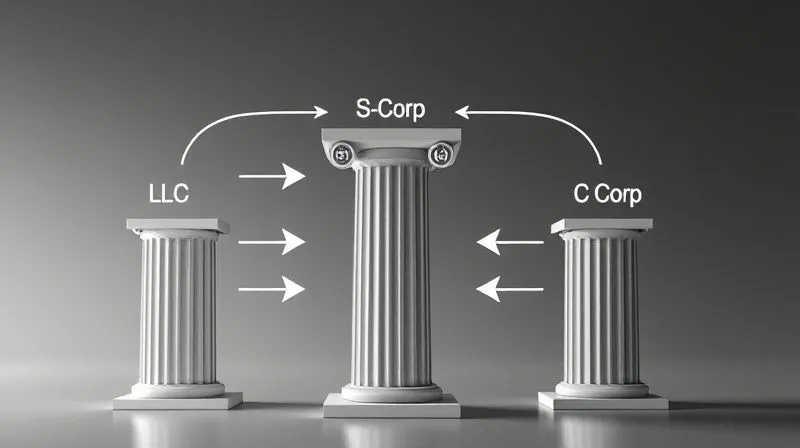
Choosing between an S-Corp and C-Corp, or electing S-Corp status for an LLC, is a nuanced decision that often requires careful financial modeling and consultation with a tax professional. The IRS provides detailed guidance on S-Corp elections, which is essential to review. Consult IRS resources for S-Corporation specifics.
Your Decision Framework: 5 Critical Questions to Ask
Now that we've covered the main structures, let's put it all together. To choose the optimal legal structure for a new small business, you need a systematic approach. Here are the five critical questions I guide my clients through:
Question 1: What's Your Personal Liability Tolerance?
This is arguably the most important question. Are you comfortable with your personal assets being at risk for business debts or lawsuits? If not, a structure that provides limited liability (LLC, S-Corp, C-Corp) is non-negotiable.
- Assess your industry's risk: Does your business involve physical products, direct client interaction, or high-stakes services that could lead to injury or significant financial loss for others?
- Evaluate your personal assets: Do you have significant savings, a home, or other valuable assets you need to protect?
- Consider insurance: While business insurance is vital, it's a secondary layer of protection; legal structure is your primary shield.
Question 2: How Do You Plan to Be Taxed?
Tax implications can significantly impact your net income. Understanding how each structure is taxed is crucial for financial planning.
- Pass-through vs. Corporate Tax: Do you prefer profits to be taxed only once at the individual level (Sole Prop, Partnership, LLC, S-Corp) or are you prepared for potential double taxation for the sake of other benefits (C-Corp)?
- Self-employment taxes: Are you aware of the self-employment tax burden for pass-through entities and how an S-Corp election might mitigate it?
- Future tax planning: As your business grows, will your chosen structure remain tax-efficient, or will you need to consider a change?
Question 3: What Are Your Fundraising Goals?
Your plans for growth and investment significantly influence the best structure. If you envision seeking outside capital, particularly from venture capitalists or angel investors, certain structures are more appealing.
- Bootstrapping vs. External Funding: Are you self-funding, or do you anticipate needing significant capital from investors?
- Investor preferences: Most sophisticated investors prefer C-Corporations due to their established legal framework for equity, stock options, and investor rights.
- Complexity of ownership: C-Corps handle complex shareholder agreements and different classes of stock more readily than LLCs.
Question 4: How Many Owners Will There Be?
The number of owners and their roles dictates partnership agreements and management structures.
- Solo venture: Sole proprietorship or single-member LLC are common.
- Multiple partners: A partnership or multi-member LLC are typical. Consider a comprehensive partnership or operating agreement.
- Future partners/employees: How easily can you bring on new owners or offer equity to key employees? Corporations generally offer more flexibility here.
Question 5: What's Your Administrative Capacity?
The level of ongoing paperwork, compliance, and legal formalities varies greatly between structures.
- Simplicity preference: Do you want minimal administrative burden (Sole Prop, GP, LLC) or are you prepared for more rigorous corporate governance (S-Corp, C-Corp)?
- Cost of compliance: Factor in not just initial filing fees, but also annual report fees, registered agent services, and potential legal/accounting costs for ongoing compliance.
- Time commitment: More complex structures demand more time from you or your team for record-keeping and regulatory adherence.
Beyond the Basics: State Laws, Professional Advice, and Future Flexibility
While the five critical questions provide an excellent framework, there are always additional layers to consider when choosing the optimal legal structure for a new small business. Neglecting these can lead to unforeseen complications.
State-Specific Regulations and Requirements
It's vital to remember that business formation is primarily governed by state law. While the federal tax treatment (like S-Corp election) is universal, the process of registering your entity, the associated fees, and ongoing compliance requirements can vary significantly from state to state. For example, some states require specific publications for LLC formation, while others may have higher annual fees. Always check with your specific state's Secretary of State or equivalent business registration agency.
The Indispensable Value of Professional Advice
I cannot stress this enough: consult with both a business attorney and a tax professional (CPA) before making your final decision. While this guide provides a solid foundation, your specific business model, personal financial situation, and long-term goals are unique. An attorney can advise on liability, contracts, and state-specific legal nuances, while a CPA can help you project tax liabilities and optimize your structure for tax efficiency. This upfront investment in expert advice can save you tens of thousands of dollars and countless headaches down the road. It's a cornerstone of establishing trust and authority for your new venture.
The Ability to Change Structures (But Plan Ahead)
Many entrepreneurs worry about making the 'wrong' choice. The good news is that legal structures are not set in stone. You can typically change your business structure as your company evolves. For instance, a sole proprietorship can incorporate into an LLC, or an LLC can elect S-Corp status. However, changing structures can involve legal fees, filing costs, and potential tax implications. While flexibility exists, it's far more efficient and cost-effective to choose wisely from the beginning. Think of it like building a house: you can remodel, but it's always better to pour the right foundation initially.
Common Pitfalls and How to Avoid Them
Even with good intentions, new business owners often fall into common traps when selecting their legal structure. Recognizing these pitfalls is the first step to avoiding them and ensuring you choose the optimal legal structure for a new small business.
Pitfall 1: Choosing Solely Based on Lowest Cost or Easiest Setup
It's tempting to opt for the cheapest or simplest option, like a sole proprietorship, to save a few hundred dollars initially. However, this short-term saving can lead to significant long-term costs in the form of unlimited personal liability, higher taxes, or complex restructuring later. Prioritize protection and long-term strategy over minimal upfront expense.
Pitfall 2: Ignoring Future Growth and Investment Potential
Many entrepreneurs start small but have big dreams. If you envision seeking venture capital, bringing on multiple partners, or going public, starting as a C-Corporation or an LLC with a clear path to corporate conversion can save immense effort and cost. Choosing an LLC and then trying to convert it to a C-Corp for Series A funding can be a complex and expensive process, potentially deterring investors.
Pitfall 3: Not Consulting Legal and Tax Experts
As mentioned, this is a critical mistake. Relying solely on online articles (even this one!) or advice from well-meaning friends can lead to an ill-suited structure. A qualified attorney and CPA can provide tailored advice specific to your unique business, industry, and financial situation. Their fees are an investment, not an expense.
Pitfall 4: Neglecting State-Specific Requirements and Ongoing Compliance
Each state has its own rules for formation and ongoing compliance. Failing to maintain your entity's good standing (e.g., forgetting annual reports, not paying franchise taxes) can lead to penalties, loss of liability protection, or even administrative dissolution. Staying compliant is non-negotiable once your business is registered.
Pitfall 5: Failing to Create Foundational Agreements (Operating Agreements, Partnership Agreements)
For multi-owner entities like LLCs and partnerships, a well-drafted operating agreement or partnership agreement is crucial. It defines roles, responsibilities, profit distribution, decision-making processes, and dispute resolution. Without one, disagreements can easily escalate, potentially dissolving the business. Even for single-member LLCs, an operating agreement adds credibility and clarity.

By being aware of these common missteps, you can navigate the complex waters of business formation with greater confidence and make a truly informed decision about the optimal legal structure for a new small business.
Frequently Asked Questions (FAQ)
Q: Can I change my legal structure later if my business grows or my needs change? Yes, it is generally possible to change your business's legal structure. For example, a sole proprietorship can convert to an LLC, or an LLC can elect S-Corp or C-Corp status. However, this process involves legal filings, potential fees, and can have tax implications, so it's always best to try and choose the most appropriate structure from the outset. Consulting with a legal and tax professional before making such a change is highly recommended.
Q: What's the main difference between an LLC and an S-Corporation? An LLC is a legal entity that provides limited liability protection. An S-Corporation is a tax designation that an LLC or C-Corp can elect. The key distinction lies in taxation: an LLC by default is a pass-through entity (taxed like a sole proprietorship or partnership), while an S-Corp election allows owners to pay themselves a reasonable salary and take remaining profits as distributions, potentially reducing self-employment taxes. Both offer personal liability protection, but the S-Corp primarily optimizes for specific tax scenarios.
Q: When should a C-Corporation be considered for a small business? A C-Corporation is typically the best choice if you plan to seek significant venture capital funding, issue various classes of stock, or eventually go public. While it involves double taxation (corporate profits are taxed, and then dividends to shareholders are taxed again), its established structure is highly appealing to sophisticated investors and facilitates complex equity arrangements. It's often not the initial choice for very small, self-funded businesses due to its administrative complexity and tax structure.
Q: Do I need a lawyer to register my business? While you can often file the necessary paperwork to register an LLC or corporation yourself (or use online services), I strongly advise consulting with a business attorney. An attorney can help you understand the nuances of state law, draft or review critical documents like operating agreements or bylaws, and ensure your business is set up correctly to protect your assets and align with your long-term goals. This legal foundation is crucial for avoiding costly mistakes.
Q: What are the ongoing compliance requirements for an LLC versus a Corporation? LLCs generally have fewer formal ongoing compliance requirements than corporations. LLCs typically need to file annual reports with the state and maintain an operating agreement. Corporations (S-Corp or C-Corp) have more stringent requirements, including maintaining corporate bylaws, holding annual shareholder and board meetings, keeping detailed meeting minutes, and more extensive record-keeping. Failure to adhere to these can lead to 'piercing the corporate veil,' where owners lose their personal liability protection.
Key Takeaways and Final Thoughts
Choosing the optimal legal structure for a new small business is a foundational decision that impacts everything from your personal liability to your tax burden and future growth potential. It's a choice that demands careful consideration, not just a quick guess.
- Prioritize Liability Protection: Shielding your personal assets should be a top concern for most businesses.
- Understand Tax Implications: Different structures have vastly different tax treatments that can significantly affect your bottom line.
- Consider Your Growth Trajectory: Your plans for fundraising and expansion should heavily influence your choice.
- Don't Skimp on Professional Advice: An attorney and a CPA are invaluable partners in this process.
- Plan for the Future, But Don't Fear Change: While it's best to choose wisely from the start, structures can evolve with your business.
As an experienced industry specialist, I've witnessed the profound impact of this decision. Take the time to evaluate these factors, ask the critical questions, and seek expert guidance. Your business deserves a strong foundation, and choosing the right legal structure is the first, most crucial step toward building a resilient, prosperous future. Go forth, build wisely, and thrive!
Recommended Reading
- 5 Steps to Bridge the Gap: Explaining Complex Models to Executives
- Failed? 7 Steps to Rebuild Founder Resilience & Rise Stronger After Business Failure
- 7 Proven Strategies: How to Counter Competitors Copying Your New Product Launch?
- Liability for Foreign Subsidiaries: Navigating International Law Risks
- Unmasking Fraud: Your 7-Step Guide to Detecting Balance Sheet Manipulation





Comments
Leave a comment below. Your email will not be published. Required fields marked with *