


How to convert business data into actionable growth plans?
For over 18 years in the trenches of business analytics, I've seen countless companies invest heavily in data infrastructure, only to watch their valuable insights gather digital dust. The ambition is always there – to be 'data-driven' – but the execution often stumbles, leaving executives scratching their heads, wondering why their expensive dashboards aren't translating into tangible growth.
The problem isn't usually a lack of data; it's an inability to bridge the chasm between raw numbers and strategic action. Organizations often face 'analysis paralysis,' overwhelmed by dashboards, or they generate reports that lack context and clear next steps. This disconnect means missed opportunities, wasted resources, and a stagnant growth trajectory, despite having a treasure trove of information.
In this definitive guide, I'll walk you through a proven 7-step framework, honed over nearly two decades, designed to demystify the process of how to convert business data into actionable growth plans. We'll move beyond mere reporting, delving into practical strategies, real-world analogies, and expert insights to transform your data into your most powerful growth engine. You'll learn not just what to do, but precisely how to do it, turning every data point into a catalyst for strategic decision-making.
Step 1: Define Your North Star – Clarity Before Clicks
Before you even think about opening a spreadsheet, the most critical step is to clearly define your business objectives. As I often tell my clients, 'Garbage in, garbage out' applies not just to data, but to the questions you ask of it. Without a clear 'North Star' – a specific, measurable, achievable, relevant, and time-bound (SMART) goal – your data analysis will be a rudderless ship, drifting without purpose.
Why Vision Matters More Than Volume
Many organizations leap into data collection and analysis without first articulating what they actually want to achieve. Are you aiming to reduce customer churn, increase market share, optimize operational efficiency, or launch a new product? Each objective demands a different set of data, different analytical approaches, and ultimately, different actionable plans.
- Clarity of Purpose: What specific business problem are you trying to solve, or what opportunity are you trying to seize?
- Measurable Outcomes: How will you know if you've succeeded? Define clear KPIs (Key Performance Indicators) upfront.
- Strategic Alignment: Ensure your data initiatives align with the broader company strategy.
“The goal is not to sail the boat, but rather to have the boat sail itself.” – Seth Godin. In our context, the goal isn't just to collect data, but to create a system where data naturally guides your strategic direction.
I've seen companies spend months analyzing sales data, only to realize their real problem was customer retention. Had they defined 'reducing churn by 15% within 12 months' as their North Star, their entire data journey would have been far more focused and fruitful.

Step 2: The Art of Data Collection – Beyond the Obvious
Once your objectives are crystal clear, the next step is to identify and gather the right data. This isn't just about pulling numbers from your CRM or ERP system; it's about understanding the full spectrum of data available and ensuring its quality and relevance. In my experience, the most impactful insights often come from connecting seemingly disparate data sources.
What Data Truly Matters?
Think broadly about your data ecosystem. This includes:
- Quantitative Data: Sales figures, website traffic, customer demographics, operational costs, marketing campaign performance, inventory levels.
- Qualitative Data: Customer feedback (surveys, interviews, social media sentiment), employee feedback, competitor analysis, market research reports.
- External Data: Economic indicators, industry benchmarks, government statistics, social trends.
The synergy between quantitative and qualitative data is particularly powerful. Numbers tell you 'what' is happening, while qualitative insights explain 'why' it's happening. For instance, low sales numbers (quantitative) combined with customer feedback citing poor customer service (qualitative) paint a much clearer picture.
Ensuring Data Quality and Integrity
Bad data leads to bad decisions. Period. Data quality isn't a technical chore; it's a strategic imperative. I've often seen organizations base multi-million dollar decisions on flawed data, leading to costly mistakes. According to a Harvard Business Review article, poor data quality costs the U.S. economy billions of dollars annually.
- Identify Data Sources: Map out all potential internal and external data sources.
- Establish Data Governance: Define who owns the data, how it's collected, stored, and maintained.
- Clean and Validate: Implement processes to identify and correct errors, remove duplicates, and standardize formats.
- Regular Audits: Schedule periodic checks to ensure ongoing data accuracy and completeness.
- Integrate Systems: Break down data silos by integrating disparate systems where feasible, creating a unified view.
Step 3: Transform Raw Data into Meaningful Metrics
Collecting mountains of data is only the first step. The real magic happens when you transform that raw data into meaningful, understandable metrics and Key Performance Indicators (KPIs) that directly relate to your North Star objectives. This is where the signal emerges from the noise, allowing you to see patterns and trends that inform your growth plans.
From Data Points to KPIs
KPIs are the vital signs of your business. They are specific, measurable values that demonstrate how effectively a company is achieving key business objectives. The trick is to choose the *right* KPIs – those that are truly indicative of performance and actionable.
- Sales & Marketing: Customer Acquisition Cost (CAC), Customer Lifetime Value (CLTV), Conversion Rate, Return on Ad Spend (ROAS).
- Operations: Order Fulfillment Time, Inventory Turnover, Production Efficiency, Employee Productivity.
- Customer Service: Customer Satisfaction (CSAT), Net Promoter Score (NPS), First Contact Resolution Rate.
- Financial: Profit Margins, Revenue Growth Rate, Return on Investment (ROI).
“What gets measured gets managed.” This old adage holds profound truth. If you're not measuring the right things, you can't effectively manage – or grow – your business.
Avoid 'vanity metrics' – numbers that look good but don't translate into real business value. A high number of website visitors might seem impressive, but if your conversion rate is abysmal, those visitors aren't contributing to your growth.
| KPI Category | Example KPI | Actionable Insight |
|---|---|---|
| Sales & Marketing | Customer Lifetime Value (CLTV) | Identifies high-value customer segments for targeted retention efforts. |
| Operations | Order Fulfillment Time | Highlights bottlenecks in the supply chain or delivery process. |
| Customer Service | Net Promoter Score (NPS) | Gauges customer loyalty and identifies areas for service improvement. |
| Financial | Profit Margin | Reveals pricing strategy effectiveness and cost control. |
| Website Performance | Conversion Rate | Measures the effectiveness of website design and calls-to-action. |

Step 4: Unearthing Insights – The Analyst's Detective Work
With clean, meaningful metrics in hand, the real detective work begins: analysis. This is where you move beyond simply reporting numbers to understanding the 'why' and 'what if.' It's about finding patterns, correlations, anomalies, and underlying drivers that explain current performance and predict future trends. This step is crucial for how to convert business data into actionable growth plans.
Pattern Recognition and Trend Spotting
Effective analysis involves several techniques:
- Segmentation: Breaking down your data into smaller, more manageable groups (e.g., by customer segment, product category, geographic region) to identify unique behaviors or performance issues.
- Correlation vs. Causation: Understanding that two things happening together (correlation) doesn't necessarily mean one caused the other (causation). This is a common pitfall.
- Trend Analysis: Looking at data over time to identify upward, downward, or cyclical trends. Are sales consistently dipping in Q3? Is customer churn increasing year-over-year?
- Comparative Analysis: Benchmarking your performance against industry averages, competitors, or your own historical data.
- Root Cause Analysis: When a KPI deviates, digging deep to understand the fundamental reason behind it.
Case Study: How Stellar Solutions Boosted Customer Lifetime Value
Stellar Solutions, a B2B SaaS company, noticed a plateau in their revenue growth despite steady customer acquisition. Their North Star was to increase Customer Lifetime Value (CLTV) by 20% in 18 months. Through deep data analysis, they segmented their customer base and discovered that customers who engaged with their online knowledge base within the first 30 days had a 40% higher CLTV. Further analysis revealed these customers were more likely to adopt advanced features and refer new clients. This insight, previously hidden in their support data, became the cornerstone of a new onboarding strategy. They implemented proactive email campaigns guiding new users to the knowledge base, leading to a significant increase in early engagement and, ultimately, exceeding their CLTV growth target.
As a McKinsey report highlighted, the ability to derive deep, actionable insights from data is becoming a key differentiator for leading businesses.
Step 5: Crafting the Narrative – Storytelling with Data
An insight, no matter how profound, is useless if it can't be effectively communicated to decision-makers. This is where data storytelling comes in – transforming complex analyses into clear, compelling narratives that inspire action. As an expert, I've found that the best analysts aren't just good with numbers; they're exceptional storytellers.
Beyond Charts: Communicating Impact
Data storytelling isn't just about presenting pretty charts; it's about:
- Context: Explaining *why* this data matters in relation to the business objective.
- Clarity: Simplifying complex information into easily digestible insights.
- Call to Action: Clearly articulating what needs to be done based on the data.
- Credibility: Presenting your findings with confidence, backed by robust analysis.
I often use the analogy of a doctor explaining a diagnosis. They don't just hand you raw lab results; they explain what the numbers mean for *your* health and what steps you need to take. Your data insights should be presented with the same care and clarity.
- Know Your Audience: Tailor your message to their level of technical understanding and their specific concerns.
- Start with the Conclusion: Lead with the most important insight and its implication for the business.
- Provide Supporting Evidence: Use visualizations (charts, graphs) to illustrate your points, but don't let them overshadow the narrative.
- Explain the 'So What?': Clearly connect the data insight to its business impact and the proposed solution.
- Anticipate Questions: Be prepared to defend your analysis and offer deeper dives if required.

Step 6: From Insight to Action – The Growth Plan Blueprint
This is the pivotal step where you translate insights into concrete, actionable growth plans. It's not enough to know *what* the data suggests; you must define *how* you will leverage that knowledge to drive measurable improvements. This requires strategic thinking, resource allocation, and a clear roadmap for execution.
Developing Hypotheses and Experiments
Based on your insights, formulate specific hypotheses about how certain changes will lead to desired outcomes. For example, 'If we personalize product recommendations for returning customers, we will see a 10% increase in average order value.' Then, design experiments to test these hypotheses:
- A/B Testing: Comparing two versions of a webpage, email, or product feature to see which performs better.
- Pilot Programs: Rolling out a new strategy or feature to a small segment of your audience before a full launch.
- Controlled Experiments: Isolating variables to understand their individual impact.
Building Actionable Roadmaps
A growth plan needs to be a detailed blueprint, not just a vague idea. It should clearly outline who does what, by when, and with what resources. As Forbes often emphasizes, strategic planning is about turning goals into action.
- Define Specific Actions: Break down the overall plan into granular, manageable tasks.
- Assign Ownership: Clearly designate who is responsible for each task.
- Set Timelines: Establish realistic deadlines for completion.
- Allocate Resources: Ensure that the necessary budget, personnel, and tools are available.
- Establish Metrics for Success: Reiterate the KPIs that will be used to measure the plan's effectiveness.
- Risk Assessment: Identify potential challenges and develop contingency plans.
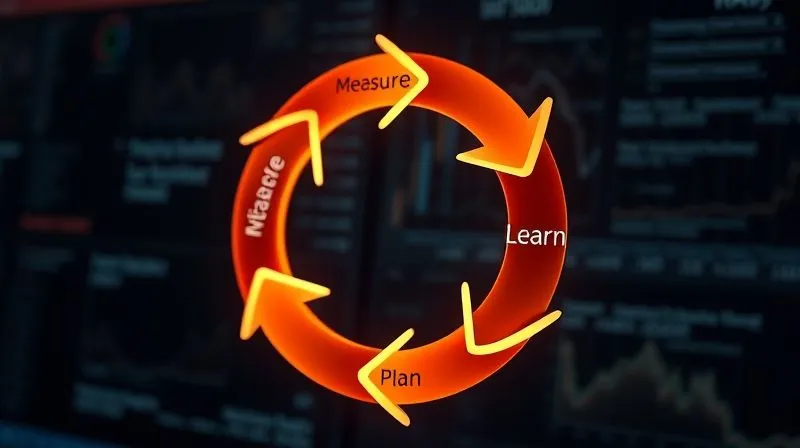
Step 7: Measure, Learn, and Iterate – The Continuous Growth Loop
The journey of data-driven growth is not linear; it's a continuous loop of measurement, learning, and iteration. Launching a growth plan is not the end; it's the beginning of a new cycle of data collection and analysis. This agile approach ensures that your strategies remain relevant and effective in a dynamic business environment.
Establishing Feedback Loops and Performance Tracking
Once your actionable growth plans are in motion, it's crucial to continuously monitor their performance against your defined KPIs. Implement dashboards and reporting systems that provide real-time visibility into your progress. This isn't just about celebrating successes; it's about quickly identifying what isn't working and why.
- Automated Dashboards: Utilize tools like Tableau, Power BI, or Google Data Studio to visualize KPIs automatically.
- Regular Review Meetings: Schedule consistent check-ins to discuss progress, challenges, and new insights.
- A/B Test Monitoring: Continuously track the performance of your experiments.
- Qualitative Feedback: Supplement quantitative metrics with ongoing feedback from customers and employees.
“The only way to win is to learn faster than anyone else.” This encapsulates the essence of continuous iteration. Businesses that embrace this mindset are the ones that consistently outperform.
This continuous feedback loop allows you to make data-informed adjustments, pivot strategies when necessary, and optimize for maximum impact. It's the engine that keeps your growth plans dynamic and aligned with evolving market conditions.
| Growth Initiative | Key Metric | Target | Current | Status | Next Action |
|---|---|---|---|---|---|
| Personalized Email Campaign | Conversion Rate | +10% | +7% | In Progress | Optimize subject lines, A/B test CTAs. |
| Website UI Redesign | Bounce Rate | -15% | -10% | In Progress | Analyze user session recordings for friction points. |
| New Product Feature Launch | Feature Adoption Rate | +25% | +18% | In Progress | Enhance in-app onboarding for the new feature. |
| Customer Support Chatbot | First Contact Resolution | +20% | +22% | On Track | Expand chatbot knowledge base to cover more queries. |
Overcoming Common Hurdles in Data-Driven Growth
Even with a solid framework, implementing data-driven growth plans isn't without its challenges. From my vantage point, two major obstacles consistently emerge: organizational resistance and data silos.
Addressing Data Silos and Resistance to Change
Data silos, where different departments hoard their own data without sharing, are growth inhibitors. They prevent a holistic view of the business and make comprehensive analysis impossible. To combat this, foster a culture of data sharing and collaboration. Invest in integrated platforms and establish clear data governance policies that encourage cross-functional access and usage. As Gartner frequently points out, strong data governance is foundational to digital transformation.
Resistance to change is often rooted in fear or lack of understanding. People may feel threatened by data that challenges their assumptions or fear that data will expose their shortcomings. Overcome this by:
- Education: Train employees on data literacy and the benefits of data-driven decision-making.
- Inclusion: Involve key stakeholders from different departments in the data analysis and planning process.
- Transparency: Clearly communicate the 'why' behind data initiatives and how they benefit everyone.
- Small Wins: Start with pilot projects that demonstrate quick, tangible successes to build confidence and buy-in.
Frequently Asked Questions (FAQ)
How long does it typically take to see results from data-driven growth plans? The timeline varies significantly based on the complexity of the initiative and the business cycle. Small, targeted experiments (like A/B tests) can yield results in weeks. Larger strategic shifts, like overhauling a customer retention strategy, might show initial improvements in 3-6 months, with full impact realized over a year or more. The key is continuous monitoring and iteration, which ensures you're always optimizing.
What's the biggest mistake companies make when trying to convert data into growth? The most common mistake is failing to define clear business objectives (Step 1) before diving into data. Without a 'North Star,' analysis becomes aimless, leading to 'analysis paralysis' or generating insights that aren't strategically relevant. Another major error is not embedding a culture of action and iteration, treating data analysis as a one-off project rather than a continuous loop.
Do I need expensive tools and a team of data scientists to do this effectively? While advanced tools and data scientists can accelerate the process, you don't necessarily need them to start. Many valuable insights can be derived using readily available tools like Excel, Google Analytics, and CRM reporting features. The crucial element is developing a data-driven mindset and following a structured approach. As your data maturity grows, then investing in specialized tools and talent becomes more impactful.
How can I ensure my team actually uses the insights generated? Effective communication and integration are key. Present insights as compelling narratives (Step 5), not just raw numbers. Involve the teams who will implement the actions in the analysis and planning process. Make sure the growth plans are clearly articulated, with assigned ownership and measurable outcomes. Finally, celebrate successes to reinforce the value of data-driven decisions.
What if my data seems contradictory or inconclusive? This is a common challenge. First, revisit your data quality (Step 2) to ensure accuracy. Then, broaden your data sources to include more qualitative or external data for context. Sometimes, inconclusive data simply means your hypothesis was incorrect, which is a valuable learning in itself. It’s also an opportunity to refine your questions or design new experiments to gather more targeted information. Don't be afraid to acknowledge uncertainty and pivot.
Key Takeaways and Final Thoughts
The journey to convert business data into actionable growth plans is a strategic imperative, not just a technical exercise. It demands clarity of purpose, meticulous execution, and a commitment to continuous learning. As an industry specialist, I can attest that the companies that master this process are the ones that not only survive but thrive in today's competitive landscape.
- Start with a Clear North Star: Define your objectives before you analyze.
- Prioritize Data Quality: Flawed data leads to flawed decisions.
- Focus on Actionable KPIs: Measure what truly drives your business forward.
- Master Data Storytelling: Translate insights into compelling narratives.
- Embrace Iteration: Growth is a continuous cycle of learning and optimization.
Don't let your valuable business data remain an untapped resource. By systematically applying these 7 steps, you can transform it from a mere collection of numbers into a dynamic engine for sustainable growth. The power to unlock your organization's full potential lies within the data you already possess; it's simply waiting for you to unleash it. Start today, and watch your business not just grow, but evolve.
Recommended Reading
- Calculated Risk Fails? 5 Steps to Pivot, Recover & Grow Stronger
- Mastering Deal Closure: 7 Steps to Identify Critical Legal Risks
- Stop Losing Top Talent: 7 Strategies to Revamp Uncompetitive Benefits
- Free Territory Management Plan Template: Maximize Your Sales Now!
- Unlock Talent: The Ultimate Employee Benefits Package for Small Business





Comments
Leave a comment below. Your email will not be published. Required fields marked with *