


How to Improve B2B Sales Pipeline Conversion Rates by 15%?
For over 15 years in the B2B sales landscape, I've seen countless companies pour resources into lead generation, only to watch those valuable leads leak out of a poorly optimized sales pipeline. It's a frustrating cycle: high activity, low results, and the nagging feeling that your team is leaving significant revenue on the table. This isn't just about losing a few deals; it's about squandered potential, demoralized sales reps, and a direct hit to your bottom line.
The problem often isn't a lack of effort or even bad leads; it's a lack of precision, a fuzzy understanding of buyer behavior, and a sales process that hasn't been rigorously optimized for today's complex B2B buying journey. Many organizations operate with assumptions about their pipeline rather than data-driven insights, leading to bottlenecks and missed opportunities at every stage.
But what if you could systematically identify and fix those leaks? What if you could implement proven strategies that not only plug the gaps but also accelerate deals, delight prospects, and empower your sales team? In this definitive guide, I'll share my experience and a practical framework designed to help you dramatically improve B2B sales pipeline conversion rates by 15% or more, transforming your sales efforts into a predictable revenue engine.
1. Master Your Data: Diagnose & Benchmark Your Current Pipeline Performance
Before you can improve anything, you must first understand its current state. I always tell my clients, 'If you can't measure it, you can't manage it.' This principle is nowhere more critical than in your B2B sales pipeline. Many teams track basic metrics, but true optimization requires a deeper dive into the nuances of conversion rates at each stage.
The Power of Data-Driven Diagnosis
Start by extracting comprehensive data from your CRM. Focus on historical data for at least the last 12-18 months. You need to calculate conversion rates between *each* stage of your pipeline: from MQL to SQL, SQL to discovery call, discovery call to proposal, proposal to closed-won. Don't just look at the overall win rate; understand where prospects are dropping off.
This granular analysis will reveal your 'leaky' stages – the points where prospects are stalling or exiting the funnel. For instance, you might discover an excellent lead-to-SQL conversion but a dismal proposal-to-close rate, indicating an issue with your value proposition or closing skills rather than lead quality. According to a study by CSO Insights, companies that formally define and optimize their sales process experience 18% higher revenue growth than those that don't. This isn't a coincidence; it's the power of data.
Actionable Steps:
- Define Your Pipeline Stages Clearly: Ensure every stage in your CRM is distinct and represents a significant progression in the buyer's journey.
- Calculate Stage-Specific Conversion Rates: Use your CRM's reporting features to calculate the percentage of opportunities that move from one stage to the next.
- Measure Pipeline Velocity: How long does it take for a deal to move from inception to close? Identify stages where deals commonly get stuck.
- Analyze Win/Loss Reasons: Categorize reasons for lost deals. Is it price, competition, lack of need, or internal process issues?
By systematically reviewing these metrics, you'll gain invaluable insights into where your B2B sales pipeline conversion rates are weakest and where the biggest opportunities for a 15% improvement lie.
| Metric | Current Performance | Target Performance (15% increase) |
|---|---|---|
| Overall Win Rate | 10% | 11.5% |
| MQL to SQL Conversion | 25% | 28.75% |
| Discovery to Proposal Conversion | 40% | 46% |
| Proposal to Close Conversion | 30% | 34.5% |
2. Refine Your Ideal Customer Profile (ICP) & Buyer Personas
One of the most common reasons for low pipeline conversion is a fundamental misalignment between who you're selling to and who truly benefits from your solution. Chasing every lead that comes in is a recipe for wasted effort and low conversion rates. To truly improve B2B sales pipeline conversion rates by 15%, you must focus on quality over quantity.
Targeting with Laser Precision
Your Ideal Customer Profile (ICP) is a description of the type of company that would gain the most value from your product or service and, in turn, provide the most value to your business. Buyer personas, on the other hand, are semi-fictional representations of the individuals within those ICP companies who are involved in the buying decision.
When your sales and marketing teams are perfectly aligned on who the ICP and personas are, every effort becomes more targeted. Marketing attracts the right leads, and sales spends its valuable time on prospects who are genuinely a good fit and have a high propensity to convert. This dramatically reduces the number of unqualified leads entering the pipeline, freeing up sales reps to focus on high-potential opportunities.
Actionable Steps:
- Collaborate with Marketing: Work closely with your marketing team to ensure a shared understanding and definition of your ICP.
- Analyze Your Best Customers: Look at your most successful, profitable, and long-term clients. What common characteristics do they share (industry, company size, revenue, pain points, tech stack)?
- Develop Detailed Buyer Personas: For each key decision-maker within your ICP, create a persona. Include their role, responsibilities, goals, challenges, preferred communication channels, and what success looks like for them.
- Continuously Update: ICPs and personas aren't static. Review and update them quarterly or semi-annually based on market changes and new customer insights.

By narrowing your focus to truly ideal customers, you'll find that your messaging resonates more deeply, your solutions are more relevant, and your sales conversations are far more productive, all contributing to higher conversion rates.
3. Optimize Your Lead Qualification Process
Once you've defined your ICP and personas, the next critical step is to rigorously qualify every lead that enters your pipeline. Sending unqualified leads to sales is like sending a chef rotten ingredients – no matter how skilled they are, the end product won't be good. This step is paramount to improving B2B sales pipeline conversion rates by 15%.
Implementing a Robust Scoring System
Effective lead qualification acts as a gatekeeper, ensuring that only prospects who are a good fit and have a genuine need for your solution proceed. This saves your sales team invaluable time and allows them to concentrate on opportunities with the highest likelihood of closing. I've seen countless sales teams waste hours on 'tire-kickers' simply because there wasn't a clear qualification framework in place.
Frameworks like BANT (Budget, Authority, Need, Timeline) or MEDDPICC (Metrics, Economic Buyer, Decision Criteria, Decision Process, Implicate the Pain, Champion, Competition) provide structured ways to assess a prospect's viability. However, it's not enough to just know these acronyms; you need to tailor them to your specific business and consistently apply them.
Actionable Steps:
- Choose a Qualification Framework: Select a framework (BANT, MEDDPICC, GPCTBA/C&I, etc.) that best suits your sales cycle and product complexity.
- Define Qualification Criteria: Translate your ICP and persona attributes into specific, measurable questions for each stage of the qualification framework.
- Train Your SDRs/BDRs: Equip your sales development team with the skills and questions needed to effectively qualify leads before passing them to account executives.
- Implement Lead Scoring: Use your CRM to assign scores to leads based on their demographic information (fit) and behavioral engagement (interest). Set a clear threshold for when a lead becomes an SQL (Sales Qualified Lead).
- Establish a Feedback Loop: Regularly review the quality of SQLs with your sales team. If too many 'unqualified' leads are reaching AEs, adjust your scoring and qualification criteria.

By tightening your qualification process, you'll see an immediate increase in the quality of opportunities entering your pipeline, which directly translates to higher conversion rates downstream.
4. Crafting Compelling Value Propositions & Sales Messaging
Even with perfectly qualified leads, if your messaging doesn't resonate, you won't convert them. Many B2B sales teams fall into the trap of selling features instead of solutions. Prospects don't care about what your product *does*; they care about what it *does for them*.
Beyond Features: Selling Solutions and Outcomes
Your value proposition isn't just a tagline; it's the core promise of how you will solve your customer's most pressing problems and help them achieve their goals. To significantly improve B2B sales pipeline conversion rates by 15%, your sales team must be adept at articulating this value in a way that is specific, relevant, and compelling to each individual prospect.
“The aim of marketing is to know and understand the customer so well the product or service fits him and sells itself.” — Peter Drucker. This applies equally to sales. Your messaging must fit the customer's world.
This means moving beyond generic scripts. It requires active listening, asking insightful questions, and then tailoring your message to highlight the specific outcomes and ROI your solution will deliver for *that* particular business and *that* particular decision-maker. It’s about demonstrating empathy and understanding their challenges better than they do themselves.
Case Study: How Innovatech boosted proposal conversions
Innovatech, a mid-sized SaaS company, struggled with a low proposal-to-close rate (around 20%). Their sales team was excellent at product demos but often presented a generic list of features. I worked with them to shift their approach. Instead of starting with 'Our platform offers X, Y, Z features,' they began every proposal conversation with 'Based on our discussions, your key challenges are A and B. Our solution will help you achieve C and D outcomes, leading to an estimated ROI of E within F months.' This small but significant shift in framing, focusing on the customer's desired outcomes and quantifiable benefits, increased their proposal-to-close rate by 25% within six months, far exceeding our initial 15% goal.
Actionable Steps:
- Develop Outcome-Oriented Messaging: Train your sales team to translate features into tangible benefits and quantifiable business outcomes.
- Persona-Specific Messaging: Create messaging templates and talking points tailored to the specific pain points and goals of each buyer persona.
- Storytelling: Equip your reps with compelling customer success stories and analogies that illustrate the impact of your solution.
- Practice Active Listening: Emphasize the importance of truly understanding a prospect's needs before presenting your solution.
When your sales team can clearly articulate the unique value you provide in terms of solving specific problems, your proposals will stand out, and your conversion rates will climb.
5. Streamlining Your Sales Process & Deal Progression
A disjointed, unclear, or overly complex sales process is a silent killer of conversion rates. Prospects, especially in B2B, have busy schedules and expect efficiency. If your process has unnecessary steps, delays, or a lack of clarity, you're essentially inviting them to disengage. To significantly improve B2B sales pipeline conversion rates by 15%, you must ensure a smooth, logical flow.
Eliminating Bottlenecks and Accelerating Deals
Think of your sales process as a guided tour for your prospect. Each stage should logically lead to the next, providing value and moving the conversation forward. Any point where deals consistently stall or drop off indicates a bottleneck that needs immediate attention. This often happens when there's a handoff between teams, a lack of clear next steps, or an overly bureaucratic internal approval process.
According to research published in the Harvard Business Review, companies with a well-defined sales process achieve significantly higher win rates and lower sales costs. The goal is not just to have a process, but to have an *optimized* process that aligns with the modern B2B buyer's journey.
Actionable Steps:
- Map Your Current Sales Process: Visually map out every step of your existing sales process, from initial contact to close. Include internal activities and prospect-facing interactions.
- Identify & Eliminate Redundancies: Look for any steps that don't add value or could be combined. Simplify where possible.
- Define Clear Exit Criteria for Each Stage: What specific actions or commitments from the prospect are required to move a deal to the next stage? This reduces subjective judgment.
- Standardize Sales Collateral & Tools: Ensure your sales team has easy access to up-to-date case studies, pricing, legal documents, and demo environments to avoid delays.
- Automate Where Possible: Use CRM automation for tasks like follow-up reminders, task assignments, and reporting to free up reps' time.
- Regular Process Reviews: Conduct quarterly reviews of your sales process with the entire sales team to gather feedback and identify areas for continuous improvement.
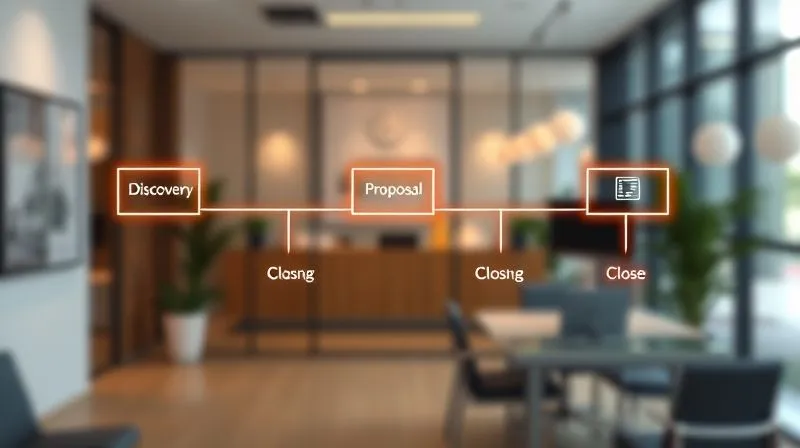
A streamlined process not only accelerates deals but also enhances the customer experience, making prospects more likely to convert.
6. Leveraging Technology: CRM, AI, & Sales Enablement Tools
In today's competitive B2B landscape, relying solely on manual efforts and intuition is a disadvantage. Technology, when properly implemented and utilized, can be a powerful accelerator for improving B2B sales pipeline conversion rates by 15% and beyond.
Tools as Force Multipliers, Not Crutches
Your CRM (Customer Relationship Management) system is the backbone of your sales operation. It's not just a contact database; it's a strategic tool for managing relationships, tracking interactions, forecasting, and providing critical insights into your pipeline. However, its effectiveness hinges on accurate data entry and consistent usage by your team.
Beyond CRM, AI-powered tools are revolutionizing sales by offering predictive analytics, automating administrative tasks, and providing real-time coaching. Sales enablement platforms ensure your reps have the right content, at the right time, for the right stage of the buyer's journey, making their interactions more impactful and reducing sales cycle times.
Actionable Steps:
- Maximize CRM Utilization: Ensure 100% adoption and accurate data entry. Regular training and auditing are crucial. Your CRM should be a single source of truth.
- Implement AI for Insights: Explore AI tools that can analyze call recordings for coaching opportunities, predict deal outcomes, or identify at-risk deals based on sentiment analysis.
- Deploy Sales Enablement Platforms: Provide your team with easy access to updated case studies, pitch decks, competitive battle cards, and pricing information. Track content engagement to understand what resonates best.
- Automate Repetitive Tasks: Use tools for email sequencing, scheduling, and data entry to free up sales reps to focus on selling.
- Integrate Your Tech Stack: Ensure your CRM, marketing automation, and sales enablement tools communicate seamlessly to provide a holistic view of the customer journey.
| Technology Category | Benefit for Conversions |
|---|---|
| CRM | Centralized data, pipeline visibility, accurate forecasting |
| AI/Predictive Analytics | Identify high-propensity leads, predict deal outcomes, personalize outreach |
| Sales Enablement | Consistent messaging, access to relevant content, reduced sales cycle |
| Sales Automation | Increased efficiency, more time for selling, consistent follow-up |
Embracing the right technology empowers your sales team to be more efficient, insightful, and effective, directly impacting your ability to improve B2B sales pipeline conversion rates by 15%.
7. Continuous Coaching, Training, and Performance Management
Even the best processes and technology are only as good as the people using them. Your sales team is your frontline; investing in their continuous growth and development is non-negotiable for improving B2B sales pipeline conversion rates by 15%.
Investing in Your Sales Team's Growth
Effective sales coaching isn't about micromanagement; it's about empowerment. It's about helping individual reps identify their strengths and weaknesses, practice new techniques, and refine their approach based on real-world feedback. A consistent coaching rhythm ensures that insights from pipeline analysis and new strategies are actually implemented and adopted by the team.
As sales guru Jeffrey Gitomer famously said, 'People don't like to be sold, but they love to buy.' Your team needs to master the art of guiding buyers, not just pushing products. This requires ongoing training not just on product features, but on negotiation, objection handling, active listening, and strategic questioning.
Actionable Steps:
- Implement a Regular Coaching Cadence: Schedule weekly or bi-weekly 1:1 coaching sessions with each rep. Focus on specific deals, skill development, and pipeline health.
- Utilize Call Recordings & Role-Playing: Review actual sales calls to provide constructive feedback. Use role-playing to practice difficult scenarios like objection handling.
- Provide Ongoing Training: Beyond initial onboarding, offer continuous training on new product features, market trends, sales methodologies, and soft skills.
- Foster a Culture of Learning: Encourage reps to share best practices, celebrate successes, and learn from mistakes in a supportive environment.
- Performance Reviews & Goal Setting: Conduct regular performance reviews tied to clear, measurable goals. Provide actionable feedback and development plans.
- Incentivize Desired Behaviors: Structure compensation and recognition programs to reward not just closed deals, but also activities that lead to higher conversion rates (e.g., successful discovery calls, strong qualification).

A well-coached and highly skilled sales team is your most valuable asset in the quest to improve B2B sales pipeline conversion rates by 15%. Their ability to connect, persuade, and guide prospects through the buying journey is ultimately what drives conversions.
Frequently Asked Questions (FAQ)
Q: How quickly can I expect to see results after implementing these strategies? A: While some improvements, especially in lead qualification and messaging clarity, can yield results within weeks, a full 15% improvement in B2B sales pipeline conversion rates typically takes 3-6 months. This allows time for process adjustments, team training, and sufficient data collection to measure impact. Consistency and commitment are key.
Q: What if my sales team resists these changes? A: Resistance to change is common. The best approach is to involve your sales team in the process from the outset. Explain the 'why' behind the changes (better results for them, more qualified leads, higher commissions). Provide thorough training, ongoing support, and celebrate early wins. Demonstrate how these strategies empower them, rather than restrict them.
Q: Is 15% a realistic goal for every business, regardless of industry or product complexity? A: For most B2B businesses, a 15% increase is an ambitious but achievable goal, especially if there are clear inefficiencies in the current pipeline. For highly optimized pipelines, the initial jump might be smaller, but continuous improvement is always possible. The strategies outlined are foundational and applicable across various B2B contexts, though their specific implementation will need to be tailored.
Q: How does marketing alignment impact B2B sales pipeline conversion? A: Marketing alignment is absolutely critical. When marketing and sales work in silos, lead quality suffers, messaging is inconsistent, and opportunities are missed. A strong SLA (Service Level Agreement) between marketing and sales, shared ICPs/personas, and joint revenue goals ensure that marketing delivers qualified leads that sales is equipped to convert, directly impacting pipeline conversion rates.
Q: What's the biggest mistake companies make when trying to improve conversions? A: The biggest mistake I've observed is trying to implement too many changes at once without a clear baseline or measurement plan, or focusing on just one aspect (e.g., only lead generation). A holistic, data-driven approach that addresses all stages of the pipeline, from targeting to closing, and involves continuous iteration, is far more effective. Also, neglecting ongoing sales coaching is a huge oversight.
Key Takeaways and Final Thoughts
- Data is Your Compass: Start by deeply understanding your current conversion rates at every pipeline stage to pinpoint exact weaknesses.
- Precision Targeting Pays Off: Ruthlessly refine your ICP and buyer personas to ensure you're pursuing the highest-value opportunities.
- Qualify Rigorously: Implement a robust lead qualification process to prevent unqualified leads from wasting sales team valuable time.
- Value-Driven Messaging: Shift from selling features to articulating specific, quantifiable outcomes and solutions for your prospects.
- Streamline Your Process: Eliminate bottlenecks and standardize your sales stages for a smoother, faster buyer journey.
- Leverage Technology Wisely: Utilize CRM, AI, and sales enablement tools to empower your team and gain actionable insights.
- Invest in Your People: Consistent coaching and training are paramount to developing a highly skilled and adaptable sales force.
Improving B2B sales pipeline conversion rates by 15% isn't a pipe dream; it's an achievable goal through a systematic, data-driven, and people-centric approach. It requires commitment, collaboration, and a willingness to continuously analyze and adapt. By implementing the strategies I've outlined, you're not just fixing leaks; you're building a more robust, predictable, and profitable sales engine. The journey to higher conversions starts now – take these insights, apply them diligently, and watch your revenue grow.
Recommended Reading
- Mastering Quality Control: How to Perform Root Cause Analysis Effectively
- Boost Call Center Success: Agent Performance Metrics Revealed
- Unmasking Hidden Hurdles: How to Identify Conversion Roadblocks on a Website?
- Why VCs Reject Your Startup Pitch: 7 Key Mistakes to Avoid
- 7 Proven Strategies: How to Protect Your Novel Business Model from Imitation





Comments
Leave a comment below. Your email will not be published. Required fields marked with *