


How to Prevent Scope Creep in Long-Term Business Consulting Projects?
For over 15 years in the business consulting arena, I've seen countless promising long-term projects derail, not due to lack of talent or effort, but because of an insidious, often underestimated foe: scope creep. It's that gradual, almost imperceptible expansion of project requirements beyond the original agreed-upon scope, often leading to budget overruns, missed deadlines, and strained client relationships.
The pain points are universal. Consultants feel undervalued, working more for the same fee. Clients become frustrated by delayed deliverables or unexpected additional costs. What begins as a collaborative partnership can quickly devolve into a contentious battle over 'what was agreed upon'. This isn't just about losing money; it's about eroding trust, damaging reputation, and draining the passion from your most valuable engagements.
But it doesn't have to be this way. In this definitive guide, I'll share the frameworks, strategies, and hard-won insights I've developed to not just mitigate, but actively prevent scope creep in long-term business consulting projects. You'll learn how to establish impenetrable boundaries, master the art of client communication, implement robust controls, and ultimately, deliver exceptional value while protecting your firm's profitability and sanity.
1. The Bedrock: Crystal Clear Scoping & Ironclad Contracts
The first, and arguably most critical, defense against scope creep is a meticulously defined scope of work (SOW) and a robust contract. This isn't just paperwork; it's the foundational agreement that sets expectations for both parties. Without it, you're building on shifting sands.
Expert Insight: A vague SOW is an open invitation for scope creep. Precision in definition is your most powerful preventative measure.
Defining Project Boundaries with Surgical Precision
When drafting your SOW, think like a lawyer and a project manager simultaneously. Every deliverable, every responsibility, every assumption needs to be explicitly stated. I always advise my teams to use language that leaves no room for ambiguity.
- State Objectives Clearly: What is the ultimate business outcome the client expects?
- Detail Deliverables: List every report, presentation, system, or strategy document. Specify format, quantity, and acceptance criteria.
- Outline Consultant Responsibilities: What exactly will your team do? Be specific about tasks, hours, and resources.
- Define Client Responsibilities: This is crucial. What input, data, personnel, or decisions are required from the client? Lack of client engagement is a common source of perceived 'scope creep' when it's actually a dependency issue.
- Establish Exclusions: Explicitly state what is NOT included in the scope. This pre-empts common assumptions. For example, 'Development of new software features is excluded; focus is on optimizing existing CRM.'
- Set Milestones and Timelines: Break the project into measurable phases with clear start and end dates.
- Specify Reporting & Communication Cadence: How often will you meet? What kind of reports will be provided?
According to a study by the Project Management Institute (PMI), unclear objectives are a primary contributor to project failure. This directly translates to scope creep in consulting.

Crafting a Robust Contract with Change Control
Your contract isn't just a billing agreement; it's a living document that protects both parties. It must embed a clear, non-negotiable change control process. This is your formal gatekeeper against unapproved scope expansion.
| Element | Description | Impact of Vagueness |
|---|---|---|
| Project Objectives | What business problem are we solving? What success looks like. | Misaligned expectations, irrelevant deliverables. |
| Deliverables | Tangible outputs (reports, systems, strategies). | Endless revisions, 'moving goalposts'. |
| Client Responsibilities | Client's required input (data, decisions, access). | Project delays, blame game, consultant doing client's work. |
Ensure the contract stipulates that any deviation from the agreed-upon SOW, whether initiated by the client or identified by your team, must follow a formal change request procedure. This includes:
- A written change request detailing the proposed alteration.
- An assessment of the impact on timeline, budget, and resources.
- Formal approval from both parties, typically with a revised SOW addendum or change order.
This process transforms informal requests into structured discussions, forcing a cost-benefit analysis before any new work begins. As Forbes contributor Peter Cohan notes, 'A solid contract with a clear change order process is your best friend when dealing with client requests that fall outside the original scope.'
Harvard Business Review often emphasizes the strategic importance of well-structured contracts.2. Proactive Communication: Your First Line of Defense
Even with the best SOW, communication breakdowns are fertile ground for scope creep. Proactive, transparent, and consistent communication acts as an early warning system and a continuous alignment mechanism.
Setting the Communication Rhythm
From day one, establish a clear communication plan. This includes:
- Regular Cadence Meetings: Weekly or bi-weekly check-ins to review progress, discuss challenges, and re-align on objectives. These aren't just status updates; they are opportunities to identify potential scope shifts early.
- Designated Points of Contact: A primary liaison on both the client and consultant side streamlines communication and avoids conflicting instructions.
- Meeting Minutes & Action Items: Document every discussion, decision, and assigned action item. This creates an auditable trail and prevents 'I thought we agreed...' scenarios.
I always make it a point to reiterate the project scope at the beginning of these meetings, even if briefly. It keeps the boundaries top of mind for everyone involved.
Mastering the Art of 'No' (and 'Yes, but...')
One of the hardest skills for a consultant is saying 'no' to a client. But it's essential for preventing scope creep. This doesn't mean being unhelpful; it means being strategic.
- Acknowledge & Validate: 'I understand why you'd want to explore that new marketing channel; it's a great idea.'
- Reference the Scope: 'However, our current SOW focuses on optimizing your existing sales funnel, which is a different objective.'
- Propose the Process: 'If we were to pursue that, it would require a formal change request, and we'd need to assess its impact on our current timeline and budget.'
- Offer Alternatives: 'Perhaps we could scope that as a separate, follow-on project once we've achieved our current objectives?'
This approach transforms a potentially confrontational 'no' into a constructive 'yes, but let's do it properly,' reinforcing your process and demonstrating your commitment to the original goals.
3. Implementing Robust Change Control Processes
As discussed earlier, a formal change control process is non-negotiable. It's the mechanism that translates your contractual terms into actionable steps whenever a scope deviation is proposed.
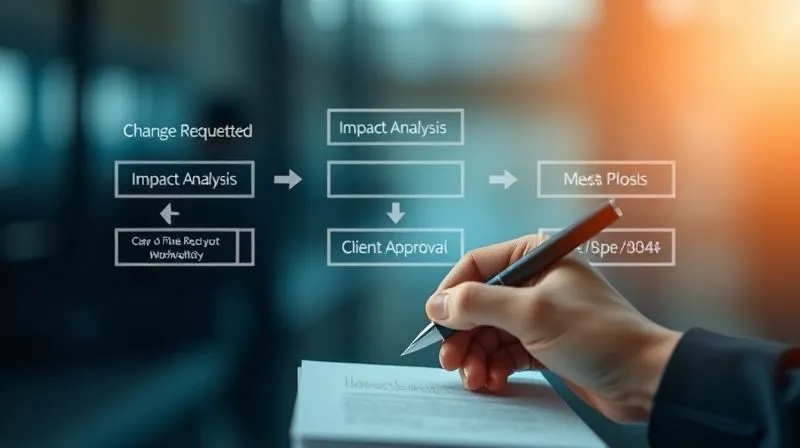
The 3-Step Change Request Workflow
I've found that a simple, yet rigorous, three-step workflow works best:
- Initiation: Any party (client or consultant) can initiate a change request. This should be a formal document (template-based) outlining: the proposed change, the reason for it, and the perceived benefits.
- Analysis & Impact Assessment: Your team (project manager, lead consultant) analyzes the proposed change. This involves assessing its impact on: timeline (how much longer will it take?), budget (what are the additional costs?), resources (do we need more people or different skills?), and original objectives (does this change align or detract?).
- Approval & Documentation: The impact assessment is presented to the client. If approved, a formal Change Order or SOW Addendum is drafted, signed by both parties, and integrated into the project documentation. Only then does the new work commence. If not approved, the project continues as originally scoped.
Case Study: How Innovate Solutions Maintained Project Integrity
Innovate Solutions, a boutique tech consulting firm, was engaged for a 12-month digital transformation project for a manufacturing client. Three months in, the client's marketing director requested adding a comprehensive social media strategy component, citing new market trends. Innovate Solutions' project lead immediately initiated a change request. Their analysis showed it would add 2 months to the timeline and increase the budget by 15% due to specialized resources needed. After presenting this impact assessment, the client opted to defer the social media strategy to a separate, follow-on project, ensuring the core transformation project stayed on track and within its original scope and budget. This demonstrated the power of a clear process and the ability to say 'yes, but later and properly'.
4. Leveraging Technology for Project Oversight
In long-term projects, manual tracking becomes unwieldy. Project management software isn't just for task management; it's a critical tool for scope control, providing real-time visibility into progress, resource allocation, and potential deviations.
Tools for Transparent Tracking
Utilize platforms like Asana, Jira, Monday.com, or even sophisticated ERP systems for larger engagements. Key features to leverage include:
- Task Breakdown Structures (WBS): Break down the project into granular, assignable tasks linked directly to SOW deliverables.
- Time Tracking: Monitor actual hours against estimated hours for each task. Significant deviations can flag potential scope creep.
- Progress Dashboards: Share dashboards with clients, showing progress against milestones. Transparency reduces anxiety and helps manage expectations.
- Document Repositories: Centralize all project documents, including the SOW, change orders, and meeting minutes, ensuring everyone works from the single source of truth.
I've seen projects with effective technology support reduce 'scope creep' incidents by 20-30% simply by making progress and deviations visible to all stakeholders. This aligns with findings from Gartner, which consistently highlights the role of project portfolio management tools in improving project success rates.
The Project Management Institute offers extensive resources on leveraging technology for project success.5. The Art of Client Education & Expectation Management
Scope creep often stems from a client's evolving understanding or unrealistic expectations. Your role as a consultant extends to educating your client on the project process and the implications of changes.
Proactive Expectation Setting
Don't wait for issues to arise. From the initial pitch, communicate clearly about:
- The Project Lifecycle: Explain the phases, key decision points, and the role of the client at each stage.
- The Nature of Consulting: Emphasize that your engagement is focused on specific outcomes, not an open-ended resource pool.
- The Cost of Change: Gently, but firmly, explain that changes to the agreed-upon scope will impact time and budget. This isn't a threat; it's a reality.
I often use analogies, like building a house. You wouldn't decide halfway through construction to add a new wing without expecting a revised blueprint, new materials, and additional costs. Business projects are no different.
Managing Stakeholder Engagement
In long-term projects, multiple stakeholders with varying agendas can emerge. Identify key stakeholders early and understand their individual needs and potential influence. Regular, tailored communication with each group can prevent their individual 'wish list' items from becoming project scope.
Expert Insight: Unmanaged stakeholder expectations are a silent killer of project scope. Proactive engagement prevents surprises.
This might involve separate, more strategic meetings with executive sponsors and more tactical updates with operational teams. The goal is to keep everyone aligned with the core SOW.
6. Phased Deliverables & Milestones: Building in Guardrails
Breaking a long-term project into smaller, manageable phases with defined deliverables and acceptance criteria at each milestone is a powerful scope control strategy. This is particularly effective in agile or iterative consulting engagements.
The Power of Incremental Delivery
Instead of one massive 'big bang' delivery at the end, structure your project to deliver value incrementally. Each phase should have:
- Clear Objectives: What will be achieved in this phase?
- Specific Deliverables: Tangible outputs that can be reviewed and accepted.
- Defined Acceptance Criteria: What constitutes 'done' for this phase?
- Client Sign-off: Formal approval at the end of each phase.
This approach provides frequent opportunities for client feedback and course correction, making it easier to identify and address scope creep before it becomes entrenched. If a client requests a major change in Phase 3, you can address it relative to the current phase, rather than the entire project. It also provides a natural point to reassess the overall project roadmap.
ProjectManager.com offers great insights into iterative methodologies like Agile, which inherently combat scope creep through phased delivery.Mini Case Study: The Retailer's CRM Implementation
A national retailer hired a consulting firm for a complex CRM implementation. Instead of attempting a full rollout in one go, the project was divided into three phases: 1) Data Migration & System Setup, 2) Sales Module Customization & Training, and 3) Marketing Automation & Analytics Integration. At the end of Phase 1, the client requested integrating a new loyalty program into the CRM, which was outside the original scope. Because of the phased approach, the consulting firm could present this as a clear addition to Phase 2 (or a new Phase 4), with a distinct cost and timeline impact, rather than a hidden burden on the existing project. The client appreciated the transparency and approved the change order for Phase 2, understanding the implications.
7. Post-Project Review: Learning from Every Engagement
Even with the best preventative measures, some level of scope creep might occur. The final, critical step in preventing future issues is a thorough post-project review, or 'lessons learned' session.
Analyzing Scope Deviations
After each long-term project, conduct an internal review (and ideally, a joint review with the client) to analyze:
- What caused any scope creep? Was it unclear requirements, new client requests, unforeseen technical challenges, or a lack of internal discipline?
- How were these deviations managed? Was the change control process effective? Were communications clear?
- What could have been done differently? In the initial SOW, during client meetings, or within the project management process?
| Scope Creep Source | Prevention Strategy | Lessons Learned |
|---|---|---|
| Vague Requirements | Detailed SOW, explicit exclusions. | Invest more time in discovery phase. |
| Unmanaged Client Requests | Formal change control, 'Yes, but...' communication. | Educate client on process early and often. |
| Internal Assumptions | Cross-functional SOW review, regular internal syncs. | Challenge assumptions, document everything. |
| New Market Conditions | Phased deliverables, agile approach. | Build flexibility into longer projects via milestones. |
Document these insights and integrate them into your firm's best practices, SOW templates, and consultant training programs. This continuous improvement loop is vital for evolving your scope management capabilities.
Frequently Asked Questions (FAQ)
Q: What if the client insists on a change without a formal change order? This is a critical moment. Politely but firmly refer back to your agreed-upon change control process outlined in the contract. Explain that for the integrity of the project, and to ensure proper resource allocation and billing, the process must be followed. Offer to help them draft the change request immediately. Never proceed with unapproved work; it sets a dangerous precedent.
Q: How do I price changes that come up? Do I just charge hourly? Pricing changes should be consistent with your original engagement model. If it was fixed-price, provide a fixed-price quote for the new scope. If it was time & materials, provide an estimate of additional hours. Always break down the costs and explain the rationale based on the impact assessment (time, resources, materials). Transparency builds trust, even when adding costs.
Q: Can scope creep be entirely prevented in long-term projects? While complete prevention is an aspirational goal, significant mitigation is absolutely achievable. Long-term projects, by their nature, can encounter evolving market conditions or internal client shifts. The goal isn't to be rigidly inflexible, but to have a robust, agreed-upon system for managing those evolutions in a controlled, transparent, and mutually beneficial way.
Q: How do I handle a client who constantly changes their mind or brings new stakeholders with new demands? This points to an underlying issue with client-side project governance or internal alignment. Beyond strict adherence to your change control process, you might need to have a candid conversation with the primary client sponsor. Offer to help them establish clearer internal decision-making processes or conduct a stakeholder alignment workshop. Sometimes, the 'scope creep' is a symptom of internal client chaos.
Q: Is it always bad to agree to a scope change? Not at all! Legitimate changes can add significant value to the client and enhance the project's overall success. The key is that these changes are formally acknowledged, properly assessed for impact, and mutually agreed upon, rather than being absorbed implicitly at the consultant's expense. When managed correctly, a scope change can strengthen the client relationship.
Key Takeaways and Final Thoughts
Preventing scope creep in long-term business consulting projects isn't about being rigid or uncooperative; it's about being professional, strategic, and disciplined. It's about protecting your firm's profitability, maintaining project integrity, and ultimately, delivering the promised value to your clients efficiently and effectively.
- Define Everything: Start with an exceptionally clear Scope of Work and a contract with a formal change control process.
- Communicate Constantly: Proactive, transparent communication is your early warning system.
- Process is King: Implement a non-negotiable, documented change request workflow.
- Leverage Technology: Use project management tools for clear visibility and tracking.
- Educate Your Client: Manage expectations from the outset and explain the implications of changes.
- Deliver Incrementally: Use phased deliverables and milestones to create natural guardrails.
- Learn & Adapt: Conduct post-project reviews to continuously refine your approach.
By embedding these strategies into your consulting practice, you'll transform potential project headaches into manageable opportunities, fostering stronger client relationships built on trust, transparency, and mutual respect for boundaries. Embrace these principles, and you'll not only prevent scope creep but elevate your firm's reputation as a reliable and results-driven partner.
Recommended Reading
- E-commerce ROAS Drop Post-iOS 14? Your 6-Step Reversal Plan
- 7 Steps: Efficiently Update Legal Firm Policies for New Data Regulations
- Service Business Startup: Your Ultimate Guide to Launching Success
- 7 Critical Legal Steps: Protect Your Startup's IP from Day One
- 5 Steps: Resolve Business Partner Disagreements on Major Decisions





Comments
Leave a comment below. Your email will not be published. Required fields marked with *