


How to prove content marketing ROI to skeptical executives?
For over 15 years in the dynamic world of digital marketing, I've witnessed a recurring, frustrating scenario: brilliant content strategies, meticulously executed, failing to secure sustained funding not because they weren't effective, but because their value wasn't articulated in the language that truly resonates with leadership – the language of measurable return on investment.
You're pouring resources into creating valuable blog posts, engaging videos, insightful whitepapers, and robust social media campaigns. You see the engagement, the traffic, the anecdotal successes. Yet, when it comes time to justify the budget, your executives squint at the numbers, asking, "What's the *real* impact on the bottom line? Is this truly moving the needle, or just a costly creative endeavor?" This skepticism isn't a dismissal of your hard work; it's a demand for clarity, accountability, and a tangible connection to financial performance.
In this definitive guide, I'll share the frameworks, metrics, and communication strategies I've honed over years of working with diverse organizations, from startups to Fortune 500s. We'll move beyond vanity metrics and explore how to build a compelling, data-driven narrative that transforms content marketing from a perceived cost center into an undeniable revenue driver, securing the executive buy-in your initiatives deserve. My goal is to equip you with the expertise to confidently prove content marketing ROI to skeptical executives, turning their questions into conviction.
Understanding the Executive Mindset: Why They're Skeptical
Before you can convince an executive, you must first understand their perspective. Their primary concerns are typically revenue growth, profitability, market share, operational efficiency, and risk mitigation. Content marketing, with its often indirect and long-term impact, can feel nebulous and less concrete compared to direct sales campaigns or product development initiatives that have immediate, quantifiable outcomes.
The Language of Business: Revenue, Profit, Efficiency
Executives operate in a world of P&L statements, shareholder value, and strategic objectives. When you present content marketing results, if you're not speaking directly to these core business drivers, your message will likely fall flat. They need to see how content contributes to tangible business outcomes, not just 'brand awareness' or 'engagement' in isolation. They want to know: How does this content help us acquire customers more cheaply? How does it increase customer lifetime value? How does it reduce support costs or accelerate sales cycles? Frame your success in terms of dollars saved, revenue generated, or efficiency gained.
Common Pitfalls in Presenting Content Data
A common mistake I've observed is overwhelming executives with a deluge of raw data – page views, bounce rates, social shares – without connecting these metrics to strategic business objectives. This often leads to confusion, not clarity. Another pitfall is focusing solely on top-of-funnel metrics without demonstrating how that awareness translates into leads, opportunities, and ultimately, revenue. Executives need a clear, concise story that links your efforts directly to their financial goals, and avoids jargon that only marketing professionals understand.

As marketing guru Seth Godin often says, "Marketing is a contest for people's attention." While content certainly captures attention, the executive question quickly shifts to: "What did we *do* with that attention? How did it impact our financial performance or strategic position?" This gap between marketing activity and business impact is precisely what we need to bridge.
Step 1: Define Your Content Marketing Goals & KPIs (The Foundation)
The first, and arguably most critical, step in proving content marketing ROI is to clearly define what success looks like *before* you even create your first piece of content. This isn't just about setting goals; it's about aligning those goals directly with overarching business objectives and ensuring they are measurable.
Aligning Content Goals with Business Objectives
Your content strategy shouldn't exist in a vacuum. It must serve a higher purpose within the organization. Are you aiming to increase brand awareness, generate qualified leads, support the sales cycle, improve customer retention, reduce customer service inquiries, or enhance thought leadership? Each of these business objectives requires a different content strategy and, crucially, different metrics for success. Without this clear alignment, any content effort risks being perceived as a disjointed activity rather than a strategic investment.
- Identify Core Business Objectives: Work collaboratively with leadership, sales, and product teams to understand the top 2-3 strategic goals for the quarter or year. These could be increasing market share by 10%, reducing customer acquisition cost (CAC) by 15%, improving customer retention by 5%, or accelerating time-to-market for a new product.
- Translate to Content Marketing Goals: For each overarching business objective, define how content can directly contribute. For example, if the business goal is to reduce CAC, a content goal might be 'Generate 20% more marketing-qualified leads (MQLs) through organic search at a lower cost per lead compared to paid channels.'
- Establish SMART KPIs: For each content goal, identify Specific, Measurable, Achievable, Relevant, and Time-bound Key Performance Indicators. These are the precise, quantifiable metrics you will track, analyze, and report on. Ensure each KPI has a baseline and a target.
For instance, if a business objective is "increase product adoption for our new SaaS feature," your content goal might be "drive feature engagement and educate users." The KPIs could then be: increase unique users of the feature by 15% within 3 months, measured by in-app analytics and content consumption of feature-specific tutorials, alongside a 10% reduction in support tickets related to that feature. This direct linkage between content activity and tangible business impact is what executives want to see.
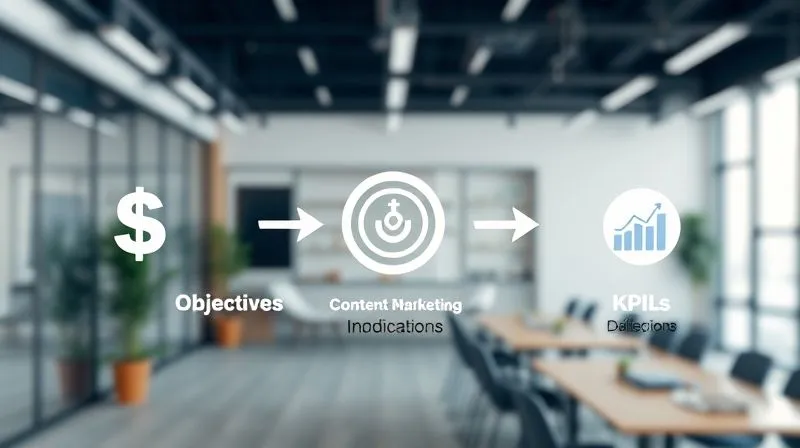
Here’s an example of how to map these, providing a clear roadmap for how to prove content marketing ROI:
| Business Objective | Content Marketing Goal | Key Performance Indicators (KPIs) |
|---|---|---|
| Increase Market Share by 10% in Q4 | Generate 25% more MQLs from target accounts via organic channels | Organic MQLs, Cost Per MQL, MQL-to-SQL Conversion Rate, Organic Search Visibility (SERP rankings) |
| Reduce Customer Churn by 5% Annually | Improve customer education and engagement with product features | Time spent on knowledge base articles, NPS scores from content consumers, Support Ticket Reduction for common issues, Feature Adoption Rate |
| Successfully Launch New Product (X) in 6 Months | Drive pre-launch interest and early adoption among target audience | Email sign-ups for early access, Demo requests, Social Mentions and Sentiment, Website traffic to product launch page, Beta program applications |
Step 2: Track the Right Metrics Across the Funnel (Beyond Vanity)
Once your goals and KPIs are set, the next critical step is to rigorously track the metrics that truly matter. It's easy to get lost in a sea of data, but executives need you to filter out the noise and present the signals that indicate business value. This means tracking performance across the entire customer journey, from initial awareness to post-purchase advocacy, not just at the top of the funnel.
Awareness & Engagement Metrics (Top-of-Funnel)
While not directly revenue-generating, these metrics are crucial for establishing reach, interest, and authority. When presented correctly, they demonstrate the foundational work that leads to later conversions and builds brand equity.
- Organic Traffic: Monitor key metrics like sessions, unique users, and page views from organic search. A sustained increase indicates improved content discoverability, strong SEO performance, and growing audience interest.
- Unique Visitors: A more accurate indicator than total page views for true audience reach, showing how many distinct individuals your content is attracting.
- Time on Page/Engagement Rate: Higher average times and lower bounce rates suggest content relevance, quality, and value to the reader. This indicates your content is resonating and holding attention.
- Social Shares/Mentions: While not directly ROI, these metrics show content virality, brand resonance, and amplification, contributing significantly to broader awareness and thought leadership.
- Brand Search Volume: An increase in direct searches for your brand name or product indicates growing brand recognition and recall, often influenced by consistent content exposure.
Lead Generation & Nurturing Metrics (Mid-Funnel)
This is where content starts to demonstrate its potential for revenue impact. These metrics show how effectively your content is capturing interest, generating leads, and nurturing potential customers further down the sales funnel.
- Lead Magnets Downloads/Submissions: Track conversion rates on gated content like whitepapers, ebooks, templates, and webinar registrations. This directly measures content's ability to capture contact information.
- Marketing Qualified Leads (MQLs): Quantify the number of leads generated directly or indirectly by content that meet specific qualification criteria set by your sales team. This is a critical hand-off point.
- Subscriber Growth: Consistent growth in your email list or blog subscribers indicates a deepening relationship with your audience and a channel for ongoing nurturing.
- Cost Per Lead (CPL): If content marketing can generate leads at a lower cost than other channels (e.g., paid advertising), this is a powerful ROI story demonstrating efficiency.
Sales & Revenue Metrics (Bottom-of-Funnel)
This is the ultimate proof point for skeptical executives. Connect your content efforts directly to sales outcomes and demonstrate tangible financial returns.
- Sales Qualified Leads (SQLs): Track how many MQLs, influenced by content, are accepted by the sales team as legitimate sales opportunities.
- Content-Influenced Opportunities/Revenue: Utilize CRM data to track opportunities where content played a role in moving a lead through the pipeline or directly contributed to a closed-won sale. This often involves tracking which content assets were viewed by prospects before conversion.
- Customer Lifetime Value (CLTV): Analyze whether customers who engaged with specific content (e.g., onboarding guides, loyalty program content) exhibit higher retention rates or encourage repeat purchases, thus increasing their CLTV.
- Content Marketing ROI Calculation: The classic financial metric: (Revenue Generated by Content - Cost of Content Marketing) / Cost of Content Marketing. This is where all your tracking culminates into a clear financial indicator.
According to a report by the Harvard Business Review, "The most successful marketing organizations are those that move beyond simple activity metrics to link marketing efforts directly to business outcomes." This underscores the critical need to connect your content data to the financial health and strategic objectives of the company.
Step 3: Attribute Revenue & Link Content to Business Outcomes
This is where the rubber meets the road. Simply tracking metrics isn't enough; you must be able to draw a clear line from a piece of content to a specific business outcome, ideally revenue. This requires robust attribution modeling and a clear understanding of the customer journey.
Multi-Touch Attribution Models
In today's complex customer journeys, a single piece of content rarely closes a deal on its own. Customers interact with multiple touchpoints – blog posts, emails, social media, sales calls – before converting. Multi-touch attribution models distribute credit across all content and marketing interactions. While full attribution can be complex, even a basic multi-touch model provides far more insight than simplistic last-touch reporting.
- First-Touch Attribution: Gives 100% credit to the first content piece a customer interacted with. Excellent for understanding initial awareness and how content brings new prospects into your funnel.
- Last-Touch Attribution: Gives 100% credit to the last content piece consumed before conversion. Good for understanding which content pieces are most effective at closing deals or driving immediate action.
- Linear Attribution: Distributes credit equally across all touchpoints in the customer journey. Provides a balanced view of content's role at every stage.
- Time Decay Attribution: Gives more credit to touchpoints that occurred closer in time to the conversion. Recognizes that recent interactions often have a greater influence.
- U-Shaped (Position-Based) Attribution: Gives 40% credit to the first touch and 40% to the last touch, distributing the remaining 20% among all middle touches. This acknowledges the importance of both initial discovery and final conversion content.
Choosing the right model depends on your business, sales cycle length, and the specific questions you're trying to answer. The key is to be consistent, transparent about the model you use, and explain *why* it's the most appropriate for your context. Leverage your CRM and marketing automation platforms to implement these models effectively.
Calculating Content-Assisted Conversions
Beyond direct attribution, you can also demonstrate "content-assisted conversions." This involves identifying instances where content was consumed at any point in the customer journey leading to a sale, even if it wasn't the direct conversion touchpoint. Many CRM and marketing automation platforms can track this by linking content consumption data to lead records and sales outcomes. By doing so, you can show how content shortens sales cycles, increases deal size, or improves conversion rates across the board.
"Don't just report on what happened. Explain *why* it matters. Executives want to know the 'so what?' behind your data. Connect every metric to a strategic implication, a financial impact, or a competitive advantage. This transforms raw numbers into actionable insights."
Case Study: How InnovateTech Secured a $500K Deal with Content
InnovateTech, a B2B SaaS company specializing in supply chain optimization, faced skepticism about their content marketing's direct revenue impact. Their sales cycle was notoriously long, typically 6-9 months, making direct attribution challenging. We implemented a robust CRM integration that tracked every content interaction from initial website visit through to closed-won deals, assigning unique IDs to track individual prospect journeys.
Through this enhanced tracking, we discovered that a particular series of in-depth whitepapers and webinars on 'AI in Supply Chain Management' consistently appeared in the customer journey of high-value clients. By analyzing a U-shaped attribution model, we found that prospects who engaged with at least two pieces of this specific content series had a 3x higher conversion rate from MQL to SQL and experienced a 20% faster sales cycle compared to those who didn't. We identified a specific $500,000 deal where the key decision-maker had downloaded three whitepapers and attended two webinars from this series before initiating contact with sales. Presenting this direct link, alongside the aggregate data on improved conversion rates and reduced sales cycles, transformed executive perception. It moved content from a 'nice-to-have' to an indispensable sales enablement and revenue-generating tool.
Step 4: Quantify the Intangibles: Brand Equity & Thought Leadership
While direct revenue attribution is paramount, content marketing also delivers significant value that isn't always immediately quantifiable in dollars, but undeniably impacts the bottom line over time. These 'intangibles' contribute to long-term business health, market position, and future revenue potential, and should be a compelling part of your ROI narrative.
Measuring Brand Awareness & Sentiment
Content marketing consistently builds your brand, positioning your organization as an authority, fostering trust, and enhancing your reputation. While harder to tie to a specific immediate sale, these factors profoundly influence purchasing decisions, talent acquisition, and investor confidence over the long term.
- Brand Mentions: Track how often your brand is mentioned across social media, news outlets, industry publications, and forums. Tools for social listening and media monitoring are invaluable here.
- Brand Search Volume: Monitor the trend of direct searches for your brand name or specific products/services. A sustained increase indicates growing brand recognition and recall, often influenced by consistent content exposure.
- Share of Voice: Analyze your brand's presence and mentions within industry conversations compared to your competitors. A higher share of voice indicates greater influence and visibility.
- Sentiment Analysis: Utilize natural language processing tools to monitor the tone of conversations around your brand (positive, negative, neutral). Positive sentiment builds trust and reduces reputational risk.
SEO Value & Organic Traffic Gains
Content is the foundational engine of organic search. The value of ranking for high-volume, relevant keywords can be directly quantified by comparing it to what you would pay for equivalent traffic via costly paid advertising. This presents a clear, ongoing cost-saving benefit that resonates strongly with executives.
- Calculate "Equivalent Ad Spend": Use SEO tools (e.g., Ahrefs, SEMrush) to estimate the cost of acquiring your organic traffic if you had to pay for it via PPC campaigns. This provides a direct monetary value for your organic efforts.
- Track Keyword Rankings: Monitor improvements for target keywords in search engine results pages (SERPs). Higher rankings mean increased visibility, more qualified organic traffic, and a stronger competitive position.
- Backlink Profile Growth & Domain Authority (DA): Quality content naturally attracts high-value backlinks from other reputable sites. Track the growth of your backlink profile and improvements in your Domain Authority score, as these directly correlate with enhanced search performance and long-term SEO health.

By demonstrating how your content reduces reliance on expensive paid channels, builds a valuable digital asset, and enhances your brand's market standing, you present a compelling case for cost efficiency and sustainable, long-term asset building. This is particularly appealing to executives focused on strategic growth and optimizing resource allocation.
Step 5: Present Your Case: The Executive-Ready Narrative
Even with impeccable data and robust attribution, your presentation style can make or break your pitch. Executives are time-strapped and need information delivered concisely, clearly, and with a laser focus on impact. You're not just reporting data; you're telling a compelling story of value and strategic contribution.
Focus on Story, Not Just Data Dumps
Resist the urge to show every single metric you've tracked. Instead, curate your data to support a clear, impactful narrative. Start with the overarching business objective, then show how content contributed, backed by key, relevant metrics. Use visuals to make complex data digestible and memorable.
- Start with the "So What?": Begin with the conclusion – the ultimate impact, ROI, or strategic achievement – then back it up with the supporting data. This immediately grabs their attention.
- Highlight Key Wins: Showcase specific campaigns, content pieces, or initiatives that achieved exceptional results. Use mini case studies or testimonials to add a human element.
- Address Challenges & Solutions: Demonstrate your problem-solving capabilities and strategic thinking by acknowledging obstacles and explaining how you overcame them. This builds trust.
- Future Outlook: Conclude with forward-looking recommendations and explain how future content efforts will build on current successes to achieve even greater strategic objectives.
Visualize Data Effectively
Visuals are far more impactful than raw numbers alone. Use charts, graphs, and infographics to illustrate trends, comparisons, and relationships. Ensure your visuals are clean, easy to understand at a glance, and directly support your narrative. Avoid cluttered or confusing graphics. Think about how to tell a story with each chart.

As a study by Deloitte emphasizes, "Data visualization is increasingly critical for effective decision-making, allowing leaders to quickly grasp complex information, identify trends, and make informed choices with greater speed and confidence."
Here’s a template for an executive summary that focuses on impact and action:
| Section | Key Message |
|---|---|
| Executive Summary: Q3 Content Performance | Content marketing delivered a strong 3.5:1 ROI this quarter, contributing $1.2M in pipeline influence and reducing our average customer acquisition cost (CAC) by 18% compared to previous periods. |
| Strategic Alignment & Impact | Our content efforts directly supported the Q3 objective of 'Increasing Market Share in Key Segment X' by driving 350 MQLs, which converted into 75 SQLs, and ultimately 15 new high-value customers. |
| Key Performance Highlights | Organic traffic increased by 22%, leading to 45% more MQLs from organic search. Our top 3 content pieces generated over $750K in pipeline influence and saw a 5x higher engagement rate than average. |
| Financial Impact & ROI | Content-assisted revenue reached $2.5M, with an estimated equivalent ad spend saving of $300K. Our calculated content ROI stands at an impressive 3.5:1, demonstrating efficient resource utilization. |
| Next Steps & Recommendations | Proposing to scale successful content formats (e.g., interactive tools, video series), invest in new long-tail topics identified through keyword research, and optimize distribution channels to further enhance ROI and penetrate new markets. Requesting a 10% budget increase to capitalize on proven strategies. |
Step 6: Address Objections and Foster Continuous Dialogue
Proving ROI isn't a one-time event; it's an ongoing process of communication, education, and refinement. Skepticism might persist, and new questions will inevitably arise. Be prepared to address these proactively and maintain an open, transparent dialogue with your leadership team.
Anticipate Questions and Prepare Responses
Put yourself in an executive's shoes. What are their likely concerns? "Is this sustainable?" "What about the competition?" "Can we reallocate these resources elsewhere for better returns?" "How long until we see the full impact?" Have data, logical arguments, and strategic insights ready for these common questions. For instance, if asked about sustainability, highlight the evergreen nature of your content and its compounding SEO benefits as a long-term asset, unlike perishable paid ads.
Be ready to discuss specific points like:
- Cost vs. Value: Clearly differentiate the upfront investment in content creation from the long-term asset value it creates (e.g., SEO equity, brand authority, sales enablement).
- Speed of Results: Acknowledge that content marketing is often a long-game strategy but show milestones and early indicators of success (e.g., MQL growth, reduced CPL) that lead to later revenue attribution.
- Competitive Landscape: Explain how your content positions you uniquely in the market, differentiates your brand, and captures market share that competitors might be missing.
- Resource Allocation: Be prepared to discuss how content marketing integrates with and amplifies other marketing and sales efforts, demonstrating its synergistic value rather than being a standalone silo.
Establish a Reporting Cadence
Regular, consistent reporting builds trust, maintains transparency, and keeps content marketing top-of-mind for leadership. Whether it's monthly, quarterly, or both, establish a predictable schedule for executive updates. These reports don't need to be exhaustive; they should be concise summaries focusing on key KPIs, strategic progress, and the overall financial impact of your content efforts. The goal is consistent communication that reinforces content's strategic value without overwhelming them with unnecessary detail.
As Forbes highlights, "Proactive communication is essential for building trust and strong relationships with stakeholders, especially when dealing with complex initiatives." This applies directly to how you manage executive expectations and secure ongoing support for content marketing.
Frequently Asked Questions (FAQ)
Q: My executives expect immediate results. How do I manage expectations for content marketing's longer sales cycle? A: It's crucial to set realistic expectations upfront. Content marketing is an investment in long-term organic growth and brand equity, which often has a compounding effect. While some content (e.g., promotional offers, newsjacking) can yield quick results, the true ROI often materializes over time through sustained SEO gains, enhanced thought leadership, and effective lead nurturing. Present a phased ROI timeline, showing early indicators like traffic growth, increased engagement, and MQLs, which then lead to later, more significant revenue attribution. Emphasize the "evergreen" value of content, which continues to generate leads and awareness long after its initial publication, unlike the transient nature of paid ads.
Q: We have limited budget for advanced analytics tools. How can I still prove ROI effectively? A: Even with basic tools like Google Analytics, your CRM, and marketing automation platforms, you can make significant progress. Focus on connecting content page views/downloads directly to lead generation forms and then meticulously tracking those leads through your sales pipeline. Implement UTM parameters religiously for all content promotion to accurately track sources. Simple spreadsheets for manual tracking and correlation can go a long way in demonstrating content engagement's relationship with sales outcomes, especially for smaller volumes. The key is consistent data collection, a clear, logical narrative, and leveraging the tools you have to their fullest potential, rather than waiting for the perfect solution.
Q: My executives are only interested in direct revenue. How do I quantify softer metrics like brand awareness or thought leadership? A: While direct revenue is undeniably vital, you can quantify "softer" metrics by linking them to potential revenue generation or demonstrable cost savings. For brand awareness, calculate the "equivalent ad spend" – what it would cost to achieve similar reach, impressions, and brand recognition through paid advertising channels. For thought leadership, track increases in brand search volume, positive media mentions, industry award nominations, or invitations to speak at prestigious industry events. These directly contribute to a stronger sales pipeline, reduce future customer acquisition costs, enhance sales efficiency, and build a competitive moat around your brand. Frame these as strategic investments that yield long-term financial benefits.
Q: How often should I report on content marketing ROI to executives? A: The ideal frequency depends on your organization's operational rhythm and the length of your sales cycle, but generally, a monthly or quarterly executive summary is most effective. Monthly reports can focus on operational KPIs, progress towards short-term content goals, and immediate campaign results. Quarterly reports should provide a more strategic, consolidated overview, including cumulative ROI, a deeper analysis of impact on overarching business objectives, and future recommendations. The goal is consistent, transparent communication that reinforces content's strategic value without overwhelming leadership with excessive detail.
Q: What if our sales team isn't using the content? How does that affect ROI reporting? A: This is a common and significant challenge that directly impacts your ability to prove ROI. Content isn't just about creation; it's about utilization. First, foster strong collaboration with your sales team to understand their pain points, common objections, and specific content needs. Create content that genuinely helps them overcome these. Second, ensure content is easily accessible and integrated into sales enablement tools and CRM systems, making it effortless for sales reps to find and share. Third, track content usage by the sales team and correlate that with their success metrics (e.g., higher win rates for deals where specific content was shared). If content isn't being used, it's a process and enablement problem that needs to be addressed before you can effectively measure its ROI impact on sales.
Key Takeaways and Final Thoughts
Proving content marketing ROI to skeptical executives is less about simply presenting raw data and more about translating that data into a compelling, business-centric narrative. It requires a strategic mindset, meticulous tracking, clear communication, and a deep understanding of your organization's financial drivers.
- Align with Business Objectives: Always start by linking your content goals directly to the company's overarching strategic and financial priorities.
- Track the Right Metrics: Focus on Key Performance Indicators that demonstrate tangible impact across the entire customer journey, from initial awareness to bottom-line revenue.
- Embrace Attribution: Utilize multi-touch attribution models to accurately show how various content pieces contribute to conversions and accelerate the sales cycle.
- Quantify Intangibles: Where direct revenue isn't immediately apparent, assign monetary value to brand equity, SEO gains, and thought leadership by framing them as cost savings or future revenue enablers.
- Craft a Story: Present your data as a clear, concise narrative that highlights impact, strategic contribution, and future potential, tailored to an executive audience.
- Communicate Continuously: Establish regular, transparent reporting cadences and be prepared to address objections proactively with data-backed insights.
I've seen firsthand how adopting these comprehensive strategies can profoundly shift executive perception, transforming content marketing from an ambiguous expense into a recognized, indispensable growth engine. By consistently demonstrating value in the language of business, you won't just secure budget and buy-in; you'll elevate your content team's strategic importance, foster greater organizational alignment, and drive truly impactful, measurable results for your organization. Go forth, measure, and tell your story with confidence!
Recommended Reading
- Unlock Peak Performance: Implementing Lean Principles for Operational Efficiency
- Aggressive Growth Without Ethical Lapses? 7 Proven Strategies
- 7 Proven Ways: What to Do When Channel Partners Consistently Miss Sales Targets?
- Beyond Advice: 5 Frameworks to Drive Client Strategy Implementation
- Prevent IT Budget Overruns: 5 Steps to Curb Scope Creep





Comments
Leave a comment below. Your email will not be published. Required fields marked with *