


What to do when quarterly actuals consistently miss financial forecasts?
For over 15 years in financial management, I've seen countless organizations, from nimble startups to established enterprises, grapple with a recurring and often debilitating problem: their quarterly actuals consistently miss financial forecasts. This isn't just a minor inconvenience; it's a symptom of deeper issues that can undermine strategic decision-making, erode stakeholder trust, and ultimately, stifle growth.
The frustration is palpable. Leadership teams spend countless hours on planning, only to find their meticulously crafted projections falling short, quarter after quarter. This cycle of disappointment breeds uncertainty, leads to reactive rather than proactive management, and can leave even the most seasoned finance professionals questioning their methodologies.
But there's good news. In my experience, these persistent misses are rarely due to a lack of effort. More often, they stem from a combination of flawed processes, outdated models, insufficient data, and a disconnect in cross-functional collaboration. This article will provide you with a definitive, expert-led framework – a five-step actionable guide – to diagnose the root causes of your forecasting inaccuracies and implement robust solutions, ensuring your financial predictions become a reliable compass for your business.
The Hidden Costs of Inaccurate Forecasting: More Than Just Missed Numbers
When quarterly actuals consistently miss financial forecasts, the repercussions extend far beyond mere numerical discrepancies. I've witnessed firsthand how this can create a ripple effect throughout an entire organization, impacting everything from operational efficiency to market perception.
Firstly, there's the issue of resource misallocation. If you're over-forecasting revenue, you might overspend on hiring or inventory, leading to unnecessary costs and cash flow strain. Conversely, under-forecasting can mean missed growth opportunities due to insufficient capacity or capital. This directly impacts profitability and competitive advantage.
Secondly, inaccurate forecasts severely erode trust and credibility. Internally, departmental heads lose faith in the finance team's projections, making it harder to secure buy-in for strategic initiatives. Externally, investors and lenders view consistent misses as a red flag, potentially impacting stock prices, credit ratings, and access to capital. I've seen promising companies struggle to secure funding simply because their financial narrative wasn't credible.
"Inaccurate forecasts aren't just bad numbers; they're a breakdown in communication, trust, and strategic alignment that can cripple an organization's ability to navigate its future."
Finally, poor forecasting leads to suboptimal decision-making. Without a reliable financial roadmap, leadership is forced to make critical choices based on incomplete or misleading information. This can result in delayed product launches, ineffective marketing campaigns, or missed opportunities for cost optimization. The cumulative effect of these errors can be devastating to long-term business health.
- Operational Inefficiencies: Overstocking or understocking inventory, mismanaging staffing levels.
- Eroded Stakeholder Confidence: Disappointed investors, skeptical lenders, internal team disillusionment.
- Strategic Blind Spots: Inability to seize market opportunities or effectively mitigate risks.
- Increased Stress & Reactivity: A constant state of crisis management rather than proactive planning.
Step 1: Deep Dive into Variance Analysis – Beyond the Obvious
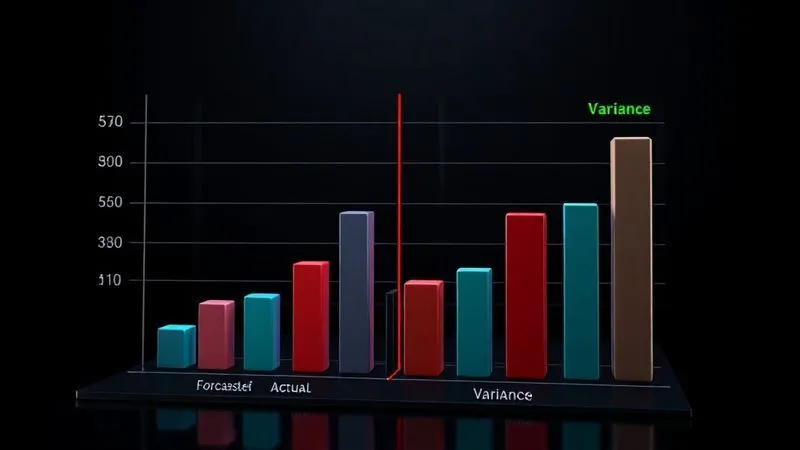
The first and most critical step when facing consistent forecast misses is to move beyond a superficial comparison of 'actual vs. budget.' You need to conduct a forensic variance analysis that dissects the discrepancies at a granular level. In my experience, the devil is always in the details.
Deconstructing Revenue Variances
Don't just look at total revenue. Break it down by product line, customer segment, geographic region, and sales channel. Is the miss concentrated in a specific area? For example, is a new product underperforming, or are existing customer renewals lower than expected? Analyze key drivers like average selling price, sales volume, and customer churn. A drop in volume might indicate market saturation or competitive pressure, while a price drop could point to aggressive discounting.
Unpacking Expense Variances
Similarly, expenses need a detailed review. Are your variable costs (e.g., Cost of Goods Sold) higher than anticipated due to increased material costs or production inefficiencies? Are fixed costs (e.g., rent, salaries) aligned with your forecast, or have there been unexpected increases? Look for trends in discretionary spending and compare actual headcount to planned. Sometimes, a seemingly small overrun in one department can have a significant cumulative impact.
The Role of External Factors
Beyond internal operational aspects, external factors often play a crucial, yet overlooked, role. Consider market shifts, economic downturns, regulatory changes, or even unforeseen events like supply chain disruptions. Was a major competitor's new product launch underestimated? Did a sudden currency fluctuation impact your international sales or purchasing power? Documenting and categorizing these external influences is vital for future forecasting accuracy.
Here's a simplified example of how a detailed variance analysis could look:
| Metric | Forecast | Actual | Variance | Variance % | Key Driver |
|---|---|---|---|---|---|
| Revenue (Product A) | $1,000,000 | $900,000 | -$100,000 | -10% | Lower Sales Volume |
| Revenue (Product B) | $500,000 | $550,000 | +$50,000 | +10% | Higher ASP |
| COGS | $600,000 | $660,000 | +$60,000 | +10% | Increased Material Costs |
| Marketing Spend | $150,000 | $140,000 | -$10,000 | -7% | Delayed Campaign Launch |
By systematically breaking down each variance, you can pinpoint the specific areas where your initial assumptions or operational execution deviated most significantly. This level of detail provides the actionable insights necessary to move forward.
Step 2: Re-evaluating Your Forecasting Model and Assumptions
Once you understand *where* the variances occurred, the next logical step is to question *why* your forecasting model didn't predict them. This involves a critical review of the model's design, its underlying assumptions, and the methodologies employed. Many times, organizations continue to use models that are no longer fit for purpose or are built on outdated premises.
Assessing Model Type and Complexity
Is your current forecasting model appropriate for your business's stage and industry? Are you relying too heavily on historical trends in a volatile market? Or perhaps your model is overly complex, leading to 'analysis paralysis' and errors. Common models include top-down (based on market size), bottom-up (based on individual sales projections), driver-based (linking financial outcomes to operational metrics), or statistical models (time-series analysis). Each has its strengths and weaknesses. For instance, a simple top-down model might suffice for a stable, mature business, but a rapidly growing tech company needs a more dynamic, driver-based approach.
Scrutinizing Underlying Assumptions
This is where many forecasts falter. Every forecast is built on a series of assumptions about the future – market growth rates, pricing strategies, customer acquisition costs, operational efficiencies, inflation, exchange rates, and more. When actuals consistently miss, it's a strong indicator that these assumptions are either unrealistic, not regularly updated, or were never thoroughly validated. I advise challenging every major assumption: "What evidence supports this?" and "What if this assumption is wrong?"
"The accuracy of your forecast is only as good as the realism and relevance of your underlying assumptions. Challenge them, validate them, and update them relentlessly."
For example, if your forecast assumes a 10% market growth, but industry reports from sources like Harvard Business Review indicate a slowdown to 5%, your revenue projections will inevitably be off. Document all assumptions transparently, assign ownership for their validation, and review them quarterly, not just annually. This discipline is crucial for continuous improvement.
Step 3: Enhancing Data Quality and Integration
The adage "Garbage In, Garbage Out" (GIGO) holds particularly true for financial forecasting. Even the most sophisticated models and brilliant analysts will produce flawed forecasts if the underlying data is inaccurate, inconsistent, or incomplete. In my career, I've seen organizations spend millions on advanced forecasting software, only to realize their data infrastructure was the real bottleneck.
Consolidating Data Sources
Many companies operate with data siloed across various systems – CRM for sales, ERP for operations, separate spreadsheets for marketing, and so on. This fragmentation makes it incredibly difficult to get a single, accurate source of truth. The first step is to identify all relevant data sources that feed into your forecast and work towards consolidating them or at least establishing clear integration points. This might involve implementing a robust data warehouse or a business intelligence (BI) platform.
Implementing Data Validation Processes
Once data is consolidated, rigorous validation is essential. This includes checking for: accuracy (are numbers correct?), completeness (are there missing entries?), consistency (do similar data points match across systems?), and timeliness (is the data up-to-date?). Automated data validation rules can be implemented within your systems, flagging discrepancies before they corrupt your forecasts. Regular data audits are also crucial to maintain data integrity.
Leveraging Technology for Real-Time Insights
Modern forecasting demands real-time or near real-time data. Relying on month-old data for a quarterly forecast is a recipe for misses. Invest in technologies that can pull data automatically from your source systems, reducing manual errors and providing the freshest possible inputs. As Deloitte often highlights, advanced analytics and AI can significantly enhance the quality and speed of data processing, enabling more dynamic and responsive forecasting.
Step 4: Fostering Cross-Functional Collaboration and Accountability
Financial forecasting is not, and should never be, solely the responsibility of the finance department. It's a cross-functional exercise that requires input, buy-in, and accountability from every key department. I've observed that a significant reason for consistent misses is a lack of effective collaboration, where departments operate in silos, leading to misaligned expectations and incomplete data.
Establishing Clear Roles and Responsibilities
Every department that influences revenue or expenses – sales, marketing, operations, HR, R&D – must understand their role in the forecasting process. Sales teams provide insights into pipeline and conversion rates; marketing contributes campaign effectiveness and lead generation data; operations offers production capacity and supply chain costs. Clearly define who is responsible for providing what data, by when, and in what format. This clarity eliminates ambiguity and ensures timely, relevant inputs.
Regular Inter-Departmental Review Sessions
Formalized, recurring meetings where finance presents the draft forecast and other departments provide feedback are invaluable. These aren't blame sessions; they are collaborative workshops. For example, if finance forecasts a certain sales volume, the sales director can challenge it based on current market conditions or pipeline strength. Operations can highlight potential bottlenecks. These discussions surface critical assumptions and potential risks that finance might not be privy to.
Incentivizing Accurate Inputs, Not Just Optimistic Ones
A common pitfall is that departments, particularly sales, are incentivized to provide overly optimistic forecasts. While enthusiasm is good, realism is paramount for financial planning. Consider structuring incentives to reward forecasting accuracy, not just hitting ambitious targets. This shifts the focus from 'what do you want to see?' to 'what do you genuinely expect?' and fosters a culture of truthful communication.
Case Study: How InnovateCo Improved Forecasting Accuracy
InnovateCo, a mid-sized software firm, consistently missed its revenue forecasts by 15-20% each quarter. The finance team was frustrated, blaming sales for inflated pipelines. I advised them to implement a structured, cross-functional forecasting committee, meeting bi-weekly. Sales, marketing, product, and operations heads were required to present their current insights and data, challenging the finance team's assumptions and vice-versa. After two quarters, their forecast variance dropped to less than 5%, primarily because sales targets became more realistic, and product development delays were factored in earlier. This resulted in better resource allocation and improved investor confidence.
Step 5: Implementing Dynamic Forecasting and Scenario Planning
In today's volatile business environment, static annual budgets are increasingly becoming relics of the past. To effectively address consistent forecast misses, organizations must adopt more dynamic forecasting methodologies and embrace robust scenario planning. This allows for agility and resilience in the face of change.
Embracing Rolling Forecasts
Instead of a single annual forecast, implement a rolling forecast. This typically involves extending the forecast period by a month or a quarter as each period passes (e.g., a 12-month rolling forecast is updated monthly, always looking 12 months ahead). This keeps the forecast fresh, incorporates the latest actuals and market intelligence, and reduces the 'hockey stick' effect often seen at the end of annual budget cycles. As Forbes often emphasizes, rolling forecasts are crucial for business agility.
Developing Robust Scenario Analysis
The future is uncertain, so relying on a single 'base case' forecast is inherently risky. Develop multiple scenarios: a "Best Case" (optimistic but plausible), a "Worst Case" (pessimistic but plausible), and a "Most Likely" (your base case). For each scenario, articulate the key assumptions and their potential financial impact. This helps leadership understand the range of possible outcomes and prepare contingency plans. What if a key competitor enters your market? What if a new regulation is passed? What if a new product launch exceeds expectations?
Post-Mortem Analysis and Continuous Improvement
After each quarter, conduct a thorough post-mortem analysis. Compare actuals against all your scenarios, not just the base case. What did you get right? What did you get wrong? Why? Document these learnings and integrate them back into your forecasting process. This continuous feedback loop is critical for refining your models, improving your assumptions, and enhancing overall forecasting accuracy over time. It's a journey, not a destination.
Here's an example of how a scenario planning matrix might look:
| Scenario | Revenue | EBITDA | Key Assumptions |
|---|---|---|---|
| Base Case | $10M | $2M | Modest market growth, stable costs |
| Best Case | $12M | $3M | Successful new product launch, lower COGS |
| Worst Case | $8M | $1M | Economic downturn, supply chain disruption |
The Human Element: Overcoming Bias and Building a Culture of Realism
Even with the best models, data, and processes, human biases can significantly skew financial forecasts. As an industry specialist, I've observed that psychological factors often play a subtle yet powerful role in why quarterly actuals consistently miss forecasts. Addressing these biases is as crucial as any technical adjustment.
Identifying and Mitigating Optimism Bias
One of the most pervasive biases is optimism bias, where individuals tend to overestimate positive outcomes and underestimate negative ones. Sales teams might be overly optimistic about pipeline conversions, and project managers might underestimate timelines. To counteract this, encourage a culture of 'challenge and verify.' Implement structured review sessions where assumptions are rigorously debated, and ask individuals to justify their numbers with concrete evidence rather than just gut feelings. Consider using 'pre-mortems' where teams imagine the forecast has failed and work backward to identify potential reasons.
Promoting a 'Learning from Mistakes' Culture
Fear of failure or retribution can lead individuals to hide bad news or present overly rosy projections. This creates a dangerous environment where reality is obscured. Foster a culture where learning from mistakes is celebrated, not punished. When a forecast misses, focus on understanding the 'why' rather than assigning blame. This encourages transparency and honest assessment, which are vital for continuous improvement in forecasting accuracy. As psychological research on forecasting, such as studies cited in academic journals on behavioral finance, consistently shows, cognitive biases are powerful and require deliberate strategies to overcome.
"True forecasting accuracy isn't just about numbers; it's about cultivating a psychological environment where realism trumps optimism and learning is prioritized over blame."
By actively addressing these human elements, you build a foundation of psychological safety and intellectual honesty that empowers your teams to produce more accurate and trustworthy forecasts.
Leveraging Technology and Advanced Analytics for Predictive Power
In today's data-rich world, technology is an indispensable ally in overcoming consistent forecast misses. While processes and people are paramount, the right tools can supercharge your efforts, providing deeper insights and greater predictive power. I've guided numerous companies through technology adoptions that have transformed their financial forecasting capabilities.
Business Intelligence (BI) Tools
Modern BI platforms (like Tableau, Power BI, Qlik Sense) are essential for visualizing your actuals against forecasts, performing detailed variance analysis, and identifying trends. They can integrate data from multiple sources, create interactive dashboards, and allow for drill-down analysis, giving finance and leadership a clear, real-time picture of performance. This moves beyond static spreadsheets to dynamic, actionable insights.
Predictive Analytics and Machine Learning
For organizations ready to push the boundaries, predictive analytics and machine learning (ML) models offer a significant leap forward. These technologies can analyze vast datasets, identify complex patterns and correlations that human analysts might miss, and generate highly accurate forecasts. ML algorithms can learn from past forecast errors, automatically adjusting parameters to improve future predictions. This is particularly powerful for businesses with high volumes of transactional data or complex, non-linear trends. However, remember that these tools are only as good as the data fed into them.
The Evolving Role of the Financial Professional
The rise of these technologies doesn't diminish the role of the financial professional; it elevates it. Instead of spending hours on data aggregation and basic calculations, finance teams can focus on strategic analysis, interpreting model outputs, scenario planning, and providing valuable business insights. This shift transforms finance from a reporting function to a strategic partner, driving growth and profitability. Industry reports from firms like Gartner consistently highlight the increasing importance of data analytics skills for finance leaders.
Frequently Asked Questions (FAQ)
Q: How often should we review and update our financial forecasts? A: For most businesses, a monthly review of a rolling 12-18 month forecast is ideal. This frequency allows you to incorporate recent actuals and market changes without getting bogged down in excessive recalculations. Quarterly deep dives are also crucial for strategic adjustments.
Q: What's the difference between budgeting and forecasting, and why do both matter? A: A budget is a plan for future spending and revenue, typically set annually, representing financial goals and resource allocation. A forecast, on the other hand, is a prediction of what will actually happen, based on current information and trends. While a budget is a target, a forecast is a dynamic estimate. Both are crucial: the budget sets the aspiration, and the forecast helps you navigate towards it, adjusting course as needed.
Q: Can small businesses benefit from sophisticated forecasting techniques, or are they only for large enterprises? A: Absolutely, small businesses can benefit immensely. While they might not need complex ML models, the principles of detailed variance analysis, clear assumptions, cross-functional input, and scenario planning are universally applicable. Even a simple driver-based model in a spreadsheet can provide significant advantages over guessing or relying solely on gut feeling, enabling better cash flow management and growth planning.
Q: How do I get buy-in from other departments for more accurate forecasting? A: Start by demonstrating the 'what's in it for them.' Show how accurate forecasts lead to better resource allocation for their projects, more realistic targets, and reduced last-minute fire drills. Involve them early in the process, make it collaborative, and ensure their input is genuinely valued and visibly incorporated. Frame it as a shared responsibility for collective success, not just a finance mandate.
Q: What if external factors are too unpredictable (e.g., during a pandemic or major economic shift)? How can we forecast effectively then? A: In highly unpredictable environments, the emphasis shifts even more towards dynamic forecasting and robust scenario planning. Focus on shorter-term rolling forecasts (e.g., 3-6 months), increase the frequency of updates, and develop a wider range of scenarios (optimistic, pessimistic, and several in-between). Monitor key leading indicators aggressively and be prepared to pivot quickly. The goal isn't perfect prediction, but intelligent anticipation and rapid adaptation.
Key Takeaways and Final Thoughts
Consistently missing financial forecasts is a clear signal that your financial management processes need an overhaul. It's not merely a numbers problem; it's a strategic impediment that impacts every facet of your business. As an experienced industry specialist, I've seen that addressing this challenge requires a multi-faceted approach – one that integrates meticulous analysis, robust models, high-quality data, collaborative efforts, and a forward-looking mindset.
- Dive Deep into Variances: Don't just note the miss; dissect it by segment, driver, and external factor.
- Critically Assess Your Model: Ensure your forecasting methodology and underlying assumptions are realistic, current, and appropriate for your business.
- Prioritize Data Quality: Invest in clean, integrated, and timely data, as it's the lifeblood of accurate forecasts.
- Foster Cross-Functional Collaboration: Make forecasting a shared responsibility, with clear roles and incentives for accuracy across all departments.
- Embrace Agility: Implement rolling forecasts and comprehensive scenario planning to navigate uncertainty effectively.
- Address Human Biases: Cultivate a culture of realism and continuous learning, rather than optimistic projections or blame.
- Leverage Technology: Utilize BI tools and advanced analytics to enhance insights and predictive capabilities.
By systematically implementing these strategies, you won't just reduce forecast misses; you'll transform your financial planning into a powerful strategic asset. You'll gain greater clarity, make more informed decisions, and build a resilient, agile organization capable of navigating any economic landscape. The journey to forecasting excellence is continuous, but the rewards of improved accuracy and strategic confidence are immeasurable.
Recommended Reading
- Decoding Dilution: Can a Majority Shareholder Legally Dilute Your Shares?
- Supplier Lead Times Double? Your 7-Step Crisis Plan for Inventory
- 7 Proven Steps: Build Resilient Startup Culture Under Intense Pressure
- Viral Complaint Crisis? 7 Steps to Reclaim Your Brand's Reputation
- Boost Productivity: 7 Ways to Stop Wasting Staff Time on Repetitive Tasks





Comments
Leave a comment below. Your email will not be published. Required fields marked with *