


How to Prevent Scope Creep on Fixed-Price Consulting Projects?
For over two decades in the consulting trenches, I've witnessed firsthand how even the most meticulously planned projects can unravel. The culprit? Often, it's the insidious, creeping expansion of requirements—a phenomenon we've all come to know as scope creep. It's a silent killer of profitability, a drain on team morale, and a significant risk to client relationships, especially when you're operating on a fixed-price model.
The pain points are universal: unexpected hours, budget overruns, frustrated consultants, and ultimately, a project that delivers less value than promised, despite all the extra effort. Fixed-price contracts, while offering clients budget certainty, place the entire risk of scope expansion squarely on the consultant's shoulders, making prevention not just good practice, but an absolute necessity for survival and success.
In this definitive guide, I'll draw upon my extensive experience to provide you with a comprehensive framework for tackling scope creep head-on. We'll explore actionable strategies, real-world insights, and practical tools to define boundaries, manage expectations, and protect your project's integrity and your firm's profitability. This isn't just theory; these are the battle-tested methods that have saved countless projects from the brink.
The Unseen Costs of Scope Creep: Why Fixed-Price Projects Are Most Vulnerable
Before we dive into prevention, let's truly understand the adversary. Scope creep isn't just about doing 'a little extra.' On fixed-price projects, every 'little extra' chips away at your profit margin. What starts as a seemingly minor adjustment can quickly snowball into a significant deviation from the original agreement, leading to a host of negative consequences.
The direct financial impact is obvious: unbilled hours, increased resource allocation, and potential delays that prevent you from taking on new work. However, the costs extend far beyond the balance sheet. You face reputational damage if you fail to deliver on time or within the originally perceived scope, even if it's due to client-driven changes. Team morale plummets as consultants are forced to work longer hours, feeling undervalued and overwhelmed. Furthermore, the client relationship can suffer; what began as a partnership can devolve into contention over expectations and deliverables.
"Scope creep is the quiet erosion of project boundaries, a gradual accumulation of changes that, left unchecked, can sink even the most promising fixed-price engagement. It's not always malicious; often, it's born from enthusiasm or evolving understanding, but its impact is undeniably detrimental to profitability and project success."
Understanding this vulnerability is the first step toward building robust defenses. Fixed-price models demand absolute clarity and an unwavering commitment to process, as the financial buffer for unforeseen expansion is minimal or non-existent.
Foundation First: The Art of a Rock-Solid Statement of Work (SOW)
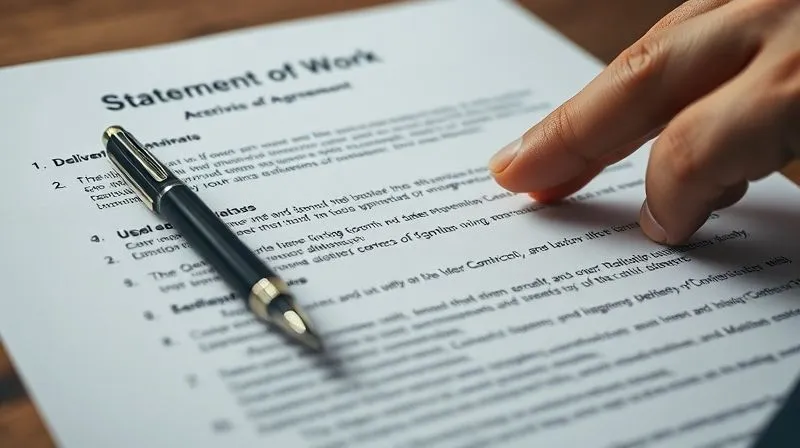
Your Statement of Work (SOW) is not just a document; it's your project's constitution, its blueprint, and its ultimate guardian against scope creep. A poorly defined SOW is an open invitation for misunderstandings and uncontrolled expansion. A robust SOW, however, sets clear boundaries, defines expectations, and provides a reference point for every decision throughout the project lifecycle.
Precision in Deliverables and Milestones
The core of an effective SOW lies in its specificity regarding deliverables and milestones. Generic terms like 'reporting' or 'analysis' are breeding grounds for creep. Instead, define *exactly* what will be delivered, in what format, and when.
- Clearly Itemize Deliverables: List every tangible output. For example, instead of 'marketing strategy,' specify 'A 30-page PDF document outlining target audience profiles, competitive analysis, messaging frameworks, and a 12-month campaign roadmap.'
- Define Milestones with Dates: Break the project into distinct phases, each with a clear completion date and associated deliverables. This creates natural checkpoints for review and sign-off.
- Specify Exclusions: Just as important as defining what's *in* scope is defining what's *out* of scope. Explicitly state services or deliverables that are NOT included in the fixed price.
- Detail Client Responsibilities: Outline what the client needs to provide (e.g., access to data, timely feedback, stakeholder availability) and the impact of delays on their part.
Defining "Done": Clear Acceptance Criteria
How will both parties know when a deliverable is complete and acceptable? This is where acceptance criteria come in. These are measurable, objective standards that a deliverable must meet to be considered 'done' and approved by the client. Without them, project completion becomes subjective, leading to endless revisions and rework.
For instance, if a deliverable is 'website redesign,' acceptance criteria might include 'Website passes all W3C validation tests,' 'All pages load within 3 seconds on standard broadband,' 'Achieves a minimum score of 90 on Google Lighthouse for performance and accessibility,' and 'Client-approved content is accurately implemented.' This leaves no room for ambiguity and provides a clear target for your team and a clear benchmark for the client.
Master Client Expectations: Communication as Your First Line of Defense
Even the best SOW can't prevent scope creep if client expectations aren't managed proactively and consistently. Communication is not just about informing; it's about guiding, educating, and sometimes, gently redirecting. Misaligned expectations are a primary driver of scope creep, often leading clients to believe 'just one more thing' is included.
Setting the Stage: Kick-off Meetings That Work
The project kick-off meeting is your golden opportunity to reinforce the SOW and align all stakeholders. It's more than introductions; it's a strategic session to solidify boundaries.
- Review the SOW Together: Walk through every section, especially deliverables, exclusions, and acceptance criteria. Encourage questions and ensure everyone has a shared understanding.
- Define Roles and Responsibilities: Clearly state who is responsible for what, both on your team and the client's. Identify key decision-makers and communication channels.
- Establish Communication Protocols: Agree on how and when communication will occur (e.g., weekly status reports, bi-weekly calls, email for urgent matters).
- Discuss the Change Request Process: Explicitly explain how changes outside the SOW will be handled, even before they arise. This normalizes the process and removes potential awkwardness later.
Regular Check-ins and Progress Reporting
Consistent, transparent communication throughout the project keeps everyone on the same page and helps to identify potential scope deviations early. According to a Deloitte study on trust in organizations, transparency is a cornerstone of strong client relationships, which indirectly helps in managing project scope.
My advice is to establish a rhythm for status updates. These aren't just for reporting progress; they're opportunities to reiterate the current scope, highlight achievements *within* that scope, and gently push back on new requests. Visual aids, like dashboards or brief presentations, can be incredibly effective in showing what has been accomplished relative to the agreed-upon plan.
| Meeting Type | Attendees | Duration | Purpose |
|---|---|---|---|
| Weekly Stand-up | Core Project Team | 15 min | Quick sync, blockers, next steps |
| Bi-weekly Client Review | Client Stakeholders, Project Leads | 60 min | Progress update, review deliverables, SOW adherence, Q&A |
| Monthly Steering Committee | Executive Sponsors | 30 min | High-level status, strategic alignment, risk review |
The Ironclad Change Request Process: Your Profit Protector
Despite your best efforts, changes will happen. Client needs evolve, market conditions shift, or new opportunities emerge. The key is to manage these changes proactively and formally, rather than letting them organically expand your fixed-price commitment. A robust change request (CR) process is not an impediment to collaboration; it's a mechanism for maintaining project integrity and ensuring fair compensation for additional work.
Documenting Deviations: No Verbal Agreements
The cardinal rule of change management is simple: if it's not in writing, it doesn't exist. Verbal agreements are the bane of fixed-price projects. Every request for additional work, no matter how minor it seems, must be formally documented.
Your process should clearly outline:
- Initiation: How a change request is submitted (e.g., a specific form, an email to a designated person).
- Description: A clear, detailed explanation of the proposed change, including its objectives and desired outcome.
- Impact Analysis: Your team's assessment of how the change will affect the project's scope, timeline, budget, and resources.
- Recommendation: Your proposed solution, including any revised deliverables, new costs, and adjusted timelines.
- Approval: A formal sign-off from the client, acknowledging the new terms.
Pricing and Approving Changes: A Fair Exchange
Once a change is identified and its impact assessed, it's crucial to price it fairly and transparently. This is where your expertise truly shines. Don't be afraid to charge for additional work; you're providing value beyond the initial agreement.
Mini Case Study: How Tech Solutions Ltd. Saved a Project
Case Study: Tech Solutions Ltd. Preserves Profitability
Tech Solutions Ltd., a software consulting firm, was on a fixed-price contract to develop a new CRM integration for a manufacturing client. Midway through the project, the client's sales team requested a complex, AI-driven predictive analytics module that was clearly outside the original SOW. Instead of just absorbing the work, Tech Solutions immediately initiated their CR process. They presented a detailed impact analysis, outlining the additional 200 development hours, specialized data science resources needed, and a 6-week timeline extension. They provided a separate, fixed-price quote for this new module. The client, understanding the value and the formal process, approved the change order. This resulted in an additional 30% revenue for Tech Solutions and a delighted client who received exactly what they needed, all while maintaining the integrity and profitability of the original project.
"A robust change request process isn't a barrier; it's a service. It empowers clients to make informed decisions about their evolving needs and ensures consultants are fairly compensated for the additional value they provide. Embrace it as a tool for collaboration, not confrontation."
Risk Management & Contingency Planning: Anticipating the Unforeseen
An experienced consultant doesn't just react to scope creep; they anticipate it. Risk management and contingency planning are about identifying potential triggers for scope expansion before they manifest and building safeguards into your project and pricing model. This proactive approach significantly reduces the likelihood of being caught off guard.
Identifying Potential Scope Expansion Triggers
Through years of experience, I've identified several common triggers for scope creep:
- Vague Requirements: As discussed, a lack of specificity in the SOW is a prime culprit.
- Stakeholder Turnover: New client personnel often bring new ideas or misunderstand previous agreements.
- Evolving Business Needs: The client's internal or external environment changes, leading to new priorities.
- Technology Shifts: New tools or platforms emerge during the project, creating a desire for integration.
- Lack of Client Engagement/Responsiveness: Delays in feedback can lead to assumptions or rework, indirectly expanding scope.
- "Gold Plating": The client (or even your team, inadvertently) adding features beyond what's necessary or agreed upon.
By conducting a thorough risk assessment during the proposal phase, you can identify which of these are most likely for a given client or project type. Document these risks and discuss them transparently with the client, outlining how they will be managed if they occur.
Building Contingency into Your Fixed Price
While the SOW defines the fixed scope, a smart fixed-price proposal includes a contingency buffer. This isn't for *known* additional work, but for the *unforeseen* minor adjustments or issues that inevitably arise and don't warrant a full change request. This buffer typically ranges from 5-15% of the project's estimated cost, depending on the project's complexity and the client's clarity. As the Project Management Institute (PMI) emphasizes, effective risk management includes planning for both identified and unidentified risks.
Be careful how you communicate this. It's not about padding the price; it's about acknowledging the inherent uncertainties in complex projects and ensuring the project's success. This contingency can absorb minor scope tweaks without impacting profitability or requiring a formal CR for every tiny change, reserving the CR process for substantial deviations.

Empowering Your Team: Training and Tools for Scope Vigilance
Your SOW and processes are only as strong as the team implementing them. Every consultant on your fixed-price project needs to be a vigilant guardian of the scope. This requires specific training, clear guidelines, and the right tools to support their efforts.
Training for Scope Management
Don't assume your team instinctively understands scope management on fixed-price projects. Provide targeted training that covers:
- The 'Why': Explain the financial and relational impact of scope creep on the firm and the project.
- SOW Deep Dive: Ensure every team member understands the SOW inside and out, especially their specific deliverables and boundaries.
- Identifying Scope Creep: Train them on how to recognize subtle signs of scope creep – a casual client request, a 'quick favor,' or a new idea presented in a meeting.
- The Change Request Process: Walk them through the exact steps for initiating a CR, including who to inform internally and what documentation is required.
- Communication Skills: Role-play scenarios on how to gently push back on out-of-scope requests or how to guide a client toward the formal CR process without causing friction.
Leveraging Project Management Tools
Technology can be a powerful ally in scope management. Utilize project management software to:
- Track Deliverables: Use tools like Asana, Jira, or Monday.com to list all agreed-upon deliverables and link them directly to SOW clauses.
- Monitor Progress: Visually track tasks and milestones against the original plan. This makes it easy to spot deviations or delays.
- Document Communications: Keep a centralized record of all client communications, decisions, and approvals.
- Manage Change Requests: Some tools have built-in features for formal change requests, or you can create a custom workflow to ensure they follow your established process.
Regularly reviewing these tools with your team reinforces the importance of scope adherence and provides a clear, objective view of project status.
The Art of Saying "No" (Gracefully): Maintaining Professional Boundaries
Perhaps the most challenging, yet crucial, skill in preventing scope creep is the ability to say 'no' to a client's out-of-scope request. This doesn't mean being unhelpful or rigid; it means maintaining professional boundaries with grace and strategic communication. As Harvard Business Review advises, saying no effectively is a critical skill for leaders and professionals alike.
Strategies for Gentle Refusal
When faced with a request that falls outside the SOW, avoid an immediate, blunt refusal. Instead, employ these strategies:
- Acknowledge and Validate: Start by acknowledging the client's idea or need. "That's an interesting idea, and I can see why you'd want that functionality."
- Refer to the SOW: Gently remind them of the agreed-upon scope. "As per our Statement of Work, the current phase focuses on [original scope]."
- Explain the Impact: Briefly articulate why the request is out of scope and its potential impact. "Adding that now would require significant additional development time and resource allocation, impacting our current timeline and budget for the agreed deliverables."
- Offer Alternatives/The Change Request Process: Pivot to a solution. "We can certainly explore that as a separate enhancement, and I'd be happy to prepare a change request for your review. This would outline the new scope, timeline, and associated costs."
- Prioritize: Sometimes, a client needs help prioritizing. "Would you prefer we pause work on [current deliverable] to focus on this new request, understanding it would extend the project timeline and incur additional costs?"
"Saying 'no' to an out-of-scope request isn't saying 'no' to the client. It's saying 'yes' to the project's integrity, 'yes' to your team's well-being, and ultimately, 'yes' to the long-term success of the client relationship built on clear expectations and fair value exchange."
The goal is to educate the client, not to confront them. Frame the change request process as a way to ensure their new needs are met properly, rather than a bureaucratic hurdle.

Post-Project Review: Learning from Every Engagement
The journey to mastering scope creep prevention doesn't end when a project concludes. Each engagement, whether perfectly executed or fraught with challenges, offers invaluable lessons. A structured post-project review process is critical for continuous improvement, allowing you to refine your strategies and strengthen your defenses against future scope creep.
Identifying Scope Creep Patterns
During your post-mortem analysis, specifically look for patterns related to scope creep:
- Common Triggers: Were there specific types of client requests or internal assumptions that repeatedly led to scope expansion?
- Client Profiles: Did certain client personalities or organizational structures tend to generate more creep?
- SOW Weaknesses: Were there ambiguities in your SOW templates that were exploited or misunderstood?
- Process Gaps: Did your change request process falter at any point? Was it too slow, too cumbersome, or not consistently enforced?
- Team Preparedness: Were team members equipped to identify and address scope creep effectively?
Analyzing these patterns helps you move from reactive problem-solving to proactive prevention across your entire consulting practice.
Refining Your Processes
Based on your findings, make concrete adjustments to your internal processes and documentation. This might include:
- Updating SOW Templates: Adding new clauses, more specific language, or clearer exclusion statements.
- Enhancing Training Modules: Incorporating new case studies or role-playing exercises based on real-world project experiences.
- Streamlining the CR Process: Making it more efficient, or providing better tools for impact analysis and pricing.
- Developing Client Education Materials: Creating simple guides for clients on how your firm manages project scope and changes.
This iterative refinement is the hallmark of a truly experienced consulting firm. It transforms every challenge into an opportunity for growth and stronger project governance.
| Category | Lesson Learned | Action Item |
|---|---|---|
| SOW Clarity | Ambiguous phrasing on 'reporting metrics' led to 15 extra hours. | Add template clause: 'All reporting metrics must be pre-defined and approved in Appendix A.' |
| Client Communication | Client requested new feature verbally, wasn't documented. | Mandatory email confirmation for all client requests, even minor ones, outlining CR process. |
Frequently Asked Questions (FAQ)
What's the biggest mistake consultants make regarding scope creep on fixed-price projects? The most common and damaging mistake is assuming minor changes will just 'even out' or that absorbing them will make the client happier. This sets a dangerous precedent, erodes profitability, and fundamentally undermines the fixed-price agreement. Every change, no matter how small, has a cost and must be acknowledged, if not formally charged for, then at least tracked against a contingency.
How do I handle a client who insists on changes without paying? This requires firmness and diplomacy. Reiterate the SOW and the agreed-upon scope. Explain the impact of the requested change on the project's timeline, resources, and your ability to deliver the original scope successfully. Present the change request as a necessary mechanism to ensure the *new* requirement is met with the same quality and professionalism. If they still refuse, you may need to escalate, reminding them of the contractual agreement and outlining the consequences of not adhering to it, potentially including pausing work until a resolution is reached.
Is it ever okay to absorb minor scope changes? While I advocate for strict adherence to the CR process, sometimes very minor, almost negligible changes can be absorbed if they genuinely require minimal effort and you have a contingency built into your pricing. However, this should be an exception, not the rule, and must be a conscious decision, not an unconscious drift. Always document internally that the change occurred and was absorbed, noting its estimated cost. This helps in post-project reviews.
How do I re-negotiate a fixed-price contract already in progress due to unforeseen external factors? This is a delicate situation. First, meticulously document the unforeseen external factors and their undeniable impact on the project's viability under the original terms. Present this data to the client, focusing on the factual impact, not blame. Propose a revised SOW and pricing model, perhaps converting to a time-and-materials model for the remaining work, or a new fixed price for a redefined scope. Transparency and a focus on mutual success are key.
What tools are best for tracking scope and managing changes? For overall project management, tools like Jira, Asana, Monday.com, or Trello are excellent for tracking tasks and deliverables. For formal change requests, many project management platforms have modules, or you can use dedicated CRM/project management tools with custom workflows. For documentation, a shared drive with version control (e.g., Google Drive, SharePoint) is crucial. The 'best' tool is ultimately the one your team consistently uses and that integrates well with your existing processes.
Key Takeaways and Final Thoughts
Preventing scope creep on fixed-price consulting projects isn't just about protecting your bottom line; it's about fostering trust, delivering predictable outcomes, and ensuring the long-term health of your consulting practice. It demands vigilance, clear communication, and a robust process-driven approach. It's a continuous journey of learning and refinement.
- Invest in a precise SOW: It's your foundational defense.
- Master client expectations: Proactive communication avoids misunderstandings.
- Implement an ironclad CR process: Value changes fairly and formally.
- Anticipate risks: Plan for the unforeseen with contingencies.
- Empower your team: Train them to be scope guardians.
- Learn to say 'no' gracefully: Protect project integrity with diplomacy.
- Conduct post-project reviews: Continuously refine your approach.
By integrating these strategies into your consulting DNA, you won't just prevent scope creep; you'll elevate your project delivery, enhance client satisfaction, and secure your firm's profitability for years to come. Embrace these principles, and watch your fixed-price projects transform from high-risk ventures into predictable, successful partnerships.
Recommended Reading
- 5 Essential Strategies: What to Do When Sales Deals Stall at Negotiation?
- 7 Proven Steps: Boost Remote Staff Mental Health Measurably
- Flexible Remote Hours: 7 Ways to Measure Productivity Effectively
- Best Payment Gateway for Small Ecommerce Business: Top Choices
- 7 Steps: How to Identify Profitable Niches for Your New Business?





Comments
Leave a comment below. Your email will not be published. Required fields marked with *