


How to Revise a Pitch Deck After Multiple Investor Rejections?
For over 15 years in the entrepreneurship and venture capital space, I've witnessed firsthand the emotional rollercoaster that comes with seeking investment. One of the most common pitfalls, and paradoxically, one of the greatest opportunities for growth, arises when promising startups face repeated investor rejections.
It’s a crushing blow, I know. You've poured your heart and soul into your vision, meticulously crafted your pitch deck, and yet, the 'nos' keep coming. This isn't just about a document; it's about your dream, your team, and your future.
In this definitive guide, I will share an expert-backed, systematic framework on how to revise a pitch deck after multiple investor rejections. We’ll move beyond superficial tweaks to implement profound changes that resonate with investors, transforming setbacks into stepping stones toward successful funding.
1. Embracing the 'No': The Art of Deep Feedback Analysis
The Psychological Hurdle and Its Overcome
The first step in knowing how to revise a pitch deck after multiple investor rejections isn't about the slides themselves; it's about your mindset. Rejection often triggers defensiveness or despair, but as an experienced entrepreneur, I've learned to view every 'no' as data, not a personal failing. Each rejection carries a kernel of truth that, if properly extracted, can illuminate the path forward.
It takes courage to ask for candid feedback, and even more to truly listen to it. Overcome the ego trap by reframing feedback as a gift – a free consultation from experienced professionals who’ve seen hundreds, if not thousands, of pitches.
Systematizing Investor Feedback
Vague rejections like "it's not a fit" are unhelpful. Your goal is to gently probe for specifics. Was it the market size? The team? The financials? The ask? Don’t be afraid to follow up politely with specific questions.
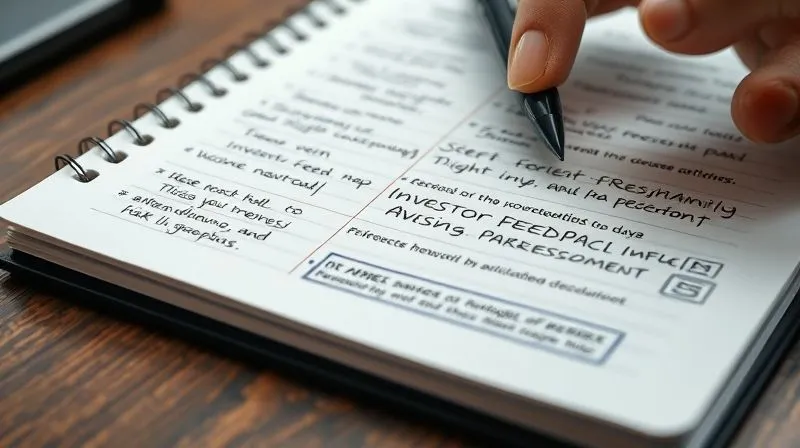
Once you gather feedback, you need a system to process it effectively. I recommend creating a simple spreadsheet to track common themes and specific comments across all your investor conversations. This allows you to spot patterns that individual rejections might obscure.
- Categorize Feedback: Group comments by pitch deck section (e.g., Problem, Solution, Market, Team, Financials, Ask).
- Identify Recurrent Themes: Note down issues that come up repeatedly. These are your highest-priority areas for revision.
- Distinguish Actionable from Subjective: Some feedback is subjective ('I don't like the color scheme'), while other feedback is actionable ('Your CAC projection seems unrealistic'). Focus on the actionable.
- Prioritize Based on Impact: Address the feedback that, if resolved, would most significantly strengthen your core investment thesis.
- Don't Over-Optimize for One Investor: While individual feedback is valuable, avoid tailoring your entire deck to one specific investor's preference if it contradicts general best practices or other feedback.
2. Re-Evaluating Your Core Story: Is Your 'Why' Compelling Enough?
The Problem-Solution-Impact Narrative
Many founders dive straight into their product's features without first establishing a compelling narrative. Investors aren't just buying into a product; they're buying into a vision that solves a significant problem for a large market. Your story must be crystal clear: what problem are you solving, how does your solution uniquely address it, and what is the profound impact of that solution?
If investors aren't connecting, it's often because the 'why' isn't clear or emotionally resonant. I've found that a strong story can often overcome minor imperfections in other areas of the pitch.
Clarity, Conciseness, and Conviction
Your story should be simple enough for a layperson to understand, yet robust enough to impress an expert. Eliminate jargon, complex diagrams that require explanation, and anything that distracts from your core message. Think of it as a movie trailer: it needs to be exciting, informative, and leave the audience wanting more, all in a very short timeframe.
Conviction isn't just about enthusiasm; it's about deep understanding and belief in your mission. If you're not entirely convinced by your own story, how can you expect an investor to be?
Key Insight: Your pitch isn't just about what you do; it's about why it matters and who it matters to. If you can't articulate that in 30 seconds, you haven't refined it enough.
3. Data-Driven Decisions: Letting Numbers Guide Your Narrative
Beyond Vanity Metrics: What Investors REALLY Want to See
One of the most common reasons I've seen pitch decks fail after multiple investor rejections is a misalignment or weakness in the financial and traction slides. Investors are looking for proof points, not just promises. This means showcasing key performance indicators (KPIs) that demonstrate genuine growth, product-market fit, and a clear path to profitability.
Move beyond vanity metrics like total downloads or social media followers. Investors want to see metrics that directly relate to revenue, user engagement, retention, and defensibility. According to a Harvard Business Review article on building a great pitch, demonstrating a clear understanding of your unit economics is paramount.
Projecting Realistic, Yet Ambitious, Financials
Your financial projections must be grounded in reality, but also reflect an ambitious vision. Investors are looking for a significant return on their investment, so simply breaking even isn't enough. However, overly aggressive or unsubstantiated projections will instantly raise red flags. Show your assumptions, and be prepared to defend them rigorously.
Consider scenarios – best case, worst case, and most likely case. This demonstrates foresight and a solid grasp of your business model's variables. Focus on the key drivers of your growth and how your funding will accelerate those.
| Metric | Before Revision | After Revision Focus |
|---|---|---|
| Customer Acquisition Cost (CAC) | $150 | $100 (with improved funnel) |
| Lifetime Value (LTV) | $450 | $600 (with retention strategy) |
| Monthly Recurring Revenue (MRR) | $50k | $80k (with new pricing model) |
| Burn Rate | $20k/month | $15k/month (optimized operations) |
4. Strengthening Your Team Slide: The Untapped Potential
Beyond Bios: Highlighting Synergy and Gaps
Investors invest in people as much as, if not more than, ideas. Your team slide is not just a collection of résumés; it’s an opportunity to showcase why *this* specific group of individuals is uniquely positioned to execute your vision. I've often seen founders underestimate the power of this slide.
Highlight relevant experience, past successes, and complementary skill sets. Instead of just listing titles, explain the unique value each team member brings to the table and how their combined expertise creates an unstoppable force. Emphasize any 'founder-market fit' – why your team intrinsically understands the problem you're solving.
Addressing Concerns About Missing Expertise
Sometimes, rejections stem from perceived gaps in the team. Perhaps you lack a strong technical co-founder, or an experienced sales leader. Don't hide these gaps. Instead, proactively address them.
Show how you plan to fill these roles (e.g., "actively recruiting a VP of Sales with 10+ years experience," or "advisory board includes industry veteran X"). This demonstrates self-awareness and a strategic approach to building out a complete team. It's about demonstrating you know what you don't know, and have a plan for it.

5. Market Opportunity: Proving Your Niche is a Goldmine
Beyond TAM, SAM, SOM: The 'Why Now?' Factor
While Total Addressable Market (TAM), Serviceable Available Market (SAM), and Serviceable Obtainable Market (SOM) are crucial, investors also want to understand the 'why now?' factor. Why is this the perfect time for your solution to enter the market? Is there a recent technological shift, a regulatory change, or an emerging consumer trend that creates an urgent need for what you offer?
As marketing guru Seth Godin often says, "The market chooses you." You need to articulate why your market is ripe for disruption and why your solution is perfectly timed to capture it. This demonstrates a strategic understanding beyond just raw numbers.
Competitive Landscape: Differentiating Beyond Features
Many pitch decks present competitors as a list, often downplaying their strengths. This is a mistake. Investors know your competitors exist and are often well-funded. Acknowledge them, show you understand their strengths and weaknesses, and then clearly articulate your defensible competitive advantage. As Forbes highlights, differentiation is key.
Is it your proprietary technology? A unique business model? A superior user experience? A deep understanding of an underserved niche? Your differentiation should be clear, compelling, and difficult for others to replicate. Don't just list features; explain how those features create a superior value proposition that solves the customer's problem better than anyone else.
6. The Ask and Use of Funds: Precision and Transparency
Defining Your Funding Needs Clearly
A common critique I hear from investors is a vague or overly ambitious 'ask.' When you're learning how to revise a pitch deck after multiple investor rejections, one critical area is your funding request. You need to be crystal clear about how much money you are seeking and, more importantly, *why* that specific amount is necessary. Avoid generic statements.
The ask should be tied directly to achieving specific, measurable milestones that significantly de-risk the investment and increase the company's valuation for the next round. This demonstrates financial discipline and strategic planning.
Transparent Allocation for Milestones
Investors want to see a detailed breakdown of how their money will be spent. This isn't just about showing a budget; it's about building trust and demonstrating that you have a clear roadmap for growth. Link each dollar to a specific outcome.
- Break Down by Category: Allocate funds across key areas like product development, marketing & sales, team expansion, and operational expenses.
- Tie to Milestones: For each category, explain what specific milestones this funding will enable you to achieve (e.g., "$X for product development to launch V2.0 and achieve 10k paying users").
- Show Runway: Clearly articulate how long this funding will last (your 'runway') and what you expect to achieve by the end of that period.
- Future Rounds: Briefly touch on how this round sets you up for future funding, indicating a long-term vision.
7. Mastering the Delivery: Beyond the Slides
Practice, Personalization, and Presence
Even the most perfectly revised pitch deck can fall flat without a strong delivery. I've seen countless founders with brilliant ideas stumble at this final hurdle. Practice is paramount, but it shouldn't sound rehearsed. You want to appear confident, knowledgeable, and passionate.
Personalize your pitch for each investor group. Research their portfolio, their investment thesis, and their specific interests. This shows you've done your homework and value their time. During the pitch, maintain eye contact, use confident body language, and project your voice. Your presence in the room is as important as the content on your slides.
Anticipating Questions and Crafting Responses
The Q&A session is where many deals are won or lost. Investors will probe your assumptions, test your knowledge, and look for weaknesses. As CB Insights frequently points out, unprepared answers can be deal-breakers. Anticipate the tough questions related to your market, competitors, financials, and team.
Prepare concise, data-backed answers. If you don't know an answer, be honest and offer to follow up. This shows integrity. Acknowledge concerns, but always pivot back to your strengths and strategic plan. Remember, the goal is to leave them with confidence in you and your venture.
Case Study: Pivotly's Funding Breakthrough
Pivotly, an AI-driven analytics startup, faced three consecutive rejections despite a solid product. Their issue wasn't the product itself, but their pitch deck's narrative and their delivery. After receiving feedback that their story was too technical and their team slide generic, they embarked on a rigorous revision process. They restructured their deck to lead with the compelling problem they solved for SMBs, simplified their technical explanations with clear analogies, and critically, revamped their team slide to highlight each co-founder's specific, complementary expertise and prior successes relevant to scaling. They also conducted mock pitches with mentors, focusing on engaging storytelling and anticipating tough questions. Their revised approach led to a successful seed round of $1.5M within two months, proving that a refined narrative and confident delivery can turn rejections into opportunities.

Frequently Asked Questions (FAQ)
Q: How do I get investors to give me specific feedback instead of vague rejections? A: After a rejection, politely send a follow-up email expressing gratitude for their time and asking if they could spare 10-15 minutes for a quick call to provide specific feedback. Frame it as a learning opportunity for you. Be specific in your request: "Was there a particular area – market, team, financials – that raised the most concerns?" Most investors, if approached respectfully, will offer some insights.
Q: Should I completely redesign my pitch deck, or just make minor edits? A: The extent of revision depends on the feedback themes. If the core narrative, market opportunity, or team composition are consistently questioned, a significant overhaul might be necessary. If feedback is primarily about clarity of certain slides or financial projections, then targeted edits are sufficient. Use the systematic feedback analysis to guide this decision; don't just guess.
Q: How many times can I re-pitch the same investor with a revised deck? A: Generally, you get one good shot. However, if an investor expressed genuine interest but had specific, solvable concerns, and you've made significant, demonstrable progress on those concerns, a carefully timed re-pitch can be appropriate. Make sure you highlight exactly what has changed based on their previous feedback. Don't re-pitch without substantial revisions and a clear reason for doing so.
Q: What if I don't have impressive traction or revenue yet? How do I still make my pitch compelling? A: If early-stage, focus heavily on the problem's magnitude, your unique solution, the 'why now' market timing, and especially your team's expertise and ability to execute. Highlight any pre-seed validation, such as letters of intent, pilot program successes, or strong user engagement data, even if revenue is low. The emphasis shifts from current traction to future potential and team capability.
Q: Is it better to have a longer, more detailed deck or a shorter, high-level one? A: For an initial investor meeting, a concise (10-15 slides) deck focusing on the highlights is usually best. This serves as a conversation starter. Have an appendix ready with deeper dives into financials, market research, or technical details for when an investor requests more information. The goal is to pique interest, not overwhelm them, in the first contact.
Key Takeaways and Final Thoughts
- Embrace Feedback: See rejections as valuable data points, not personal failures. Systematize feedback analysis.
- Refine Your Story: Ensure your problem, solution, and impact narrative is clear, concise, and compelling.
- Strengthen Data: Focus on meaningful KPIs and realistic, yet ambitious, financial projections.
- Showcase Your Team: Highlight complementary skills and address any perceived gaps proactively.
- Prove Market Opportunity: Articulate the 'why now' factor and differentiate clearly from competitors.
- Clarify Your Ask: Be precise about funding needs and transparent about how funds will achieve specific milestones.
- Master Delivery: Practice, personalize, and project confidence; anticipate and prepare for tough questions.
Learning how to revise a pitch deck after multiple investor rejections is a rite of passage for many entrepreneurs. It’s a testament to your resilience and adaptability. Remember, every 'no' brings you closer to the 'yes' that truly understands and believes in your vision. Take these insights, apply them diligently, and prepare to turn those past rejections into a powerful narrative of growth and eventual success. Your next pitch could be the one that changes everything.
Recommended Reading
- 7 Proven Strategies: How to Prevent Customer Churn When CRM Data Shows High Risk?
- Uncover Your Goldmine: 7 Steps to Profitable B2B Segments from Data
- 7 Proven Ways to Cut Google Ads CPA Without Losing Lead Quality
- The Ultimate Guide: Navigating Cross-Border E-commerce Tax Implications
- The Untold Impact: How Reshoring is Reshaping Global Supply Chains





Comments
Leave a comment below. Your email will not be published. Required fields marked with *