

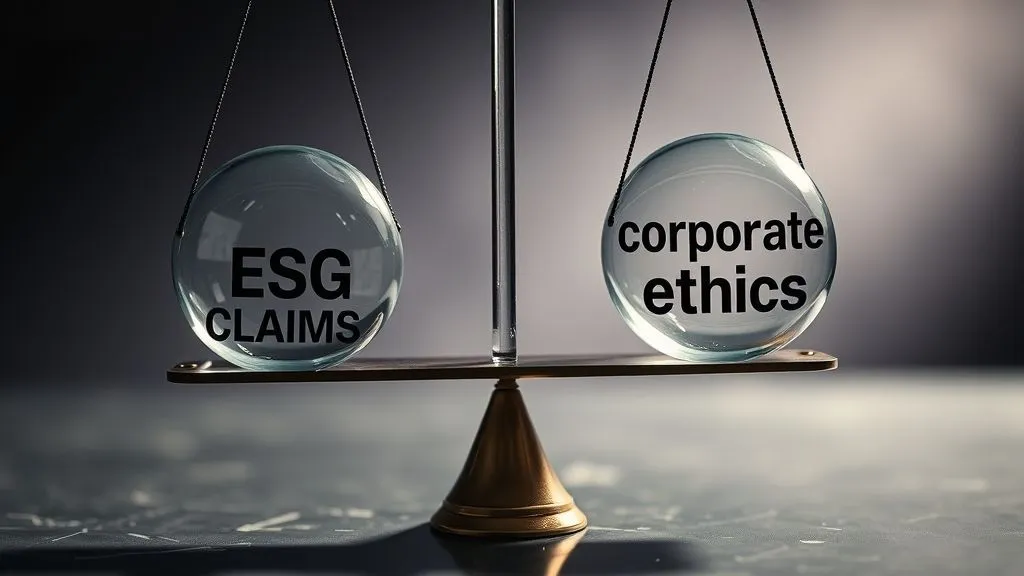
What to do when ESG claims face corporate ethics scrutiny?
For over two decades navigating the complex currents of corporate social responsibility and ethics, I've observed a profound evolution. What was once seen as a 'nice-to-have' has transformed into a fundamental pillar of corporate strategy: Environmental, Social, and Governance (ESG). Yet, this very prominence has brought an unwelcome companion: intense scrutiny. The spotlight on corporate sustainability is brighter than ever, and with it, the pressure to prove genuine commitment.
Today, companies are increasingly vulnerable to accusations of 'greenwashing' or 'ethics-washing,' where bold ESG claims don't align with actual practices. When these claims face corporate ethics scrutiny, the fallout can be devastating – eroding stakeholder trust, damaging reputation, and impacting financial stability. The challenge isn't just about having ESG initiatives; it's about proving their authenticity and ethical foundation, ensuring every statement stands up to rigorous examination.
This isn't merely a theoretical exercise; it's a critical business imperative. In this definitive guide, I'll share a battle-tested framework, drawn from years of experience, to help you understand precisely what to do when ESG claims face corporate ethics scrutiny. We'll delve into actionable steps, robust verification methods, and communication strategies to not only defend your integrity but to genuinely embed ethics at the heart of your ESG journey.
The Unseen Risks: Why ESG Claims Are Under More Scrutiny Than Ever
The landscape of corporate responsibility has shifted dramatically. Stakeholders, from investors to consumers, employees, and regulators, are no longer content with vague promises. They demand verifiable evidence and genuine impact. This heightened awareness, fueled by social media and investigative journalism, means that any perceived discrepancy between a company's ESG rhetoric and its reality can ignite a firestorm.
I've seen firsthand how a single misstep or an unsubstantiated claim can unravel years of careful brand building. The risks extend beyond reputational damage; they include significant financial penalties, investor divestment, talent drain, and even legal action. The era of 'check-the-box' ESG is over. We are in an age where authenticity is paramount, and skepticism is the default.
Key Drivers of Increased ESG Scrutiny:
- Investor Activism: Institutional investors are increasingly using ESG performance as a key metric for investment decisions and are quick to challenge companies on their commitments.
- Consumer Demand: Ethical consumerism is on the rise, with customers actively seeking brands that align with their values and punishing those perceived as disingenuous.
- Regulatory Pressure: Governments worldwide are introducing stricter regulations around ESG reporting and disclosure, increasing accountability and potential penalties.
- Employee Expectations: Top talent is drawn to organizations with strong ethical foundations and genuine social impact, making ESG integrity a critical factor in recruitment and retention.
- Media & NGO Oversight: Watchdog organizations and the media are more adept than ever at uncovering inconsistencies and holding corporations accountable.
“In the age of transparency, authenticity is your strongest currency. Any gap between what you say and what you do will be exposed, and the cost of that exposure is far greater than the cost of genuine action.” – An Experienced Industry Specialist
Step 1: Conduct an Immediate, Impartial Internal Audit
When ESG claims face corporate ethics scrutiny, your first, most crucial step is to objectively assess the situation. Panic is not a strategy. Instead, initiate an immediate, impartial internal audit of all questioned ESG claims and related operations. This isn't about finding blame; it's about understanding the truth, however uncomfortable it may be. You need a clear, unvarnished picture of where your claims stand against your actual performance.
In my experience, many companies discover that inconsistencies aren't always malicious but often stem from siloed data, poor internal communication, or an overzealous marketing department. An effective internal audit will cut through these issues, providing the factual basis for your response. It's about gathering undeniable evidence, both supporting and refuting your current claims, to inform a credible path forward.
Key Audit Areas to Focus On:
- Data Verification: Scrutinize all data supporting your ESG claims. Is it accurate, complete, and consistently collected? Trace data points back to their source.
- Policy vs. Practice: Compare stated ESG policies and commitments with actual operational practices. Are your actions truly aligned with your intentions?
- Supply Chain Review: Extend your audit to key suppliers and partners. Are their practices consistent with your ethical standards and ESG commitments?
- Stakeholder Feedback Analysis: Review any past feedback, complaints, or concerns from employees, customers, or community groups related to your ESG performance.
- Documentation & Reporting: Assess the robustness of your internal documentation and external reporting processes. Are they transparent, auditable, and easily understood?

Step 2: Embrace Radical Transparency and Open Communication
Once you have the audit results, the natural inclination might be to downplay or deflect. Resist this urge. When your ESG claims face corporate ethics scrutiny, silence or evasiveness is a death knell for trust. Instead, embrace radical transparency. This means openly acknowledging the scrutiny, sharing your findings (even the uncomfortable ones), and outlining your plan for remediation.
I've guided numerous organizations through crises, and the ones that emerge stronger are always those that communicate openly and honestly, taking responsibility where due. This doesn't mean admitting guilt where there is none, but rather demonstrating a genuine commitment to ethical conduct and continuous improvement. Your communication strategy must be proactive, consistent, and empathetic.
Crafting Your Communication Strategy:
- Be Timely: Address the scrutiny promptly. Delays can be interpreted as evasion or indifference.
- Be Honest & Factual: Stick to the facts uncovered by your audit. Avoid jargon or corporate speak.
- Take Responsibility: If mistakes were made, own them. Apologize sincerely if appropriate, and articulate clear corrective actions.
- Outline Corrective Actions: Don't just admit the problem; explain what you are doing to fix it, with timelines and measurable goals.
- Engage Key Stakeholders: Tailor your message for different audiences – investors, employees, customers, regulators, and the public.
- Designate a Spokesperson: Ensure a credible, knowledgeable, and empathetic individual is the public face of your response.
According to a Harvard Business Review article on transparency, organizations that are open about their challenges often build deeper trust with stakeholders, as it demonstrates integrity and a commitment to learning and improvement. This principle is never more critical than when your ethical standing is questioned.
Step 3: Verify and Validate Your ESG Data with Independent Third Parties
Internal audits are essential, but in an environment of skepticism, they may not be enough to fully restore trust. When ESG claims face corporate ethics scrutiny, bringing in an independent third-party verifier adds a crucial layer of credibility and objectivity. This external validation signals to stakeholders that you are serious about your commitments and willing to subject your data and practices to unbiased expert review.
From my vantage point, the investment in third-party verification pays dividends by bolstering your reputation and providing assurances that internal assessments simply cannot. It transforms your ESG narrative from 'we say we are' to 'independent experts confirm we are,' which is a powerful distinction in today's climate.
Choosing the Right Verification Partner:
- Expertise: Select a firm with deep experience in your industry and specific ESG domains (e.g., carbon accounting, labor practices).
- Independence: Ensure the firm has no conflicts of interest that could compromise their objectivity.
- Credibility: Look for firms with strong reputations, recognized certifications, and a history of robust verification processes.
- Methodology: Understand their verification methodology. It should be transparent, rigorous, and aligned with international standards (e.g., ISAE 3000, AA1000).
- Scope: Clearly define the scope of the verification – which claims, data points, and operational areas will be assessed.
| Verification Method | Credibility | Cost | Primary Benefit | Limitation |
|---|---|---|---|---|
| Internal Audit | Moderate | Low-Moderate | Initial self-assessment, quick insights | Perceived bias, lack of external trust |
| Third-Party Assurance | High | Moderate-High | Enhanced trust, objective validation | Time-consuming, requires company cooperation |
| Certification (e.g., B Corp) | Very High | Moderate-High | Holistic evaluation, recognized standard | Rigorous process, might not cover all specific claims |
| Data Platform Ratings (e.g., MSCI, Sustainalytics) | Varies | Varies | External benchmark, investor insight | Methodology opaque, can be slow to update |
Step 4: Align ESG Goals with Core Business Ethics and Strategy
A common pitfall I’ve observed is when ESG initiatives are treated as an add-on, separate from core business strategy and ethics. This disconnect is often at the root of why ESG claims face corporate ethics scrutiny. For genuine impact and resilience, ESG must be deeply embedded into your company's DNA, driven by the same ethical principles that guide all business decisions.
This means moving beyond compliance to a strategic integration where ESG objectives are intrinsically linked to your mission, values, and long-term business goals. When ESG is seen as fundamental to value creation, rather than just risk mitigation or PR, it gains authenticity and is far less susceptible to ethical challenges.
Case Study: Ethical Reintegration at Innovate Solutions
Innovate Solutions, a mid-sized technology firm, faced public backlash when their 'carbon-neutral' claims were debunked by an investigative journalist, revealing reliance on questionable offsets and energy-intensive data centers. The crisis led to a 20% drop in stock value and significant client defections.
Under new leadership, I advised Innovate to pause all external ESG communication and launch a comprehensive internal review. Their CEO publicly acknowledged the lapse and committed to a new strategy: integrating environmental responsibility into every product development cycle and operational decision. They invested in renewable energy for their data centers, redesigned products for energy efficiency, and mandated ethical sourcing for all components, verified by blockchain. They also established an 'Ethics & Sustainability Board' with external experts.
Within two years, Innovate Solutions not only regained investor confidence but also attracted new talent, becoming a leader in sustainable technology. Their journey demonstrated that true ESG integration, driven by core ethics, transforms a crisis into a competitive advantage.
As Forbes highlights, integrating ESG into core strategy is no longer optional; it's a strategic imperative for long-term success and resilience.
Step 5: Strengthen Your Internal Governance and Ethical Oversight
Robust governance is the bedrock of ethical ESG performance. When ESG claims face corporate ethics scrutiny, it often points to weaknesses in internal oversight mechanisms. This isn't just about having an ethics committee; it's about embedding ethical considerations at every level of decision-making, from the boardroom to daily operations.
I advocate for a multi-layered approach to governance that ensures accountability, transparency, and continuous improvement. This includes clear roles and responsibilities, ethical training, whistleblower protections, and regular reporting on ESG metrics to the highest levels of leadership. A strong ethical culture, championed by leadership, is your best defense against future scrutiny.
Building a Robust Ethical Framework:
- Board-Level Oversight: Establish a dedicated board committee (or assign clear responsibilities to an existing one) for ESG strategy, risk, and ethics. Ensure diverse expertise.
- Clear Policies & Codes: Develop comprehensive ESG policies and an updated Code of Conduct that explicitly addresses ethical dilemmas related to sustainability claims, data integrity, and stakeholder engagement.
- Employee Training: Implement mandatory, regular training for all employees on ethical conduct, ESG policies, and how to identify and report potential misconduct.
- Whistleblower Channels: Create secure, anonymous, and protected channels for employees and other stakeholders to report ethical concerns without fear of retaliation.
- Performance Incentives: Link executive and employee performance incentives to genuine ESG outcomes, not just targets, to drive ethical behavior.
- Regular Risk Assessments: Conduct periodic ethical risk assessments specifically tailored to your ESG activities and supply chain.

Step 6: Engage Stakeholders Proactively and Constructively
In my experience, many companies only engage stakeholders reactively, usually when a crisis hits. This is a missed opportunity. When ESG claims face corporate ethics scrutiny, proactive and constructive stakeholder engagement can turn potential adversaries into allies and provide invaluable insights for improvement.
Stakeholders – including employees, customers, investors, local communities, NGOs, and regulators – hold diverse perspectives and can offer critical feedback on your ESG performance. Engaging them authentically demonstrates respect, builds trust, and helps you identify blind spots before they become public controversies. It’s about creating a dialogue, not just delivering a monologue.
Strategies for Effective Stakeholder Dialogue:
- Identify Key Stakeholders: Map out all groups affected by or interested in your ESG activities. Prioritize based on influence and impact.
- Understand Their Concerns: Actively listen to their perspectives, concerns, and expectations. Use surveys, focus groups, and one-on-one meetings.
- Be Responsive: Acknowledge feedback, explain how it's being considered, and communicate any actions taken as a result.
- Build Long-Term Relationships: Foster ongoing dialogue, not just crisis communication. Regular engagement builds resilience.
- Collaborate on Solutions: Where appropriate, involve stakeholders in co-creating solutions to complex ESG challenges.
- Report Back: Transparently report on your engagement efforts and how stakeholder input has influenced your strategy and outcomes.
Engaging stakeholders meaningfully is a cornerstone of effective sustainability management, as advocated by frameworks like the Global Reporting Initiative (GRI), which emphasizes the importance of understanding and responding to stakeholder concerns.
Step 7: Implement Continuous Monitoring and Adaptive Improvement
ESG is not a destination; it's a continuous journey of improvement. When ESG claims face corporate ethics scrutiny, it's a stark reminder that your work is never truly done. Implementing robust monitoring systems and fostering a culture of adaptive improvement are essential for maintaining integrity and staying ahead of evolving expectations.
This means regularly tracking your ESG performance against established metrics, reviewing the effectiveness of your policies and programs, and being prepared to adapt your strategy based on new data, emerging risks, and changing stakeholder demands. Proactive evolution, rather than reactive damage control, is the hallmark of truly ethical and resilient organizations.
Developing an ESG Performance Dashboard:
- Key Performance Indicators (KPIs): Define clear, measurable, and relevant KPIs for each aspect of your ESG strategy (e.g., carbon emissions per unit, diversity metrics, employee training hours).
- Data Collection & Reporting: Establish consistent processes for collecting, aggregating, and reporting on your ESG data, ensuring accuracy and auditability.
- Regular Reviews: Conduct quarterly or semi-annual reviews of your ESG performance with relevant leadership teams and the board.
- Benchmarking: Compare your performance against industry peers and best practices to identify areas for improvement.
- Feedback Loops: Integrate feedback from internal audits, third-party verifications, and stakeholder engagement into your continuous improvement cycle.
- Adaptive Strategy: Be prepared to adjust your ESG goals, strategies, and initiatives based on performance data and external developments.

| ESG Pillar | Example Metric | Monitoring Frequency | Improvement Goal |
|---|---|---|---|
| Environmental | GHG Emissions (Scope 1, 2, 3) | Monthly/Quarterly | 5% reduction YoY |
| Social | Employee Diversity (% by gender/ethnicity) | Annually | Increase underrepresented groups by 10% in leadership |
| Social | Employee Engagement Score | Bi-annually | Increase score by 5 points |
| Governance | Board Diversity (% independent, gender) | Annually | Achieve 40% gender diversity |
| Governance | Ethics Training Completion Rate | Quarterly | Maintain 95% completion rate |
The Long-Term Dividend: Rebuilding Trust and Reputation
Successfully navigating a period when ESG claims face corporate ethics scrutiny isn't just about crisis management; it's about emerging stronger, more resilient, and genuinely more ethical. The actions you take during such a period will define your organization for years to come. By embracing transparency, rigorous verification, and deep ethical integration, you don't just mitigate risk; you build a foundation of trust that delivers significant long-term dividends.
A strong, authentic ESG profile enhances brand value, attracts and retains top talent, improves access to capital, and fosters stronger relationships with all stakeholders. It moves you from being merely compliant to becoming a true leader, capable of driving positive impact while achieving sustainable business success. This journey requires courage, commitment, and a willingness to look inward, but the rewards for genuine ethical leadership are immeasurable.
“Trust is the ultimate intangible asset, painstakingly built brick by brick, but shattered in an instant. When ESG claims come under fire, your response is the blueprint for rebuilding that trust, stronger and more resilient than before.” – An Experienced Industry Specialist

Frequently Asked Questions (FAQ)
Question? How do we differentiate genuine ESG efforts from 'greenwashing' or 'ethics-washing'?
Detailed answer: The key differentiator lies in verifiability, transparency, and integration. Genuine efforts are backed by robust, auditable data, often verified by independent third parties. They are transparent about challenges and progress, not just successes. Critically, authentic ESG is integrated into the core business strategy and decision-making, driven by ethical principles, rather than being a standalone marketing initiative. Look for consistent actions across the value chain, not just aspirational claims.
Question? What role does leadership play when ESG claims face corporate ethics scrutiny?
Detailed answer: Leadership's role is paramount. The CEO and board must visibly champion the ethical response, demonstrate commitment to transparency, and take ownership of corrective actions. Their communication sets the tone for the entire organization. A strong, ethical leader can transform a crisis into an opportunity for genuine change, fostering a culture where integrity is valued above all else. Without leadership buy-in, any response will lack credibility and impact.
Question? Can small and medium-sized businesses (SMBs) also face ESG scrutiny, and what should they do?
Detailed answer: Absolutely. ESG scrutiny is not exclusive to large corporations. SMBs are increasingly scrutinized by customers, employees, and even larger business partners who require ethical supply chains. For SMBs, the principles remain the same: honesty, internal assessment, and clear communication. While extensive third-party audits might be costly, focus on transparent documentation of your practices, engaging local stakeholders, and aligning your core values with your operational decisions. Start small, but start authentically.
Question? What's the cost of not addressing ESG ethics scrutiny proactively?
Detailed answer: The costs are multifaceted and can be severe. They include significant reputational damage, leading to decreased customer loyalty and sales, difficulty attracting and retaining talent, increased regulatory fines, potential legal action from stakeholders, and reduced access to capital as investors shy away from ethically compromised companies. In the long term, it can erode brand value, market share, and ultimately, the company's license to operate. Proactive engagement is an investment, not an expense.
Question? How long does it typically take to rebuild trust after an ESG ethics scandal?
Detailed answer: Rebuilding trust is a long and arduous process, often taking years, not months. It depends heavily on the severity of the initial breach, the sincerity and speed of the company's response, and its consistent, demonstrable commitment to ethical change over time. There's no quick fix. It requires sustained effort, genuine accountability, and a track record of improved performance. Each step outlined in this guide contributes to that long-term rebuilding effort.
Key Takeaways and Final Thoughts
Navigating the complex terrain where ESG claims face corporate ethics scrutiny is one of the defining challenges for businesses today. It demands more than just compliance; it calls for genuine integrity, radical transparency, and an unwavering commitment to ethical leadership. As an experienced specialist, I've seen that the companies that truly thrive are those that view these challenges not as obstacles, but as catalysts for profound and positive transformation.
- Act Decisively: When scrutiny arises, conduct an immediate, impartial internal audit to ascertain the facts.
- Communicate Openly: Embrace radical transparency, taking responsibility and outlining clear corrective actions.
- Verify Externally: Leverage independent third-party verification to bolster the credibility of your ESG data and claims.
- Integrate Ethics: Align your ESG goals with your core business ethics and strategic objectives, embedding them deeply within your organization.
- Strengthen Governance: Build robust internal governance and ethical oversight mechanisms, from the board to every employee.
- Engage Proactively: Foster constructive dialogue with all stakeholders, listening to their concerns and collaborating on solutions.
- Continuously Improve: Implement systems for ongoing monitoring and adaptive improvement, treating ESG as a dynamic journey.
The path to genuine ESG leadership is paved with accountability, authenticity, and continuous learning. By following these actionable steps, you can not only weather the storm of scrutiny but emerge as a more ethical, trusted, and ultimately more successful organization. Your commitment to integrity in ESG is not just good for the planet and society; it's essential for the enduring health and prosperity of your business. The future belongs to those who lead with purpose and prove it with action.
Recommended Reading
- Unlock the Truth: Are Startup Accelerators Worth It for Your Founding Journey?
- Stop Diverse Talent Churn: 7 Strategies to Retain Top Performers Past Year One
- Overwhelmed Team? 7 Smart Ways to Delegate Effectively Now
- Holiday Rush: 7 Urgent Strategies to Scale E-commerce Support Now
- 7 Steps: Overcome Employee Resistance to Continuous Improvement





Comments
Leave a comment below. Your email will not be published. Required fields marked with *