


What to Do When International Trade Sanctions Impact Supply?
For over 15 years in international legal business, I've witnessed firsthand the devastating ripple effects that unforeseen international trade sanctions can have on even the most meticulously planned supply chains. It's not just a logistical headache; it's a legal minefield, a financial drain, and a significant threat to business continuity that can catch many off guard.
The problem is multifaceted: a sudden embargo on a key supplier's region, restrictions on specific goods, or even sanctions on financial transactions can halt critical imports or exports, leaving businesses scrambling. This disruption isn't merely inconvenient; it can lead to production halts, contractual breaches, reputational damage, and severe financial penalties for non-compliance.
In this definitive guide, I will share the actionable frameworks, legal insights, and strategic approaches I've developed and refined over years, empowering you to effectively navigate and mitigate the complex challenges that arise when international trade sanctions impact supply. We'll explore immediate triage, long-term resilience, and critical legal considerations to safeguard your operations.
Understanding the Sanctions Landscape: A Prerequisite for Action
Before you can react, you must understand the environment. International trade sanctions are not monolithic; they are complex, dynamic, and often rapidly evolving. They can be imposed by various bodies, including the United Nations, individual nations (like the U.S. through OFAC, the EU, or the UK), or regional blocs.
These sanctions can target specific countries, entities, individuals, sectors, or even types of goods and services. Understanding the precise scope, duration, and enforcement mechanisms of the sanctions impacting your supply chain is the absolute first step. Without this clarity, any action you take risks being misdirected or, worse, non-compliant.
Key Sanctions Types and Their Implications:
- Comprehensive Sanctions: Broad prohibitions on all trade and financial transactions with a targeted country or regime.
- Targeted Sanctions: Focus on specific individuals, entities, or sectors (e.g., arms embargoes, travel bans, asset freezes).
- Sectoral Sanctions: Restrict activities within particular economic sectors, often seen in energy, finance, or defense.
- Secondary Sanctions: Aimed at deterring non-U.S. persons from engaging in certain transactions with sanctioned parties, even if those transactions are not subject to U.S. jurisdiction.
My advice here is always to consult official government resources and, ideally, legal counsel specializing in international trade law. The nuances are too significant to rely on general news or hearsay. According to a recent report by the Atlantic Council, the complexity and frequency of sanctions regimes have increased by over 90% in the last decade, making continuous monitoring essential.
Immediate Triage: Assessing Impact and Ensuring Compliance
When sanctions hit, panic can set in. My experience tells me that a structured, methodical approach is vital. The immediate priority is to assess the specific impact on your operations and ensure continued compliance to avoid severe penalties.
Actionable Steps for Immediate Response:
- Stop and Assess: Immediately halt any affected transactions, shipments, or payments related to the sanctioned entity, region, or goods. Do not proceed until a full assessment is complete.
- Identify Affected Parties: Pinpoint all direct and indirect parties in your supply chain (suppliers, logistics providers, financial institutions, customers) that might be affected. This includes checking their ultimate beneficial ownership.
- Review Sanctions Lists: Cross-reference all identified parties and goods against relevant sanctions lists (e.g., OFAC's SDN List, EU Consolidated List, UN Security Council List). This is non-negotiable for compliance.
- Legal Counsel Engagement: Engage legal experts specializing in international trade sanctions immediately. Their interpretation of the specific sanctions and guidance on compliance is invaluable.
- Internal Communication: Communicate clearly and concisely within your organization. Designate a crisis management team and ensure all relevant departments (legal, procurement, logistics, finance, sales) are aware and aligned.
"In times of crisis, clarity and compliance are your greatest assets. Ignorance of sanctions law is never an excuse, and the penalties for non-compliance can be catastrophic."
I've seen companies face millions in fines and irreparable reputational damage because they failed to act swiftly and consult experts. This is not the time for guesswork.
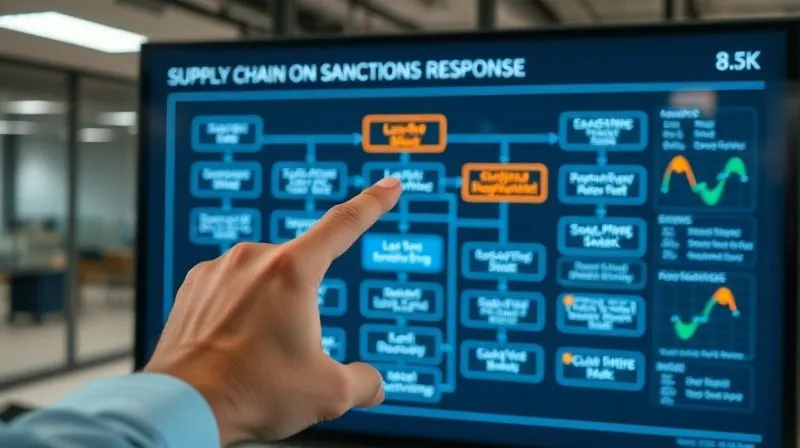
Strategic Mitigation: Diversifying and De-risking Your Supply Chain
Once the immediate compliance issues are addressed, the focus shifts to strategic mitigation. This involves actively de-risking your supply chain to prevent future disruptions and find alternative solutions for current impacts. Diversification is a powerful tool here.
Practical Strategies for Supply Chain De-risking:
- Supplier Diversification: Identify alternative suppliers in different geopolitical regions. Do not put all your eggs in one basket, especially for critical components or raw materials.
- Geographic Diversification: Spread your manufacturing, sourcing, and distribution across multiple countries and regions to reduce exposure to localized risks.
- Inventory Buffering: Consider holding buffer stock of critical components. While this incurs costs, it can provide a crucial lead time during unexpected disruptions.
- Technology Adoption: Implement supply chain visibility tools and AI-driven risk assessment platforms to monitor geopolitical developments and supplier health in real-time.
- Nearshoring/Reshoring: Evaluate the feasibility of bringing some production or sourcing closer to your home market or to politically stable regions.
Case Study: Navigating Sanctions with GlobalTech Solutions
Case Study: How GlobalTech Solutions Pivoted Post-Sanctions
GlobalTech Solutions, a mid-sized electronics manufacturer, relied heavily on a specialized microchip produced in a region that suddenly became subject to stringent international trade sanctions. Their initial reaction was panic, as 70% of their critical chip supply was cut off overnight. By following a structured approach, they managed to pivot.
First, their legal team confirmed the sanctions' scope, identifying a grace period for existing contracts. During this window, they accelerated shipments of remaining compliant stock. Simultaneously, their procurement team, guided by legal counsel, initiated a rapid search for alternative suppliers in South Korea and Taiwan. They also fast-tracked R&D to redesign a less complex version of their product that could use a more widely available chip. This multi-pronged strategy, though costly in the short term, allowed them to resume production within three months, albeit at a reduced capacity, and avoid complete operational shutdown.
Legal Recourse and Contractual Re-evaluation
Sanctions can fundamentally alter the feasibility of existing contracts. Understanding your legal rights and obligations is paramount. This often involves reviewing Force Majeure clauses, Material Adverse Change (MAC) clauses, and exploring contract renegotiation or termination.
Key Legal Considerations:
- Force Majeure Analysis: Does your contract contain a Force Majeure clause? Do the specific sanctions qualify as a Force Majeure event? This clause can excuse non-performance without liability if certain conditions are met.
- Frustration of Contract: In jurisdictions where Force Majeure isn't applicable or sufficient, the doctrine of 'frustration' might render a contract impossible to perform, leading to its termination.
- Material Adverse Change (MAC) Clauses: Some contracts include MAC clauses that allow a party to withdraw or renegotiate if an event significantly impacts the deal's value. Sanctions could trigger this.
- Contract Renegotiation: Open communication with your suppliers and customers is critical. Explore options like revised delivery schedules, alternative payment methods (if compliant), or sourcing from non-sanctioned entities.
- Termination Rights: Understand the contractual provisions for termination, including notice periods and potential liabilities. Sometimes, terminating an affected contract and finding a new supplier is the most compliant and financially prudent path.
I always advise clients to have their contracts reviewed by legal professionals well before a crisis hits. Proactive contract drafting, including robust sanctions clauses, can save immense headaches later. For instance, the International Chamber of Commerce (ICC) offers standard Force Majeure clauses that can be adapted to specific contracts, providing a globally recognized framework.

Building Resilience: Long-Term Strategies for Future-Proofing
Responding to an immediate crisis is one thing; building a resilient supply chain that can withstand future shocks is another. This requires a shift from reactive to proactive risk management.
Pillars of Long-Term Supply Chain Resilience:
- Continuous Monitoring: Implement systems to continuously monitor geopolitical developments, sanctions updates, and the financial health of key suppliers.
- Scenario Planning: Develop contingency plans for various sanctions scenarios. What if your primary logistics corridor is sanctioned? What if a key raw material supplier is impacted?
- Supply Chain Mapping: Gain granular visibility into your entire supply chain, not just your direct suppliers. Understand your Tier 2 and Tier 3 suppliers to identify hidden risks.
- Relationship Building: Foster strong, transparent relationships with suppliers, customers, and logistics partners. Trust and open communication are invaluable during crises.
- Digital Transformation: Invest in digital tools for enhanced visibility, predictive analytics, and automated compliance checks.
As Seth Godin often emphasizes in business strategy, building a durable system requires foresight and consistent effort, not just reacting to immediate fires. A resilient supply chain is a competitive advantage.
Leveraging Technology and Data for Proactive Management
In today's complex global trade environment, manual processes for sanctions compliance and supply chain risk management are simply inadequate. Technology and data analytics are indispensable tools.
Technology Solutions for Sanctions and Supply Chain Management:
- Automated Sanctions Screening Software: Tools that automatically screen customers, suppliers, and transactions against global sanctions lists, reducing human error and improving efficiency.
- Supply Chain Visibility Platforms: Software that provides real-time tracking of goods, identifies bottlenecks, and offers insights into supplier locations and dependencies.
- Geopolitical Risk Intelligence: Subscriptions to services that provide real-time alerts and analysis on political instability, trade policy changes, and emerging sanctions.
- Blockchain for Supply Chain Transparency: While still evolving, blockchain technology offers potential for immutable records of origin, enhancing traceability and trust.
- Predictive Analytics: Using AI and machine learning to analyze historical data and current trends to forecast potential disruptions and identify vulnerabilities.
Integrating these technologies can transform your approach from reactive damage control to proactive risk mitigation. This allows for quicker identification of potential issues and more informed decision-making.
| Risk Category | Mitigation Strategy | Key Technology |
|---|---|---|
| Geopolitical | Diversify sourcing, continuous monitoring, scenario planning | Geopolitical intelligence platforms, AI risk analytics |
| Compliance | Automated screening, legal review, robust internal controls | Sanctions screening software, legal tech platforms |
| Operational | Inventory buffering, multi-modal logistics, nearshoring | Supply chain visibility, predictive analytics |
Navigating Export Controls and Licensing Requirements
Beyond broad trade sanctions, businesses must also contend with export controls and specific licensing requirements for certain goods, technologies, and destinations. These are often intertwined with sanctions regimes and require careful attention.
Key Aspects of Export Controls:
- Classification of Goods: Understand the classification of your products and technologies (e.g., Export Control Classification Number - ECCN in the U.S.). This determines what controls apply.
- Restricted Party Screening: Always screen all parties involved in an export transaction (consignee, intermediate consignee, end-user) against various denied party lists.
- End-Use/End-User Restrictions: Be vigilant about the intended end-use and ultimate end-user of your products. Even if a country isn't sanctioned, the specific application or user might be restricted (e.g., military applications).
- Licensing Requirements: Determine if an export license is required for your specific product, destination, or end-user. The process for obtaining licenses can be complex and time-consuming.
- Record Keeping: Maintain meticulous records of all export transactions, including due diligence performed, licenses obtained, and communications. This is crucial for demonstrating compliance during audits.
I've seen many companies overlook export controls, assuming they only apply to military goods. However, 'dual-use' items (commercial goods with potential military applications) are often subject to strict controls. A misstep here can lead to severe fines and criminal penalties, just like sanctions violations.

Frequently Asked Questions (FAQ)
Q: Can I still fulfill existing contracts if new sanctions impact my supply chain? A: It depends on the specific sanctions and your contract's clauses. New sanctions often have immediate effect, rendering performance illegal. However, some sanctions may include grace periods or specific exemptions for existing contracts. A thorough legal review is essential to determine compliance and potential Force Majeure applicability. Always stop and assess before proceeding.
Q: What are the penalties for non-compliance with international trade sanctions? A: Penalties vary significantly by jurisdiction and the severity of the violation. They can range from hefty civil fines (often in the millions) and asset freezes to criminal charges for individuals, including imprisonment. Reputational damage and loss of export privileges are also significant consequences.
Q: How quickly do sanctions usually take effect, and what can I do to prepare? A: Sanctions can take effect almost immediately upon announcement, sometimes with little to no warning. Preparation involves continuous monitoring of geopolitical news and official government announcements, maintaining detailed supply chain visibility, having robust compliance programs, and pre-negotiating flexible clauses in contracts. Proactive legal consultation is key.
Q: Is it enough to screen my direct suppliers for sanctions? A: No, it's generally not enough. You need to conduct due diligence on your entire supply chain, including indirect suppliers (Tier 2, Tier 3), logistics providers, and financial institutions involved. Sanctions can impact any link in the chain, and you could be held liable for facilitating a violation even unknowingly. Ultimate beneficial ownership screening is also critical.
Q: What role does my bank play in sanctions compliance for my international trade? A: Your bank plays a crucial role. Financial institutions are on the front lines of sanctions enforcement and are legally obligated to screen transactions. They may freeze payments or block transactions if they identify a potential sanctions nexus, even if you believe your transaction is compliant. Maintain open communication with your bank's compliance department and be prepared to provide extensive documentation.
Key Takeaways and Final Thoughts
- Proactive Vigilance is Paramount: Continuously monitor the global geopolitical landscape and official sanctions lists.
- Immediate Legal Triage: When sanctions hit, halt operations, assess impact, and engage legal counsel immediately for compliance guidance.
- Diversify & De-risk: Strategically diversify your suppliers and geographic sourcing to build supply chain resilience.
- Master Your Contracts: Understand Force Majeure, MAC clauses, and be prepared for renegotiation or termination.
- Embrace Technology: Leverage automated screening, visibility platforms, and AI for proactive risk management.
- Beyond Sanctions: Always consider export controls and licensing requirements as part of your overall compliance strategy.
Navigating the complexities of international trade sanctions when they impact your supply chain is undeniably challenging. However, with a clear understanding of the legal landscape, a structured response plan, a commitment to compliance, and a strategic embrace of resilience, your business can not only survive these disruptions but emerge stronger and more adaptable. The journey requires diligence, expertise, and a proactive mindset, but the rewards of a secure and compliant global operation are immeasurable. Stay informed, stay compliant, and empower your business to thrive amidst global uncertainties.
Recommended Reading
- Boost Forecast Accuracy 40%: Navigate Volatility with Expert Financial Models
- Small Business Loan with Bad Credit? Here's The Secret!
- Unlocking SaaS Growth: Your Ultimate Guide to Digital Marketing Strategy
- 7 Steps: Overcome Employee Resistance to Continuous Improvement
- Resolving Audit Findings: 5 Steps to Bridge Management Disagreements

![Breach of Contract: Fixing Vendor Agreements FAST [Expert Guide]](/uploads/businessspur/posts/breach-of-contract-fixing-vendor-agreements-fast-expert-guide-jw5hy.webp)



Comments
Leave a comment below. Your email will not be published. Required fields marked with *