


Why are our qualified leads still not converting to sales?
For over 15 years in the trenches of sales growth and lead optimization, I've seen countless companies grapple with a paradox: they invest heavily in generating 'qualified' leads, only to watch them slip away at the sales stage. It's a frustrating, often demoralizing experience that leaves sales teams scratching their heads and marketing departments questioning their efforts.
This isn't just a minor hiccup; it's a fundamental breakdown in your sales ecosystem. You've done the hard work of identifying potential buyers, yet something critical is missing between 'qualified' and 'closed-won.' The problem often lies not in the quantity of leads, but in a deeper, more systemic issue within your qualification criteria, sales process, or team capabilities.
In this definitive guide, I'll dissect the seven most common, yet often overlooked, reasons why your qualified leads are still not converting to sales. We'll move beyond surface-level assumptions and dive into actionable frameworks, real-world case studies, and expert insights to help you diagnose the root causes and implement lasting solutions that transform your sales funnel from a leaky bucket into a powerful conversion engine.
1. Your Definition of 'Qualified' is Outdated or Flawed
One of the most frequent mistakes I encounter is a disconnect between what marketing considers a 'qualified lead' and what sales truly needs to close a deal. Many organizations still rely on traditional frameworks like BANT (Budget, Authority, Need, Timeline) as the sole arbiter of qualification. While BANT offers a starting point, it's often insufficient in today's complex buying landscape, leading to leads that appear qualified on paper but lack true sales readiness.
Beyond BANT: A Holistic Qualification Framework
True qualification goes deeper. It involves understanding the prospect's pain points, their strategic goals, their internal politics, their decision-making process, and their commitment to solving the problem. A lead might have a budget and a need, but if they lack internal champions or a clear path to implementation, they're not truly 'qualified' for your sales team.
- Re-evaluate your Ideal Customer Profile (ICP): Work with sales to define not just demographics and firmographics, but psychographics and behavioral triggers. What problems do your best customers *really* need solved?
- Implement a Shared Scoring Model: Develop a lead scoring system collaboratively between sales and marketing. Assign points for explicit actions (downloads, demo requests) and implicit behaviors (website visits, content engagement).
- Integrate MEDDIC or GPCTBA/C&I: Consider more robust qualification methodologies like MEDDIC (Metrics, Economic Buyer, Decision Criteria, Decision Process, Identify Pain, Champion) or GPCTBA/C&I (Goals, Plans, Challenges, Timeline, Budget, Authority, Negative Consequences & Positive Implications). These frameworks provide a more comprehensive view of a lead's readiness and fit.
- Regularly Calibrate Definitions: Hold quarterly 'lead quality' meetings between sales and marketing to discuss conversion rates, gather feedback on lead quality, and refine qualification criteria based on real-world outcomes.
| Qualification Criteria | Pros | Cons |
|---|---|---|
| BANT | Simple, quick initial filter | Too superficial, misses strategic fit, often self-reported |
| MEDDIC | Deep understanding of buyer's situation, identifies champions | More time-consuming, requires skilled questioning |
| Shared ICP Alignment | Ensures marketing targets relevant accounts, reduces wasted sales effort | Requires continuous collaboration, can be subjective |
| Behavioral Scoring | Identifies engagement and intent, dynamic | Needs robust tracking, can be skewed by casual browsers |
When your 'qualified' leads still aren't converting to sales, the first place I look is often at the very definition of 'qualified.' Are you truly sending sales opportunities, or merely interested parties?
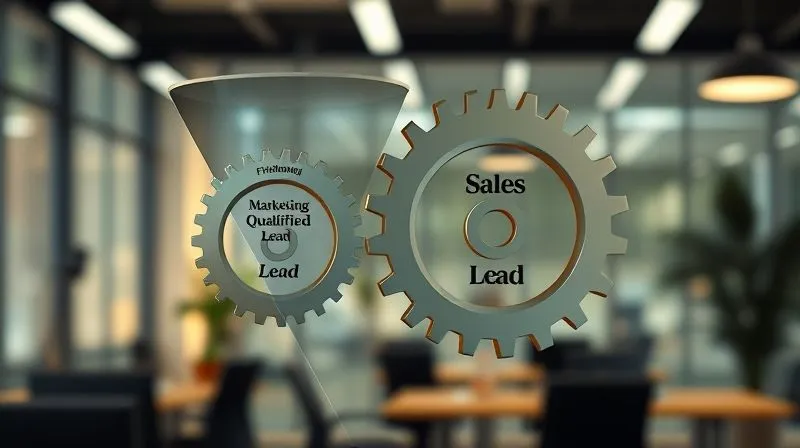
2. The Misalignment Between Sales and Marketing: A Silent Killer
Even with a robust qualification framework, if your sales and marketing teams operate in silos, your conversion rates will suffer. This misalignment is a pervasive issue, often characterized by marketing complaining about sales not following up on leads, and sales complaining about the poor quality of leads marketing provides. It's a blame game that costs companies millions.
Bridging the Gap: Establishing a Service Level Agreement (SLA)
From my experience, the most effective way to address this is through a formal Service Level Agreement (SLA) between sales and marketing. This isn't just a document; it's a commitment to shared goals and mutual accountability.
- Shared Revenue Goals: Both teams must be incentivized by the same ultimate goal: revenue. When marketing's success is tied to sales' closed deals, and vice-versa, collaboration naturally increases.
- Clear Lead Handoff Process: Define exactly when and how a lead transitions from marketing to sales. What information must be passed along? What are the service level expectations for sales follow-up?
- Consistent Feedback Loop: Marketing needs structured, regular feedback from sales on lead quality. Why did a lead disqualify? What information was missing? This feedback loop is crucial for marketing to refine their targeting and messaging.
According to a Harvard Business Review study, companies with strong sales and marketing alignment achieve 20% higher revenue growth. This isn't a coincidence; it's the direct result of a unified approach to the customer journey.
3. Ineffective Sales Process: Are You Guiding or Pushing?
Your leads might be genuinely qualified, but if your sales process is rigid, self-serving, or fails to adapt to the buyer's journey, they won't convert. Many sales teams still default to a 'pitch-first' mentality, pushing products rather than pulling prospects through a value-driven conversation. This is a common reason why qualified leads still aren't converting to sales.
Mapping the Ideal Buyer Journey to Your Sales Stages
The modern buyer is empowered. They've done their research, read reviews, and often know quite a bit about your solution before they even speak to a salesperson. Your sales process must acknowledge this and align with *their* decision-making process, not just your internal stages.
- Discovery, Not Interrogation: Focus on deep discovery questions that uncover pain points, desired outcomes, and the impact of inaction. This isn't about qualifying them for *you*, but understanding how *you* can qualify for *them*.
- Personalized Value Delivery: Tailor your messaging and demonstrations to the specific needs and context of each prospect. Generic presentations are a death knell for qualified leads.
- Enablement, Not Pressure: Provide resources, insights, and tools that help the buyer navigate their internal purchasing process. Be a trusted advisor, not just a vendor.
- Address Objections Proactively: Anticipate common objections and address them throughout the process, rather than waiting for them to derail the deal at the end.
"The sales process should be a journey of mutual discovery, not a one-way street of persuasion. Your role is to help the buyer buy, not to sell them something they don't truly need or understand." - Expert Insight
4. Skill Gaps in Your Sales Team: Beyond the Pitch
Even with perfectly qualified leads and a well-designed process, the human element is paramount. If your sales team lacks critical skills beyond simply delivering a pitch, your conversion rates will inevitably suffer. This isn't about a lack of effort; it's about a lack of specific, modern selling competencies.
The Art of Active Listening and Value Proposition Delivery
In my experience, two areas where skill gaps often manifest are active listening and the ability to articulate a compelling, differentiated value proposition that resonates with the prospect's specific challenges.
- Active Listening: Can your reps truly hear beyond what's being said? Can they identify underlying frustrations, unstated needs, and emotional drivers? This requires training in empathetic questioning and reflective listening.
- Challenger Sale Methodology: Are your reps capable of 'challenging' a prospect's assumptions, teaching them new insights about their business, and tailoring solutions to their unique context?
- Objection Handling: Do they view objections as roadblocks or opportunities to further understand and build trust? Effective objection handling is a skill that requires practice and strategic frameworks.
- Negotiation Skills: Can they navigate pricing discussions and contract terms effectively, without giving away too much value or alienating the prospect?
Case Study: How Apex Solutions Boosted Conversions with Targeted Training
Apex Solutions, a B2B software provider, consistently struggled with qualified leads stalling in the middle of their sales funnel. Analysis revealed their sales team was excellent at initial discovery but faltered when it came to demonstrating specific value and handling complex objections. By implementing a targeted 6-week training program focused on advanced active listening, value proposition customization, and a 'Challenger Sale' approach, Apex saw a significant shift. Within three months, their mid-funnel conversion rate increased by 18%, and average deal size grew by 12%. This demonstrates that even when qualified leads still aren't converting to sales, targeted skill development can be a game-changer.
5. Poor Follow-Up Strategy: The Leaky Bucket Syndrome
It's a common and costly mistake: generating a qualified lead, having a decent initial conversation, and then failing to follow up effectively. In today's noisy world, a single email or call simply isn't enough. Your follow-up strategy needs to be persistent, personalized, and multi-channel, otherwise, your qualified leads will inevitably fall through the cracks.
Multi-Channel Nurturing: Timing, Content, and Personalization
A robust follow-up strategy is about providing consistent value and staying top-of-mind without being intrusive. Think of it as a nurturing sequence designed to guide the prospect toward a decision at their own pace.
- Strategic Cadences: Implement a structured sales cadence that mixes emails, phone calls, LinkedIn messages, and even personalized video messages. Vary the content and the call-to-action with each touchpoint.
- Value-Driven Content: Don't just 'check in.' Each follow-up should offer something of value: a relevant case study, an industry insight, an invitation to a webinar, or a thoughtful question that prompts engagement.
- Personalization at Scale: Leverage your CRM to personalize messages based on previous interactions, company news, or trigger events. Generic, templated follow-ups are easily ignored.
- Timeliness is Key: The speed of initial follow-up after a lead becomes qualified is critical. Research shows that responding within five minutes can dramatically increase conversion rates compared to waiting even an hour.
- Long-Term Nurturing: Not every qualified lead is ready to buy immediately. Have a long-term nurturing track for those who aren't ready now, providing ongoing value until their timing is right.
As Forbes highlights, consistent and valuable follow-up is not just polite; it's crucial for sales success. It builds trust and keeps you top-of-mind. This persistence is often the difference when your qualified leads still aren't converting to sales.
6. Value Proposition Weakness: Why Should They Choose YOU?
Even if a lead is perfectly qualified, your sales team is skilled, and your process is smooth, if your core value proposition is weak, unclear, or undifferentiated, you won't close deals. In a competitive market, prospects need a compelling reason to choose you over alternatives, or even over doing nothing at all. They need to understand the tangible benefits and ROI you offer.
Crafting a Compelling, Differentiated Message
A strong value proposition isn't just a list of features; it's a clear statement of the specific benefits you provide, for whom, and how you do it uniquely compared to competitors. It answers the fundamental question: "Why should I buy from you?"
- Identify Core Pain Points: Deeply understand the specific problems your target audience faces that your solution addresses.
- Quantify Benefits: Instead of saying "save time," say "reduce processing time by 30%." Instead of "increase efficiency," say "improve team productivity by 15% within three months."
- Highlight Differentiation: What makes you truly unique? Is it your proprietary technology, your exceptional customer service, your industry-specific expertise, or your unique pricing model?
- Test and Refine: Continuously test your value proposition in sales conversations. What resonates? What falls flat? Use this feedback to refine your messaging.
7. Lack of Data-Driven Optimization: Guesswork is Not a Strategy
Finally, a critical reason why your qualified leads still aren't converting to sales is a reliance on intuition rather than data. Many sales leaders make decisions based on anecdotal evidence or 'gut feelings,' rather than rigorously analyzing their sales funnel metrics. This leads to repeating the same mistakes and failing to identify leverage points for improvement.
Leveraging CRM and Analytics for Continuous Improvement
Your CRM is more than just a contact database; it's a goldmine of data that can reveal precisely where your sales process is breaking down. Effective data analysis allows you to pinpoint bottlenecks, optimize strategies, and make informed decisions.
- Track Key Conversion Metrics: Beyond just overall conversion, track conversion rates at each stage of your sales funnel. Where are leads dropping off?
- Analyze Disqualification Reasons: Ensure your sales team logs detailed reasons for lost deals. Categorize these reasons (e.g., budget, no fit, lost to competitor, internal issues) to identify patterns.
- Sales Cycle Analysis: How long does it take for leads to move through each stage? Are some stages taking too long, indicating a bottleneck or an issue with your process?
- A/B Test Sales Messaging and Tactics: Experiment with different email subject lines, call scripts, or demo approaches. Use data to see what performs best.
- Identify Top Performers' Habits: Analyze what your top-performing sales reps do differently. Can these best practices be codified and shared with the rest of the team?
| Metric | Benchmark (B2B) | Impact of Improvement |
|---|---|---|
| MQL to SQL Conversion Rate | 10-20% | Increases sales-ready leads |
| SQL to Opportunity Conversion Rate | 20-30% | Optimizes sales team's focus |
| Opportunity to Closed-Won Rate | 15-25% | Directly boosts revenue |
| Average Sales Cycle Length | Varies by industry | Faster revenue recognition, better forecasting |
As marketing guru Seth Godin often says, "The market always wins." If your data is telling you something isn't working, listen to it. Ignoring the numbers is a surefire way to keep asking, "Why are our qualified leads still not converting to sales?"

Frequently Asked Questions (FAQ)
What's the difference between an MQL and an SQL, and why does it matter for conversion? An MQL (Marketing Qualified Lead) is a prospect deemed ready for sales engagement based on marketing criteria (e.g., downloaded an ebook, attended a webinar). An SQL (Sales Qualified Lead) is an MQL that has been further vetted by a sales development rep or salesperson and confirmed to meet sales' specific qualification criteria, indicating a higher likelihood of purchase. The distinction matters because sending MQLs that aren't truly SQLs to sales wastes valuable sales time and frustrates both teams, directly impacting conversion rates. A clear handoff and aligned definitions are crucial.
How can I improve my sales team's qualification skills without extensive training budgets? Focus on consistent coaching and peer learning. Implement weekly 'deal reviews' where reps present current opportunities and the team collectively identifies qualification gaps. Utilize role-playing specific scenarios (e.g., handling a budget objection). Leverage your CRM to track and provide feedback on qualification questions asked and information gathered. Encourage top performers to mentor others. There are also many free or low-cost online resources and podcasts dedicated to advanced sales qualification techniques.
Is it always a problem with sales, or can marketing also be at fault for low conversion of qualified leads? It's rarely one or the other; it's almost always a shared responsibility. Marketing can be at fault if their 'qualified' leads don't truly align with the Ideal Customer Profile (ICP) or if their messaging attracts prospects who aren't a good fit. Sales can be at fault if they lack the skills, process, or follow-up discipline to convert genuinely good leads. The key is to foster a culture of collaboration and mutual accountability, using an SLA and shared metrics to bridge any gaps.
What role does competitive analysis play when qualified leads aren't converting? A significant one. If your qualified leads are consistently choosing a competitor, it's a strong signal that your value proposition isn't strong enough, or your sales team isn't effectively articulating your differentiation. Competitive analysis helps you understand what your rivals are offering, how they're positioning themselves, and where your own strengths and weaknesses lie. This insight allows you to refine your messaging, train your sales team on competitive differentiation, and adjust your strategy to better highlight your unique advantages.
How often should we review and adjust our lead qualification criteria? Lead qualification criteria should be a living document, not a static one. I recommend a formal review and adjustment process quarterly, especially if you're experiencing changes in market conditions, product offerings, or target audience. However, an ongoing, informal feedback loop between sales and marketing should be continuous, allowing for agile adjustments as new insights emerge from sales interactions. This proactive approach prevents the problem of qualified leads still not converting to sales from festering.
Key Takeaways and Final Thoughts
- Re-define 'Qualified': Move beyond superficial criteria to a holistic understanding of true sales readiness.
- Align Sales & Marketing: Break down silos with SLAs, shared goals, and continuous feedback.
- Optimize Sales Process: Design a buyer-centric journey that guides, rather than pushes, prospects.
- Invest in Skill Development: Equip your sales team with modern selling competencies like active listening and value articulation.
- Master Follow-Up: Implement persistent, personalized, multi-channel nurturing cadences.
- Refine Value Proposition: Clearly articulate your unique, quantified benefits to stand out.
- Embrace Data: Use analytics to diagnose issues, identify opportunities, and drive continuous improvement.
The journey from 'qualified' lead to 'closed-won' deal is complex, but it's not a mystery. By systematically addressing these seven critical areas, you can transform your sales funnel from a source of frustration into a predictable, high-performing engine. Don't let the question, "Why are our qualified leads still not converting to sales?" linger unanswered. Take action, analyze your data, empower your teams, and watch your conversion rates soar. The potential is there; it's time to unlock it.
Recommended Reading
- Why Your TBL Goals Lack Executive Buy-In: 7 Solutions
- 7 Internal Barriers Preventing Disruptive Innovation in Large Firms
- 5 Critical Causes of High Franchise Turnover & How to Stop It Now
- Unlock Innovation: How to Monetize Intellectual Property for Explosive Growth
- Verify Franchisor Earnings: 7 Steps to Avoid FDD Fraud





Comments
Leave a comment below. Your email will not be published. Required fields marked with *