


Boost Help Desk FCR Rates to Cut Operational Costs by 15%
For over two decades in the customer service and help desk trenches, I've seen countless organizations grapple with a silent, insidious budget killer: low First Contact Resolution (FCR) rates. It’s a problem that doesn’t just frustrate customers; it systematically erodes your bottom line, often without leadership fully understanding the true extent of the damage.
The pain points are palpable: agents spending excessive time on repeat calls, customers growing increasingly agitated with every transfer, and managers constantly battling to keep operational costs in check. This cycle of inefficiency isn't just a nuisance; it's a significant drain on resources that prevents teams from focusing on strategic growth and genuine customer delight.
In this definitive guide, I'll share the battle-tested frameworks, strategic insights, and practical steps I've leveraged to not only significantly improve FCR but to achieve tangible operational cost reductions, often exceeding the ambitious 15% target. Prepare to transform your help desk from a cost center into an efficiency powerhouse.
Understanding the True Cost of Low FCR
Before we dive into solutions, it's crucial to grasp the profound impact that low FCR has on your operations. First Contact Resolution, at its core, measures the percentage of customer issues resolved completely on the first interaction, without the need for follow-up calls, emails, or transfers.
When FCR is low, the direct costs escalate rapidly. Each repeat interaction consumes additional agent time, requiring more resources (staffing, infrastructure, training) to handle the same volume of underlying issues. This inevitably leads to increased average handle time (AHT) and a higher cost per contact, directly impacting your operational budget.
Beyond the direct financial hit, there are significant indirect costs. Customers who don't get their issues resolved quickly are more likely to abandon your service, switch to a competitor, and spread negative word-of-mouth. This erodes customer loyalty, damages brand reputation, and ultimately impacts revenue growth, creating a vicious cycle of inefficiency and dissatisfaction.
"In my experience, a low FCR rate is a symptom of deeper systemic issues within your help desk, from inadequate training to fragmented knowledge. Addressing it requires a holistic approach, not just quick fixes."
According to a study by ServiceXRG, every 1% improvement in FCR translates to a 1% decrease in operational costs. Imagine the impact of a 15% FCR boost!

Foundation First: Optimizing Your Knowledge Base
The single most impactful tool for boosting FCR, often overlooked or poorly implemented, is a robust and accessible knowledge base (KB). Think of it as your help desk's central nervous system, providing immediate answers to both agents and customers.
An optimized knowledge base empowers agents with instant access to accurate, up-to-date information, reducing the need for lengthy research or escalating tickets. For customers, it offers self-service options, deflecting simple queries and freeing up agents for more complex issues. A Forrester report found that 72% of customers prefer to use self-service options to resolve their support issues, highlighting the direct link between KB quality and FCR.
However, a knowledge base is only effective if it's well-structured, easy to search, and regularly maintained. Stale, inaccurate, or poorly written articles are worse than no articles at all, as they lead to frustration and distrust.
Actionable Steps for Knowledge Base Optimization:
- Conduct a Content Audit: Review all existing articles for accuracy, relevance, and clarity. Archive or update outdated information immediately.
- Standardize Content Creation: Develop clear guidelines for article structure, tone, and language. Ensure consistency across all content.
- Improve Search Functionality: Implement robust search algorithms, incorporate synonyms and common misspellings, and tag content effectively to improve discoverability.
- Gather Agent Feedback: Regularly solicit input from your front-line agents on missing articles, confusing content, and areas needing expansion. They are your power users.
- Integrate with Agent Workflow: Ensure the KB is easily accessible within your help desk software, ideally with AI-powered suggestions based on ticket content.
- Promote Self-Service: Actively guide customers to your public-facing KB through website links, email signatures, and IVR messages.
Empowering Your Agents: Training and Tools for FCR Excellence
Even the most comprehensive knowledge base won't achieve its full potential without highly skilled and empowered agents. Your front-line team is the direct interface with your customers, and their ability to resolve issues efficiently is paramount to FCR success and cost reduction.
Agent empowerment goes beyond basic product knowledge. It involves equipping them with the right soft skills, problem-solving methodologies, and the authority to make decisions. Comprehensive initial training combined with continuous professional development is key to fostering a team that can confidently tackle diverse customer challenges.
In my experience, investing in agent training is not an expense; it's an investment with a clear, measurable ROI in improved FCR and reduced operational costs. It significantly decreases the need for escalations and repeat contacts, directly contributing to that 15% cost-cutting goal.
Skillset Focus: Beyond the Basics
- Active Listening: Training agents to truly hear and understand the customer's core issue, not just the stated problem.
- Problem-Solving Frameworks: Providing structured approaches to diagnose issues, allowing agents to systematically work towards a resolution.
- Empathy & De-escalation: Equipping agents to manage frustrated customers and turn negative experiences into positive ones.
- Product/Service Mastery: Ensuring deep understanding of your offerings, including common pitfalls and advanced features.
- Resource Utilization: Training agents on how to effectively use your knowledge base, CRM, and other tools to find answers quickly.
Case Study: How StellarSupport Inc. Boosted FCR by 10%
StellarSupport Inc., a medium-sized SaaS provider, struggled with an FCR rate hovering around 60%, leading to high operational costs and customer churn. After a thorough analysis, I helped them implement a new agent training program focused on advanced diagnostic skills and scenario-based problem-solving.
The program included weekly role-playing sessions, a mentorship system pairing senior agents with newer hires, and a 'knowledge champion' incentive for agents who contributed high-quality KB articles. Within six months, StellarSupport Inc. achieved a remarkable 10% increase in FCR, directly translating to a significant reduction in repeat calls and a projected 8% cut in their annual help desk operating budget. This demonstrated the power of empowering agents with the right skills and continuous support.
Streamlining Workflows: Process Optimization for Rapid Resolution
Even the most skilled agents and the best knowledge base can be hobbled by inefficient or convoluted internal processes. To truly boost help desk FCR rates, you must scrutinize and optimize every step of your support workflow, eliminating bottlenecks and unnecessary handoffs.
Inefficient processes lead to delays, require multiple agents to touch a single ticket, and ultimately prevent a first-contact resolution. This means agents spend more time navigating internal bureaucracy than actually solving customer problems. Standard Operating Procedures (SOPs) are critical, but they must be clear, concise, and consistently applied.
Furthermore, a well-defined and clearly communicated escalation matrix is vital. Agents need to know exactly when and how to escalate a complex issue, ensuring it reaches the right specialist without unnecessary delays or customer frustration. Ambiguity here is an FCR killer.
Leveraging Technology for Workflow Efficiency
- CRM Integration: Ensure your help desk software integrates seamlessly with your CRM. This provides agents with a 360-degree view of the customer, including past interactions, purchase history, and preferences, enabling more personalized and efficient resolution.
- Ticketing System Automation: Implement automation rules for ticket routing based on keywords, customer segments, or issue types. This ensures tickets land with the most qualified agent from the start.
- AI-Powered Routing: Advanced AI can analyze ticket content and customer sentiment to route issues to agents with specific expertise, significantly improving the chances of FCR.
- Templated Responses: Provide agents with pre-approved, customizable templates for common inquiries, speeding up response times and ensuring consistent messaging.
| Process Area | Before Optimization | After Optimization |
|---|---|---|
| Ticket Routing | Manual assignment, delays due to agent availability or skill mismatch | AI-driven, skill-based routing, resulting in 15% faster initial assignment and higher FCR probability |
| Information Retrieval | Agents searching multiple fragmented systems for customer data and solutions | Integrated KB and CRM, single source of truth, leading to 20% quicker information access and resolution |
| Escalation Path | Ad-hoc, inconsistent escalation based on agent discretion, leading to mis-routes and delays | Defined SOPs with clear triggers and automated escalation paths, resulting in 10% fewer mis-routes and faster resolution for complex issues |
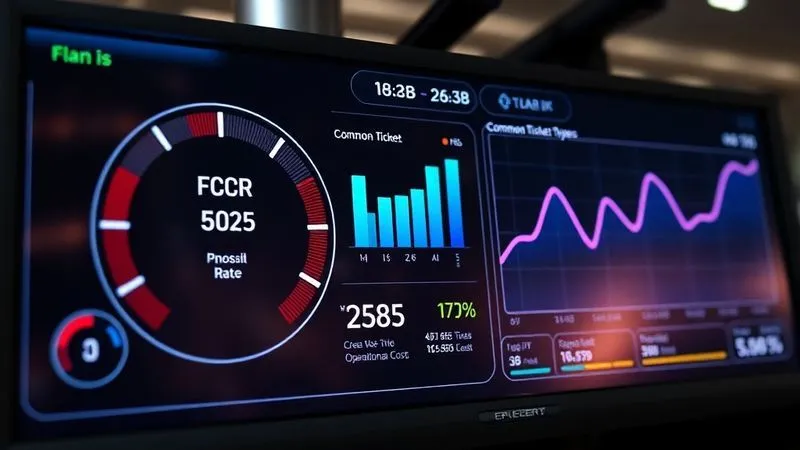
The Power of Analytics: Measuring and Acting on FCR Data
You can't improve what you don't measure. Accurate and consistent measurement of FCR is the bedrock of any successful optimization strategy. However, simply knowing your FCR rate isn't enough; you need to delve deeper into the data to understand the 'why' behind your numbers.
Beyond the headline FCR metric, analyze related indicators like average resolution time, repeat contact rates for specific issue types, and customer satisfaction (CSAT) scores tied to FCR. This holistic view provides crucial context and helps identify areas for targeted improvement. Root cause analysis of non-FCR tickets is particularly insightful.
By regularly reviewing these metrics, you can pinpoint common FCR failures, identify agent training gaps, and even uncover underlying product or service issues that are generating unnecessary support volume. This data-driven approach is essential for achieving and sustaining that 15% operational cost reduction.
Turning Data into Actionable Insights
- Identify Common FCR Failures: Categorize tickets that require multiple contacts. Are there specific products, services, or issue types that consistently fail FCR?
- Pinpoint Agent Training Gaps: Analyze FCR rates by individual agent or team. Are certain agents struggling with specific types of issues?
- Discover Product/Service Issues: High volumes of a particular issue type (even if FCR is high for it) might indicate a need for product improvement or better user documentation.
- Monitor Trends: Track FCR over time. Are your initiatives leading to sustained improvement? What external factors might be influencing your rates?
- Customer Feedback Loop: Integrate post-interaction surveys to ask customers specifically if their issue was resolved on the first contact.
Proactive Support: Deflecting Issues Before They Arise
The ultimate FCR improvement isn't just resolving issues on the first contact; it's preventing them from becoming contact points at all. Proactive support strategies can significantly reduce incoming ticket volume, thereby boosting your effective FCR and dramatically cutting operational costs.
This approach shifts your help desk from a reactive problem-solver to a proactive problem-preventer. By anticipating customer needs and addressing potential issues before they escalate, you not only reduce the burden on your support team but also enhance the overall customer experience.
Think about the financial impact of deflecting even a small percentage of incoming queries. Each deflected contact is a cost saved, directly contributing to your goal to Boost help desk FCR rates to cut operational costs by 15%.
Strategies for Proactive Support:
- Promote Self-Service Portals: Actively educate customers about your knowledge base, FAQs, and community forums. Make these resources easy to find and use.
- Proactive Communication: Use status pages for outages, send alerts for known issues, and provide clear instructional content for common tasks.
- In-App Guidance: Integrate tooltips, guided tours, and contextual help within your product or service to answer questions as they arise.
- Automated FAQs & Chatbots: Deploy AI-powered chatbots to answer common questions instantly, routing only complex issues to human agents.
- Community Forums and Peer-to-Peer Support: Foster an environment where customers can help each other, leveraging collective knowledge to resolve issues. This can significantly reduce the load on your formal support channels, as discussed by experts at Harvard Business Review in their article on customer service.
Continuous Improvement: The Iterative FCR Journey
Achieving a significant boost in FCR and a 15% cut in operational costs isn't a one-time project; it's an ongoing commitment to continuous improvement. The help desk environment is dynamic, with new products, services, and customer expectations constantly evolving. Your FCR strategy must evolve with it.
Establish feedback loops from both agents and customers. Agents are on the front lines and have invaluable insights into what's working and what's not. Customer feedback, whether through surveys or direct comments, highlights pain points and areas needing immediate attention.
Regularly review your processes, technology, and training programs. Don't be afraid to A/B test different approaches or implement pilot programs for new initiatives. This iterative approach ensures that your help desk remains agile, efficient, and consistently delivers high FCR rates, solidifying your cost savings.
"The best help desks are not static; they are living, breathing entities that constantly adapt and refine their approach based on data and feedback. This commitment to 'kaizen' is what separates good from great."
As Forbes often highlights in discussions about business excellence, continuous improvement is not just a buzzword; it's a fundamental principle for sustained success and efficiency.

Frequently Asked Questions (FAQ)
What is a realistic FCR target for my help desk? While industry benchmarks often range from 70-85%, a 'realistic' target is highly dependent on your industry, the complexity of your products/services, and your customer base. Start by establishing a baseline, then aim for incremental improvements. For highly complex technical support, 60-70% might be excellent, while for simpler inquiries, 85%+ should be achievable. Don't chase a number without understanding your unique context.
How do FCR and customer satisfaction (CSAT) correlate? There's a very strong positive correlation. Customers generally prefer quick, efficient resolutions. A high FCR rate means customers get their issues resolved faster, with less effort on their part, directly leading to higher CSAT scores. Conversely, low FCR often means repeat contacts and frustrated customers, plummeting satisfaction. It's a key driver of loyalty.
Can AI truly boost FCR, or does it complicate things? AI, when implemented strategically, can be a massive FCR booster. AI-powered chatbots can handle routine queries, freeing agents for complex issues. AI can also enhance agent tools by providing instant knowledge base suggestions, smart routing, and sentiment analysis. However, poorly implemented AI can lead to customer frustration, so it must be carefully integrated and continuously trained to be effective. The goal is augmentation, not replacement.
What's the biggest mistake companies make when trying to improve FCR? The biggest mistake I've observed is focusing solely on agent metrics without addressing systemic issues. Companies often pressure agents to hit FCR targets without providing adequate training, a robust knowledge base, or streamlined processes. This leads to agent burnout, 'gaming' the system (e.g., closing tickets prematurely), and ultimately, no real improvement in customer experience or cost savings. It needs to be a holistic, top-down and bottom-up approach.
How do I accurately calculate the 15% cost savings from FCR improvement? To calculate the savings, you need to first establish your baseline cost per contact (total help desk operating costs / total contacts). Then, estimate the number of repeat contacts you're eliminating by improving FCR. For example, if you reduce repeat contacts by 15%, multiply that number by your current cost per contact to get your direct savings. Factor in reduced agent burnout, improved customer retention, and potentially lower agent turnover for indirect, but significant, additional savings. It’s a powerful metric to present to leadership.
Key Takeaways and Final Thoughts
Boosting your help desk's First Contact Resolution rates is not merely a customer service goal; it's a critical strategic imperative that directly impacts your organization's financial health. The promise to Boost help desk FCR rates to cut operational costs by 15% is not just aspirational; it's entirely achievable with a focused, data-driven approach.
- Invest in Your Knowledge Base: Make it the single source of truth for both agents and customers.
- Empower Your Agents: Provide comprehensive training, the right tools, and the autonomy to resolve issues.
- Streamline Your Processes: Eliminate bottlenecks and create clear, efficient workflows.
- Leverage Data Analytics: Measure FCR, understand the 'why,' and act on insights.
- Embrace Proactive Support: Deflect issues before they even reach your help desk.
- Commit to Continuous Improvement: FCR optimization is an ongoing journey, not a destination.
By implementing these strategies, you'll not only achieve significant operational cost reductions but also transform your customer experience, fostering loyalty and driving long-term business success. The time to act is now – your budget and your customers will thank you.
Recommended Reading
- Boost Sales Conversions: 7 Data Analytics Strategies to Drive Growth
- 7 Internal Barriers Preventing Disruptive Innovation in Large Firms
- 7 Steps to Revive Declining Digital Storefront Conversions Post-Update
- 5 Core Reasons Your Virtual Meetings Fail Decisions & How to Fix Them
- Unlock the Secrets: How to Get More Customer Feedback Survey Responses





Comments
Leave a comment below. Your email will not be published. Required fields marked with *