

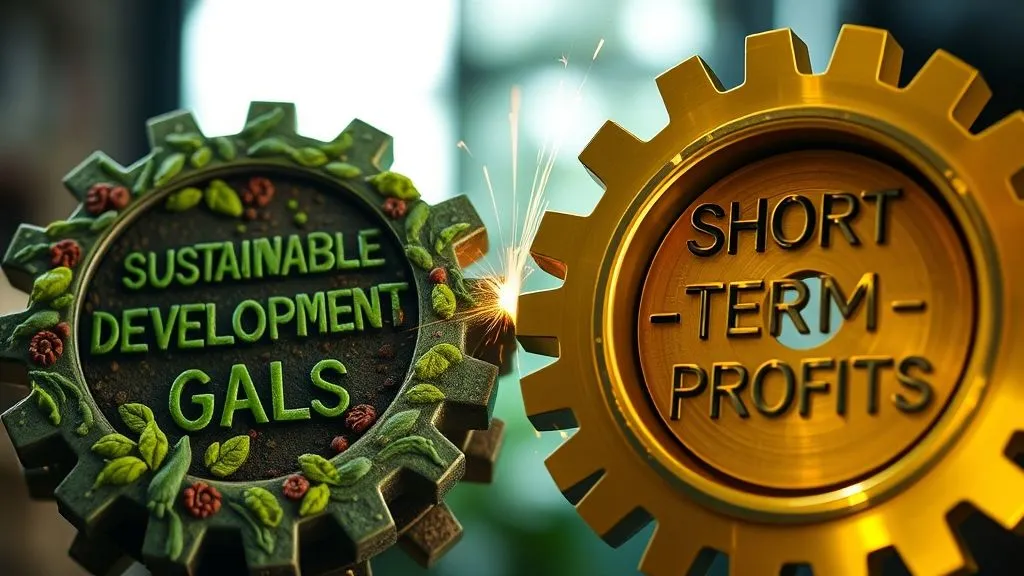
What to do when SDG goals conflict with short-term profits?
For over 15 years in the trenches of corporate social responsibility and sustainable development, I've witnessed a recurring, often agonizing dilemma for businesses: the perceived clash between ambitious Sustainable Development Goals (SDGs) and the relentless pressure for immediate, short-term profits. It’s a tension that can paralyze even the most well-intentioned leaders, leading to inaction or, worse, tokenistic gestures that satisfy no one.
This isn't just an academic debate; it's a real-world struggle faced by CEOs, sustainability managers, and even frontline employees who champion more responsible practices. The quarterly report looms, shareholder expectations demand quick returns, and the investment required for true sustainable transformation often feels like an impossible hurdle. Many companies find themselves asking: 'Can we afford to do good when the bottom line is screaming for attention?'
In this definitive guide, I will share battle-tested frameworks, strategic insights, and actionable steps to navigate this complex landscape. You'll learn how to not only reconcile but truly integrate SDG commitments with your financial objectives, transforming perceived conflicts into opportunities for long-term value creation and resilient business growth. This isn't about choosing one over the other; it's about mastering the art of strategic alignment.
Understanding the Root of the Conflict: Perception vs. Reality
The core of the conflict often lies not in an inherent incompatibility, but in a fundamental misunderstanding of time horizons and value creation. Businesses are conditioned by market forces to prioritize immediate financial returns, making any investment with a longer payback period seem risky or non-essential, especially when it comes to social and environmental initiatives.
The Quarterly Report Trap
The relentless cycle of quarterly financial reporting often forces companies into a short-term mindset. Decisions are made to boost immediate earnings, satisfy analysts, and keep stock prices buoyant. This pressure can lead to underinvestment in areas like R&D for sustainable products, supply chain ethical improvements, or renewable energy transitions, even if these would yield significant long-term benefits. It creates a perceived zero-sum game: every dollar spent on an SDG initiative is a dollar not directly contributing to this quarter's profit.
Misinterpreting 'Sustainability' as Pure Cost
Another significant barrier is the tendency to view SDG initiatives purely as a cost center or a compliance burden. While initial investments are often required, the benefits — brand enhancement, risk mitigation, innovation, talent attraction, and operational efficiencies — are frequently overlooked or poorly quantified. Many companies fail to connect the dots between improved environmental performance, for example, and reduced operational costs, or between social equity initiatives and enhanced employee productivity.
"True sustainability is not an added cost of doing business; it is the cost of not doing business in the future. It's an investment in resilience, innovation, and long-term value." - An Experienced Industry Specialist
Common misconceptions that perpetuate this conflict include:
- SDGs are a luxury: Only for large, profitable companies.
- Compliance is enough: Meeting minimum standards is sufficient.
- Greenwashing works: Superficial efforts can substitute for genuine change.
- It's someone else's problem: Government or NGOs should lead.
The Strategic Imperative: Why Aligning SDGs and Profit is Non-Negotiable
In today's interconnected world, ignoring the SDGs is no longer a viable option. The market, consumers, investors, and regulators are increasingly demanding accountability and genuine commitment to sustainable practices. Aligning your business with the SDGs isn't just 'good corporate citizenship'; it's a strategic imperative for long-term viability and competitive advantage.
Enhanced Brand Reputation & Consumer Loyalty
Consumers, especially younger generations, are more likely to choose brands that demonstrate a clear commitment to social and environmental responsibility. A strong SDG alignment builds trust, differentiates your brand in a crowded market, and fosters deep customer loyalty. This isn't just about feel-good marketing; it translates directly into market share and premium pricing power.
Attracting and Retaining Top Talent
The best talent, particularly millennials and Gen Z, seeks purpose in their work. Companies with strong SDG commitments are significantly more attractive to prospective employees and experience lower attrition rates. A workforce that believes in the company's mission is more engaged, productive, and innovative. According to a Deloitte study, purpose-driven companies have higher levels of employee satisfaction and retention.
Innovation & New Market Opportunities
Addressing SDG challenges often sparks innovation. Developing sustainable products, services, and business models can unlock entirely new market segments, create competitive advantage, and drive revenue growth. Think about companies innovating in renewable energy, circular economy solutions, or sustainable agriculture – they are not just 'doing good,' they are tapping into massive future markets.

Risk Mitigation & Regulatory Foresight
Proactive engagement with SDGs can significantly mitigate various business risks. This includes regulatory risks (e.g., carbon taxes, plastic bans), reputational risks (e.g., supply chain scandals), and operational risks (e.g., resource scarcity, climate change impacts). Companies that align with SDGs are better positioned to anticipate and adapt to evolving regulatory landscapes and societal expectations, ensuring greater stability and resilience. As Harvard Business Review often highlights, sustainability is increasingly central to risk management.
Framework 1: The Integrated Value Creation Model
My first framework for resolving the SDG vs. profit dilemma is to adopt an Integrated Value Creation Model. This approach recognizes that economic, social, and environmental value are not mutually exclusive but deeply interconnected. It's about finding the 'sweet spot' where your business goals and SDG contributions reinforce each other.
Step 1: Identify Material SDGs
Not all 17 SDGs will be equally relevant to every business. The first crucial step is to conduct a materiality assessment. This involves:
- Stakeholder Engagement: Talk to your customers, employees, investors, suppliers, and community representatives. What social and environmental issues do they care about most regarding your operations?
- Impact Mapping: Analyze your entire value chain – from raw material sourcing to product end-of-life. Where do your operations have the most significant positive and negative impacts on the SDGs? For example, a textile company might find SDG 8 (Decent Work) and SDG 12 (Responsible Consumption and Production) highly material.
- Business Strategy Alignment: Which SDGs naturally align with your core business strategy and where can you genuinely make a difference? Focus your efforts where you can achieve the greatest impact and derive the most business benefit.
Step 2: Quantify the Business Case
Once you've identified your material SDGs, the next step is to quantify the financial benefits of addressing them. This moves SDG initiatives from 'cost' to 'investment.' This involves:
- Cost Savings: Calculate how energy efficiency (SDG 7), waste reduction (SDG 12), or water conservation (SDG 6) can directly lower operational expenses.
- Revenue Generation: Estimate new revenue streams from sustainable products/services, market expansion into 'green' segments, or increased market share due to enhanced brand reputation.
- Risk Reduction: Assign a financial value to mitigated risks, such as avoiding regulatory fines, supply chain disruptions, or reputational damage.
- Productivity Gains: Quantify improved employee morale and productivity from initiatives related to SDG 3 (Good Health and Well-being) or SDG 8 (Decent Work).
Here's an example of how a company might quantify the business case for investing in renewable energy (aligned with SDG 7):
| Metric | Value |
|---|---|
| Initial Investment (Solar Panels) | $500,000 |
| Annual Energy Cost Savings | $75,000 |
| Reduced Carbon Tax Liability | $10,000 |
| Enhanced Brand Value (estimated annual) | $20,000 |
| Payback Period | ~5.5 years |
| Total ROI (10 years) | ~150% |
Step 3: Embed SDGs into Core Strategy
This is where the rubber meets the road. SDGs shouldn't be a separate 'CSR department' activity; they must be integrated into your core business strategy, product development, supply chain management, and even your financial planning. This includes:
- Setting SMART Goals: Specific, Measurable, Achievable, Relevant, Time-bound SDG targets linked to business KPIs.
- Assigning Ownership: Ensuring different departments (e.g., R&D, operations, marketing) have clear responsibilities for SDG contributions.
- Performance Incentives: Linking executive and employee compensation to the achievement of SDG targets.
Case Study: How EcoInnovate Corp Achieved Dual Success
EcoInnovate Corp, a mid-sized consumer electronics manufacturer, faced increasing pressure regarding its e-waste footprint and energy consumption (SDG 12 & SDG 7). Initially, their board viewed investments in sustainable design as a drag on short-term profits. However, by adopting the Integrated Value Creation Model, they identified that designing for modularity and energy efficiency could open new markets for repair services and appeal to a growing segment of eco-conscious consumers.
They invested in R&D for modular product designs and partnered with local recycling facilities. While the initial investment was significant, within three years, EcoInnovate saw a 15% reduction in material costs due to extended product lifecycles, a 10% increase in sales to a new 'eco-premium' segment, and a 20% reduction in energy bills. Their brand reputation soared, attracting top engineering talent. This deliberate integration turned a perceived conflict into a powerful competitive advantage, demonstrating that what's good for the planet can be profoundly good for profit.
"Don't just add sustainability to your business; embed it into the very DNA of your strategy, operations, and culture. That's where true, lasting value is created." - An Experienced Industry Specialist
Framework 2: The Long-Term Investment Mindset
My second framework addresses the fundamental challenge of time horizon. To genuinely resolve the conflict between SDG goals and short-term profits, businesses must cultivate a long-term investment mindset, extending beyond the next quarterly report. This involves a shift in perspective, investor relations, and internal incentive structures.
Shifting from Quarterly to Multi-Year Horizon
Leaders must actively communicate and champion a vision that extends years, even decades, into the future. This means: outlining a clear 5-10 year SDG roadmap, articulating the long-term value proposition of sustainability initiatives, and educating stakeholders on the compounded benefits that accrue over time. It's about emphasizing resilience, future-proofing, and enduring market relevance over fleeting financial spikes.
Investor Relations & ESG Reporting
Engage proactively with your investors. The landscape of investment is changing rapidly, with a significant shift towards ESG (Environmental, Social, Governance) factors. Institutional investors like BlackRock, as articulated by Larry Fink in his annual letters, are increasingly demanding that companies demonstrate a clear strategy for addressing climate change and social equity. Transparent and robust ESG reporting is no longer optional; it's a critical tool for attracting patient capital and demonstrating long-term value creation. Highlight how your SDG efforts mitigate risk and position the company for sustainable growth, rather than just compliance.

Internal Incentives & Performance Metrics
To truly embed a long-term mindset, internal incentive structures must reflect it. If employee bonuses are solely tied to quarterly financial performance, it will naturally disincentivize long-term SDG investments. Consider incorporating SDG-related KPIs into performance reviews and executive compensation. This could include metrics like carbon footprint reduction, employee diversity targets, responsible sourcing percentages, or community investment impact. Aligning personal incentives with organizational SDG goals is a powerful driver of change.
Navigating Trade-offs: When Tough Choices Are Inevitable
While strategic integration can resolve many conflicts, it would be disingenuous to suggest that trade-offs never occur. There will be moments when an SDG initiative requires a significant upfront investment with a longer payback period, or when a highly profitable but less sustainable option presents itself. This is where leadership, transparency, and ethical decision-making become paramount.
Transparent Communication with Stakeholders
When difficult choices arise, honesty is the best policy. Transparently communicate the rationale behind decisions, the trade-offs considered, and the long-term vision. Explain how a short-term financial dip might be a necessary investment for future resilience or competitive advantage. This builds trust with investors, employees, and customers, even when the immediate news isn't ideal.
Phased Implementation & Pilot Projects
Instead of attempting a massive, all-at-once transformation, consider phased implementation. Break down large SDG initiatives into smaller, manageable projects. Start with pilot programs that allow you to test solutions, gather data, demonstrate impact, and refine your approach before scaling up. This reduces initial financial risk and provides tangible proof points to build internal and external confidence.
Seeking Collaborative Solutions
You don't have to go it alone. Many SDG challenges are systemic and require collaboration across industries, with NGOs, or even with competitors. Joining industry consortiums, participating in multi-stakeholder initiatives, or partnering with technology providers can share the burden of investment, accelerate innovation, and create shared value that might be unattainable for a single company.
"Leadership in sustainability isn't just about making the easy choices; it's about courageously navigating the difficult ones with integrity and a clear vision for the future." - An Experienced Industry Specialist
The Role of Innovation and Technology in Bridging the Gap
Technology is a powerful enabler in bridging the gap between SDG aspirations and profit realities. Breakthroughs in various fields offer unprecedented opportunities to achieve sustainability goals more efficiently and cost-effectively, often leading to new revenue streams or significant operational savings.
Green Technologies for Efficiency
Investing in green technologies can directly impact your bottom line while advancing SDGs. This includes renewable energy solutions (solar, wind), energy-efficient machinery, water recycling systems, and advanced waste management technologies. These not only reduce your environmental footprint (SDG 6, 7, 12) but also lead to substantial long-term cost savings in utilities and waste disposal.
Data Analytics for Impact Measurement
You can't manage what you don't measure. Advanced data analytics and AI can provide invaluable insights into your environmental and social impact, allowing you to identify inefficiencies, track progress towards SDG targets, and demonstrate the tangible ROI of your sustainability initiatives. From supply chain traceability to carbon footprint measurement, technology provides the tools to move beyond guesswork to data-driven decision-making (relevant to almost all SDGs).
Circular Economy Principles
The circular economy, supported by innovative design and technology, offers a powerful model for aligning profit with SDG 12 (Responsible Consumption and Production). By designing products for longevity, reuse, repair, and recycling, companies can reduce reliance on virgin materials, minimize waste, and create new value streams through services or secondary markets. This shifts the focus from a linear 'take-make-dispose' model to a regenerative one, often resulting in significant cost savings and reduced environmental impact.

Building an SDG-Centric Culture: Beyond Compliance
Ultimately, the success of aligning SDG goals with short-term profits hinges on an organizational culture that truly embraces sustainability. It moves beyond a compliance mindset to one where every employee understands their role in contributing to both purpose and profit.
Leadership Buy-in and Championing
Change starts at the top. Senior leadership must not only endorse SDG initiatives but actively champion them. This means regularly communicating their importance, allocating necessary resources, and visibly participating in sustainability efforts. When leaders walk the talk, it inspires the entire organization.
Employee Engagement and Training
Engage your employees in the SDG journey. Provide training on relevant SDGs, explain how their daily work contributes to these goals, and create platforms for them to suggest innovative sustainable solutions. Empowered and informed employees are your greatest asset in driving change and finding efficiencies that benefit both sustainability and the bottom line.
Measuring and Reporting Progress Internally
Regularly measure and transparently report on your SDG progress, not just to external stakeholders but internally as well. Celebrate successes, learn from challenges, and use data to refine your strategies. This fosters accountability, maintains momentum, and allows teams to see the tangible impact of their efforts. Here's an example of internal SDG tracking metrics:
| SDG Goal | Key Metric | Current Value | Target (2025) |
|---|---|---|---|
| SDG 7: Affordable & Clean Energy | Renewable Energy Usage (%) | 45% | 70% |
| SDG 8: Decent Work & Economic Growth | Employee Training Hours (per year) | 3500 | 5000 |
| SDG 12: Responsible Consumption & Production | Waste Diversion Rate (%) | 60% | 80% |
| SDG 5: Gender Equality | Women in Leadership (%) | 30% | 45% |
Frequently Asked Questions (FAQ)
Is it always possible to align SDGs with profit, or are some conflicts truly irreconcilable? While the integrated value creation model aims to find alignment, it's important to acknowledge that some direct conflicts may arise, especially in the short term. For example, phasing out a highly profitable but environmentally damaging product line. In such cases, the decision hinges on a company's long-term vision, ethical stance, and commitment to stakeholder capitalism. It's about prioritizing long-term resilience and reputation over immediate gains, often requiring innovative solutions to mitigate the short-term impact or seeking alternative, sustainable revenue streams. True irreconcilable conflicts are rare, but they demand courageous leadership and a strong moral compass.
How do small and medium-sized businesses (SMBs) approach this dilemma without vast resources? SMBs can approach this by focusing on a few highly material SDGs that directly impact their local community or supply chain. Start small: implement energy-saving measures, optimize waste, or ensure fair labor practices. Leverage partnerships with local NGOs or community groups. The key is to embed sustainability into core operations from the outset, rather than treating it as an add-on. The cumulative impact of many SMBs making small, consistent changes can be immense, and they often have the agility to implement changes faster than larger corporations.
What if my industry is inherently resource-intensive or has a significant environmental footprint? For industries like manufacturing, mining, or heavy industry, the challenge is greater but the imperative is also higher. The solution lies in radical innovation and a commitment to circular economy principles. This could involve investing in carbon capture technologies, developing closed-loop material systems, exploring alternative sustainable materials, or transitioning to renewable energy sources. While the upfront costs can be substantial, the long-term benefits in terms of regulatory compliance, reduced resource dependency, and market leadership can be transformative. Collaboration within industry consortia can help share the burden of R&D and infrastructure investment.
How do I convince my board or investors that these long-term SDG investments are worthwhile? The most effective way is to speak their language: demonstrate the financial business case. Use the Integrated Value Creation Model to quantify ROI, risk mitigation, and new market opportunities. Highlight rising investor demand for ESG performance and the increasing financial risks associated with non-sustainable practices. Present compelling data, case studies (both internal and external), and a clear long-term strategy that shows how SDG alignment will drive resilience, innovation, and sustained profitability, not just compliance.
What are the first steps for a company new to integrating SDGs into its strategy? Begin with a comprehensive materiality assessment to identify which SDGs are most relevant to your business and stakeholders. Then, conduct a baseline assessment of your current impacts. Set a few SMART (Specific, Measurable, Achievable, Relevant, Time-bound) goals for the most material SDGs. Communicate these goals internally and externally. Start with pilot projects that offer clear, quantifiable benefits (e.g., energy efficiency) to build momentum and demonstrate early wins. Finally, embed these goals into your strategic planning and regularly report on progress.
Key Takeaways and Final Thoughts
The perceived conflict between SDG goals and short-term profits is one of the most pressing challenges for businesses today. However, as an industry veteran, I can confidently tell you that it is a challenge that can be overcome, not through compromise, but through strategic integration and a commitment to long-term value creation. It requires a shift in mindset, a willingness to innovate, and courageous leadership.
- Embrace Integrated Value Creation: Identify material SDGs and quantify their financial benefits to create a compelling business case.
- Cultivate a Long-Term Mindset: Shift focus beyond quarterly reports to multi-year strategies, aligning investor relations and internal incentives with sustainable growth.
- Navigate Trade-offs with Transparency: When tough choices arise, communicate openly, consider phased implementation, and seek collaborative solutions.
- Leverage Technology & Innovation: Use green tech, data analytics, and circular economy principles to drive efficiency and unlock new opportunities.
- Build an SDG-Centric Culture: Ensure leadership buy-in, engage employees, and transparently measure progress to embed sustainability throughout your organization.
The future belongs to businesses that understand that doing good and doing well are not mutually exclusive but deeply interdependent. By strategically addressing what to do when SDG goals conflict with short-term profits, you're not just building a more responsible company; you're building a more resilient, innovative, and ultimately, more profitable one. The journey may be challenging, but the destination—a sustainable and prosperous future—is undeniably worth it.
Recommended Reading
- 7 Proven Strategies to Revitalize Your Sales Team & Hit Quarterly Targets
- IT Solution Fails Post-Implementation? 7 Steps to Recovery & Success
- Unlock Long-Term Profit: How Conscious Capitalism Transforms Your Business
- 7 Crucial Steps: How to Avoid Age Discrimination in Layoffs (Legally)
- Missed DoD? 6 Proven Strategies to Master Scrum Delivery





Comments
Leave a comment below. Your email will not be published. Required fields marked with *